Project Hail Mary
Directed by Phil Lord and Christopher Miller ◆ Written by Drew Goddard and Andy Weir ◆ Produced by Pascal Pictures, Aditya Sood, and Lord Miller Productions ◆ Distributed by Amazon MGM
Project Hail Mary centers around compelling themes that have long provoked men to wonder, though it isn’t the first space-travel picture to do so.
In 1968, Stanley Kubrick’s 2001: A Space Odyssey inaugurated a new kind of space movie. There were no flashy action scenes or shootouts with space aliens, unlike the serials of yore. Instead, the film was an extended epic that meditated on the human condition, past and present, and culminated in a lone man’s voyage into the metaphysical unknown. There, in the far-flung recesses of deep space, he would discover deep truths—upon which hung the future of the human species.
In the decades since, other filmmakers have found this to be an irresistibly compelling template—a stark contrast to sci-fi stories laden with ensemble casts and ever-more-expensive special effects. In recent memory, there was 2007’s Sunshine, which featured a crew of astronauts attempting to restart the dying Sun with a nuclear blast. That film culminated in a harshly antireligious climax: a pitched battle between scientists and a crazed religious zealot longing for the apocalypse.
There was 2014’s Interstellar, which sent Matthew McConaughey on a long odyssey across time and space, searching for a new homeworld for humanity before rampant dust storms kill off the species. His great discovery is of mystical, time-transcending love: within the very heart of a black hole, he can reach through the fabric of reality to pass on the secrets of human survival, before all is lost.
And then there was 2019’s haunting, theologically ambivalent Ad Astra. A hotshot pilot played by Brad Pitt sets out to find his long-lost father at a research station on the edge of Neptune, where the great riddle of the space age—whether human beings are the only intelligent life out there—may have been answered. What would such a discovery mean? Would it signify that human beings are, in fact, special—even providentially so? Or, in secular-humanist fashion, are they merely alone?
Project Hail Mary follows a similar pattern. Yet again, a lone man ventures into the uncharted depths of space to save the human race, and perhaps find himself in the process. But where prior versions of this story reached for the heavens—sometimes quite literally—Project Hail Mary sets its sights somewhat lower. And ironically enough, that may be its greatest strength.
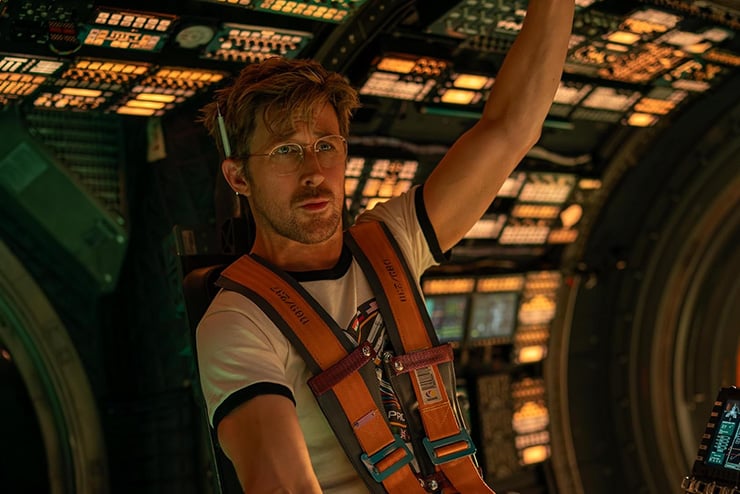
Project Hail Mary begins in media res, throwing the viewer straightaway into the action. Our hero Ryland Grace (Ryan Gosling) abruptly awakens to find himself alone and adrift in space, en route to parts unknown. He wasn’t supposed to be alone, though: the corpses of what appear to be fellow crew members are lying beside him. Grace has no memory of why he’s there, or what he was sent to accomplish.
But flickers of the past are coming back. As the film unfolds, the circumstances leading up to his trip play out in a series of flashbacks mirroring his returning memory. Grace turns out to be an experimental physicist turned high school science teacher, with an eccentric interest in the possibility of non-carbon-based life-forms.
As it happens, that unique skill set is exactly what the world’s scientists need. A bizarre astronomical phenomenon—an apparent line of light stretching between the Sun and the atmosphere of the planet Venus—turns out to be anything but benign. This line of light is actually alive. Millions upon millions of microscopic organisms dubbed “astrophages” are siphoning off the Sun’s energy for themselves, leading to a progressive dimming of the Sun and, in turn, the slow freezing of Earth. And making matters worse, the astrophages are spreading like a viral infection: they seem to have contaminated huge swaths of the surrounding galaxy, drawing off stellar energy and converting it into a sort of “food.” Things look grim.
Miraculously, there’s one star system that seems immune to the astrophages. So the world pulls together for a last-ditch interstellar mission, in which Grace—along with his untimely crewmates—has apparently been sent. But as soon as Grace reaches the far-flung system, it turns out he’s not alone. Someone—or something else, hailing from another world afflicted by the astrophages—is waiting there already.
This is all exceedingly high-concept material—though, believe it or not, these paragraphs barely scratch the surface of the film’s sprawling narrative. Project Hail Mary is based on a novel by Andy Weir, author of The Martian (also adapted into a well-regarded film starring Matt Damon). What defines Weir’s storytelling, above all else, is its relentless celebration of competence and scientific adaptation in the midst of tricky circumstances. There are very few problems—no matter how complex and cascading—that Weir’s heroes can’t engineer their way out of.
Accordingly, it wasn’t surprising that The Martian—particularly in the hands of director Ridley Scott—became a parable charged with scientific swagger. Getting off Mars and back to Earth was simply a matter of lining up the right components, like the pieces of a Rube Goldberg contraption, and hoping for the best. The tale was clever and at times exhilarating, but it lacked anything particularly existential. Pulling off a caper, after all, is something very different than grasping the human condition.
Project Hail Mary is a more serious and sober film than its forerunner. That’s not to say it’s not entertaining—it most certainly is—but it’s a tale with vastly higher stakes, demanding far more of its protagonists. Where the destiny of the human species is on the line, choices matter more.
Much has been made of Project Hail Mary’s purported religious references (the spaceship at the center of the film is, after all, called the Hail Mary… and it is full of “Grace”). That said, it’s important not to overdraw the point. Any overt religious allusions mostly stop there; what actually plays out onscreen is something rather more interesting.
Midway through, as the hopeless stakes of their situation become clear, Grace turns to Mission Commander Stratt (Sandra Hüller) and asks a simple question: “Do you believe in God?” With a half-smile, she replies: “It’s better than the alternative.” And there, the debate ends. In a genre often known for its humanism, this hopeful theism is remarkable. It’s quite different from Kubrick’s cosmic mysticism, Sunshine’s New Atheist animus, Interstellar’s sentimentality, or Ad Astra’s religious sturm und drang. And it is a hope that’s vindicated, in its way—though never obviously. Grace’s mission is insane and seemingly impossible—a Hail Mary launched into the heavens against all odds. It is providential that Grace—and the alien companion he comes to christen “Rocky”—witness their results. And Grace even undergoes a remarkable personal transformation along the way.
To be clear, Grace’s transformation arc has nothing to do with new skills or crafty engineering. Indeed, compared to past spacefaring heroes in similar straits, Grace doesn’t look like much. Kubrick’s characters are elite astronauts, trained for years to excel under pressure (if not under the threat of HAL 9000). Interstellar’s McConaughey is not merely an elite pilot, but also a heroic, larger-than-life father fighting to return to his children. And Ad Astra’s Brad Pitt is…well, Brad Pitt. Grace is, comparatively, a loser. He has no professional successes to speak of, no loving family awaiting him, and no elite skills beyond sheer gumption and resourcefulness. What ultimately changes in him is not his talent set, but his moral center and his willingness to sacrifice for others. And that is attainable for anyone, anywhere.
In a sci-fi subgenre that leans heavily into the mythic, Grace represents a genuinely everyman hero. He is, at the very least, a truly relatable one.
From a technical perspective, Project Hail Mary is a delight. The alien Rocky isn’t a pure CGI beastie, or even a motion-captured animatronic overlaid with digital tricks. Instead—in classic sci-fi form—he’s a high-quality puppet. So, too, Grace’s spaceship isn’t a green-screen projection but an actual, full-scale physical set. Bright colors pop and burst across the screen, in a welcome change from the drab “Netflix gray” palette or the oversaturated blues-and-oranges that’ve come to characterize blockbuster filmmaking. All of this, I suspect, will stand the test of time.
And special effects aren’t the only elements that will likely age well. Following in the vein of 2022’s Top Gun: Maverick, Project Hail Mary is resolutely—even shockingly—apolitical. Where Star Trek glorified liberal internationalism, the Star Wars prequels brooded over the failures of democracy in the Bush era, and Avatar boosted environmentalism and blasted colonialism, Project Hail Mary eschews such messaging altogether. Similarly striking is that it’s one of the cleanest blockbusters on record, with little sexual content and no profanity, though its action is perhaps too intense for the youngest of viewers.
In the end, though, the themes here are weighty. Calling Project Hail Mary an “allegory” doesn’t feel quite correct. This isn’t a message-minded parable about the course of science, human responsibility, or man’s place in the cosmos. If anything, it is about the human condition: its uncertainties, its joys, and the thrill of solving problems under challenging circumstances, in hope and—just maybe—faith too.
With Project Hail Mary, the Hollywood of 2026 may have delivered the seemingly impossible: a film that, against all odds, is genuinely for everyone.
Leave a Reply