Anyone despairing of the state of the American dating scene should take a good look at China.
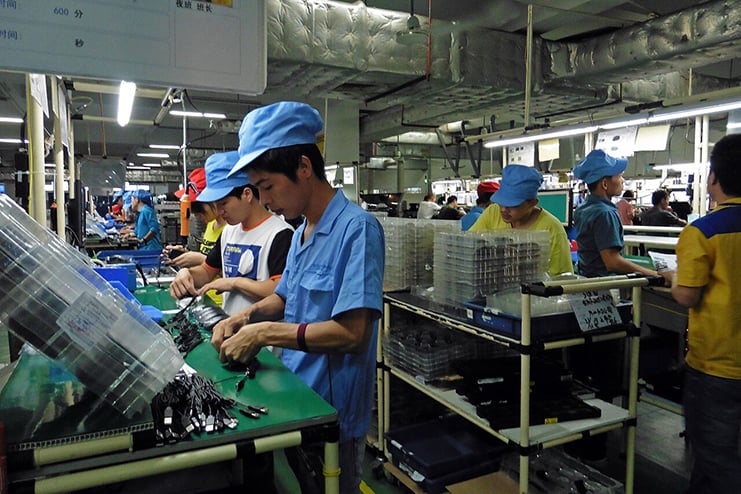
In a Substack post titled, “You Are Not the One—Chinese Dating Dystopia,” a writer using the pseudonym Terminally_Drifting describes a dating crisis so deep and extensive that even the word “dystopia” seems like an understatement. The essay centers on a young single man, Wang Wei, an unremarkable worker at an iPhone factory who cannot find a girlfriend and spends his nights (and disposable income) watching an e-girl play on her phone, answering questions from fans, and giving shoutouts to men who send her money.
Apparently, Wei is just one among millions of excess men (sex-selective abortions have resulted in men now greatly outnumbering women in China) who will never have a wife and kids.
Even so, love and marriage should at least be possible for a man like Wei, right? Maybe he just needs to introduce himself to a girl he likes, court her, and persuade her to build a life with him? As Terminally_Drifting explains, however, romance as such does not exist in China today. Finding a spouse has everything to do with material assets and nothing to do with real affection. This means that Wei will never find a wife “because the price of being considered eligible in his home province requires a car (minimum 80,000 RMB), an apartment (minimum 200,000 RMB down payment), and a caili, a bride price, that in rural Henan currently averages around 188,000 RMB,” and his “annual salary is approximately 42,000 RMB.”
Worse still, Wei’s mother tries to help her son by visiting the People’s Park in Shanghai and posting his personal information on an umbrella, where other concerned parents might look for a match. Sadly, this strategy rarely bears fruit and is undertaken mostly to make mothers feel like they are doing something to help.
For its part, the Chinese government appears aware of this issue and has sought to mitigate it through increased censorship, regulation, and propaganda. Evidently, a nationwide public meltdown threatened to overturn the country when a girl on a popular dating show rejected a guy because he was too poor. The government flew into action, condemned the girl, and set new parameters so that poorer men had a better chance on the show. Additionally, it has imposed restrictions on online gifts to e-girls and the time spent watching them. It even tried shaming women into marriage by warning them about the supposed growing number of old spinsters who regret their decision not to marry—all of which is pure fabrication in China.
None of this has come close to fixing the Chinese dating hellscape.
Nevertheless, Terminally_Drifting’s suggestion that improvement hinges on fundamentally changing the country’s economic situation misses the central point. Rather, the problem in China, as in the United States, has everything to do with the crude materialist culture that now dominates.
Eligible adults now see marriage purely in economic terms, setting expectations that are even less nuanced and impersonal than those in a typical Pizza Hut job listing. A man could be an absolute ogre who regularly kicks puppies and snorts cocaine, but if he has an “apartment with a parking spot” he becomes marriage material.
By contrast, the otherwise wholesome Wang Wei is doomed to involuntary celibacy, only occasionally relieved by online girls who giggle and, very rarely, indulge him by saying his name on camera. He will never know real intimacy, nor is he likely to develop the kind of interior life that might sustain him despite this lack. He may never know his own mind or acquire the vocabulary necessary to understand his own thoughts and desires, let alone those of another person. Every decision in his life is likely to be made along the lower rungs of Maslow’s hierarchy of needs, never approaching the higher echelons that include meaning and fulfillment of some higher human purpose.
Wang Wei is what happens to those who grow up in an environment that removes from their humanity. He was trained to pull levers, press buttons, and do the monotonous work of a robot, nothing more. It was simply assumed that he would pair up with a woman of comparable economic status and produce a few children who could do the same thing as their father. He would never need to read books, associate freely, cultivate relationships, meditate on the meaning of life, or engage in creative pursuits. After all, personality, introspection, morality, and love are just meaningless abstractions to the narrow-minded, imagination-impaired atheists running his country.
And yet, too many Americans (and other Westerners) look at the way China has arranged things with admiration. They believe the way to maximize human productivity, economic prosperity, and technological innovation is to shed the remaining vestiges of humanism and Christianity in Western culture. They have concluded that all education deviating from career-training and leftist indoctrination works against a peaceful, progressive society. This is why they spurn tradition, conservatism, and personal freedom—all of which make a mess of their promised utopia.
Naturally, this kind of thinking results in much of the Chinese population failing to fall in love, have families, or experience happiness. Everything, even sexual preferences and emotional fulfillment, is reduced to an impersonal product, which is then subject to clumsy, artificial social mechanisms that yield imperfect, even defective, outcomes.
Not only does this lead to rampant loneliness and mass despair; it also produces a generation of adults who lack the capacity to face human problems. Doubtless, the great minds of the Chinese Communist Party are trying to develop a new algorithm that might “fix” pitiful men like Wang Wei. In this regard, American tech entrepreneurs are way ahead of them, squeezing out every dollar they can from those sad adults addicted to their screens and craving human relationships with toxic dating apps.
Instead of perpetuating this kind of misery, Americans should learn from China’s mistakes. This means that every institution and household should stress transcendent, human-centered values, actively cultivate the liberal arts (the very disciplines that enable true freedom and humanity), and reject the crass materialism and mediocrity their opposites engender. Individual fulfillment and deep human connections must be consistently nurtured and modeled, not neglected in the interest of optimizing one’s income and status.
Above all, everyone should understand that romance and coupling are not flaws in an otherwise optimized system, but the natural outgrowth of a healthy, happy, and human society. Love is something that blossoms on its own. It cannot be engineered from the outside.
Leave a Reply