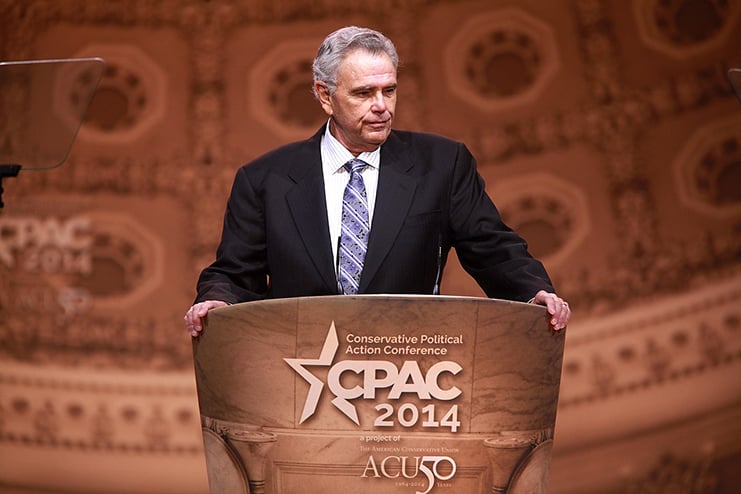
Last weekend, I learned of the passing of the man for whom I’ve worked for some 11 years, Rev. James Robison, who died on May 16 at age 82. That news brought me the same kind of grief as when I lost my father in 2005. James (as he had us all call him) wasn’t just a boss, nor was he a typical minister. He was more like a weather system, a warm front that blew through your life, shaking the trees and scattering blessings. His blessings reached those who watched his gospel broadcasts here in America and thousands of desperately poor people around the world, for whom his ministry, Life Outreach International, provides clean water, vital medical care, and rescue from sex trafficking.
In 2015, just after I’d moved down to Dallas from New York City, I started working at the ecumenical news/opinion site James founded, The Stream. Its mission was to gather evangelicals, Catholics, and other believers to champion faith and freedom—faith in the person of Jesus, and the freedom to live out the virtues in a prosperous, orderly land.
If you knew James Robison’s background, which he talked about movingly and often, you’d realize the roots of his zeal. A child conceived in a sexual assault who was almost aborted (the doctor refused), he grew up in a home cursed by alcohol addiction and familial chaos, always hungry for a father’s love. It was in high school, he used to recount to us, that he encountered the one true Father of us all, Whom Jesus took flesh to reveal. (“If you had known me, you would have known my Father also; henceforth you know him and have seen him.” John 14:7)
After a born-again experience, James was desperate to share the love he had found with others and soon began witnessing to fellow students. It wouldn’t be long before he was filling stadiums with his straightforward biblical preaching, to the point where people were calling him “the teenage Billy Graham.” Indeed, Graham would mentor him, and the two became longtime friends.
James remained a passionate, persuasive apostle of Jesus Christ for the rest of his life, never watering down the Gospel’s demands, but always a man with a heart for the broken, the lost, the friendless. He stepped back from the tent-revival circuit and took to the airwaves, broadcasting Life Today with his beloved wife Betty for decades and establishing Life Outreach International as a global mission. It still airs today, and The Stream has moved from a print to a broadcast operation, serving as an online portal for Christian programming—a gospel answer to Hulu.
By the late 1970s, James had become a friend and colleague of the men who formed the Christian right. These warriors rose up in response to the cultural collapse that began with the Sexual Revolution, turned bloody with Roe v. Wade, and menaced the natural family via the Equal Rights Amendment. As Americans stored away our mementos of America’s festive bicentennial in 1976, we looked abroad to see a still aggressive Soviet Union and a jihadi revolution in Iran. After a decade of carnage that roiled our campuses and radicalized our youth, Vietnam had fallen to Communism, and Cambodia to auto-genocide. Marxist movements were spreading throughout Africa and Latin America, and Soviet troops were flooding Afghanistan, but the best that the Baptist Sunday school teacher in the White House, Jimmy Carter, could manage was to look earnestly anguished and operate our State Department like an outreach of Amnesty International. At home, inflation, unemployment, and energy shortages blunted the hopes of ordinary Americans, while crime waves wreaked havoc on our great cities.
James liked to recount to those of us on his staff the long, anguished conversations he’d have with Rev. Jerry Falwell and others about the precarious state of our country—and about the one man who they believed might have the vision to turn our ship of state around: a divorced movie actor from California, Ronald Reagan. Would Baptist preachers and evangelical voters turn away from one of their own to support this unknown, they wondered? At a crucial point in the 1980 campaign, at Robison’s suggestion, the Religious Roundtable’s National Affairs Briefing invited Reagan to address the meeting. As The Christian Century recounts:
[A]fter being introduced by a Southern Baptist evangelist as “God’s man,” Reagan—then a presidential candidate—told the conservative Christian luminaries, “I know you can’t endorse me, but I endorse you.
That was all they needed to hear, and a long, fruitful alliance was forged—one that helped save the Republican Party in America from the fate of “Christian Democrat” parties throughout most of the West, most of which shed their Christian roots like an embarrassingly old-fashioned suit.
Sure, the GOP after Reagan began to take conservative Christians for granted, to fob them off with trinkets while serving Wall Street and the defense industry. The Christian right, for its part, made its share of blunders—for instance, lining up in lockstep behind muttering secular centrist Bob Dole in 1996, to stop the “dangerous” Pat Buchanan, who in fact championed their values.
The bargain Christians had made with the GOP really began to seem like a bad one when self-proclaimed evangelical George W. Bush preached right after 9/11 that Islam is a “religion of peace,” expanded immigration from terror-exporting countries, and launched us into two fruitless “forever wars” in Afghanistan and Iraq.
Clearly, something had to give, and once again, James played a role. While most on the Christian right (me included) were leaning toward Ted Cruz as the best presidential choice in 2016, James had his doubts. He sensed that Christian leaders had lost connection with ordinary voters and seemed to value their establishment contacts just a little too dearly. James stepped out and arranged to meet with Trump, in his own words, “downloading” on the candidate the Christian right’s concerns. Trump listened and in some key areas expressed willingness to change course.
Indeed, throughout his first term, Trump often listened when James called him directly to offer advice or a rebuke. I’ll never forget the day in 2018 when Turkish-backed militias were bombarding Christians in northeastern Syria, and I begged James to ask Trump to do something. He called the president, and within 48 hours, the U.S. was shielding those Christians, who’d go on to join the Kurds in toppling ISIS.
James didn’t take part in politics for its own sake. He considered that “building the Kingdom” on earth demanded that we seek the wisest, fairest policies for our countrymen and our neighbors. He knew that America’s founding was only made possible by men of overpowering faith, that even the Deists and Unitarians among that generation considered such faith, and the virtues it builds, to be the cornerstone of ordered liberty. He saw that the freedom we treasure is only possible if we habitually use it rightly, in obedience to the law that God wrote on each one of our hearts.
It warms my heart to know that James is now in the Kingdom he preached so winningly, with the Father he loved so well.
Leave a Reply