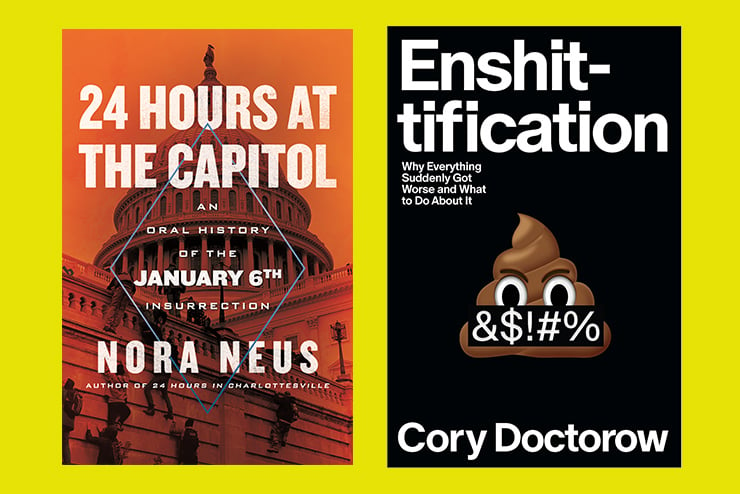
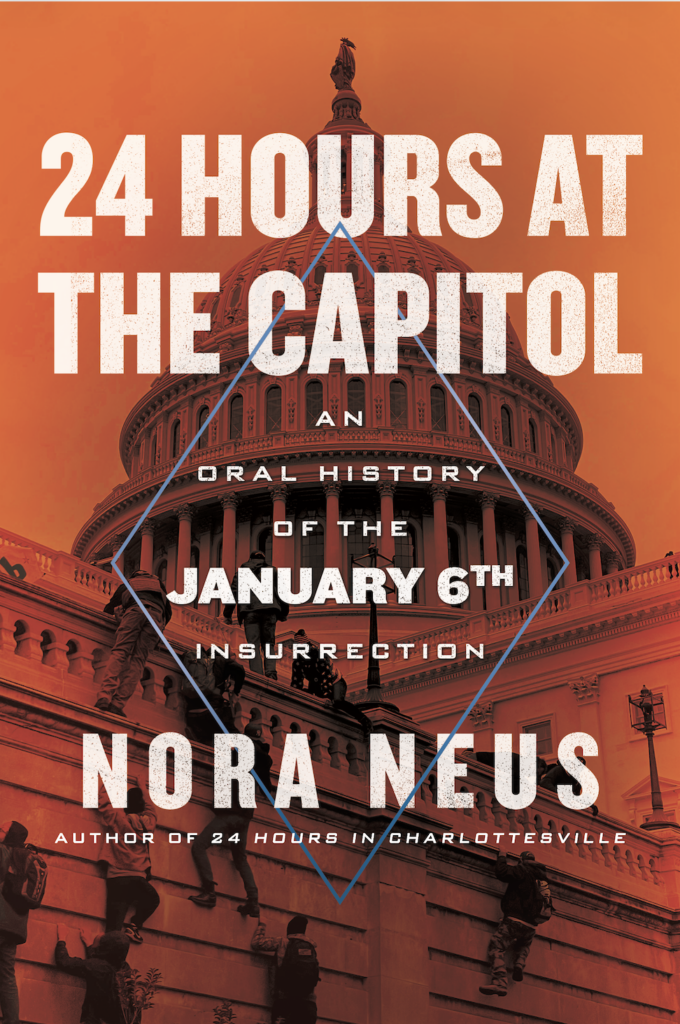
24 Hours at the Capitol: An Oral History of the January 6th Insurrection, by Nora Neus (Penguin Random House; 240 pp., $28.95). This book on the Jan. 6, 2021, riot at the Capitol is freelance journalist Nora Neus’s second with a title beginning “24 Hours at…” She has already given us her view on the Charlottesville “Unite the Right” rally of 2017, with another subtitle that gives away her bias: “An Oral History of the Stand Against White Supremacy.”
“All of my people-centered storytelling aims to amplify marginalized voices and motivate change,” Neus writes about her work on her webpage. It’s hard to find “marginalized voices” in this book, which is almost entirely the account of Jan. 6th by the elite left. By far the single largest group she quotes is fellow journalists, all from left-wing media. Members of Congress and congressional staffers, those two sadly oppressed minorities, also weigh heavily in the commentary. Another sizable group is made up of “experts on far-right domestic terrorism,” a club with a level of ideological diversity approaching that of Robespierre’s Committee of Public Safety.
“I’m the son of a cop and so I’m a rule follower,” is how now-disgraced former Rep. Eric Swalwell comedically describes how well he behaved during the affair. The many women he is accused of sexually assaulting may beg to differ. We learn from Arizona Senator Ruben Gallego that he “would have killed all those motherf*****s to save this democracy.” The esteemed senator said that while they were locked down in the Capitol, he showed colleagues how to stab people in the neck with a pen.
A New Republic reporter regrets that “lethal force” was not quickly used on the protestors. Another journalist claims that, had this been a BLM protest with a majority of nonwhite rioters, police would have shot everybody. This person is evidently unaware that 25 million people participated in the George Floyd riots of 2020, and police met exactly zero of those events with live ammunition.
Neus trots out all of the now-classic distortions of Trump’s words in order to paint him as a dictator. She says the Proud Boys ran through the streets, assaulting innocent blacks in the run-up to the event; in reality, Antifa and Black Lives Matter radicals were there, trading punches with them.
There is no doubt that many, we hear in this book, were deeply traumatized by Jan. 6th. When Neus emailed an interview request to photojournalist Jason Andrew, he called his wife and wept. He agreed to talk only in the hopes that it could serve as therapy for him, to “help him process the experience.” One hopes he is feeling better.
(Alexander Riley)
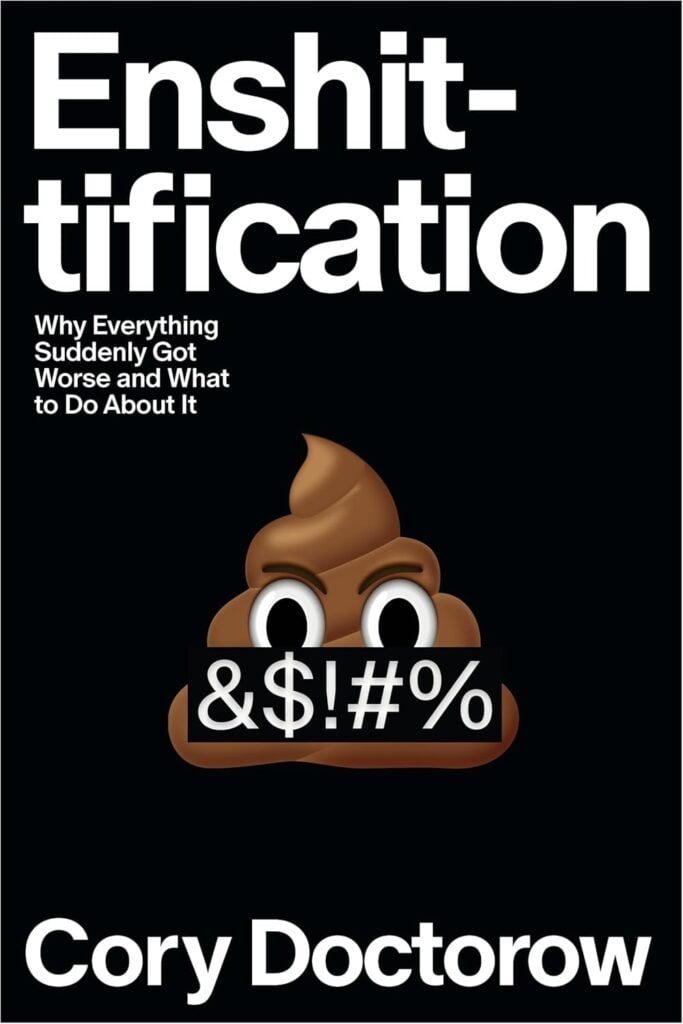
Enshittification: Why Everything Suddenly Got Worse and What to Do About It, by Cory Doctorow (Verso Books; 352 pp., $30.00). At some point, everyone has asked himself, “What happened to the internet?” Doctorow, a prolific author and digital rights activist, has an answer: the platforms. In Enshittification, he examines how Meta, Amazon, Apple, X, Google, and YouTube betrayed their early promise and became a morass of fake news, ragebait, and disagreeable advertising.
The same pattern pervades all of them. Initially, they provided valuable services that combined connectivity and creativity. In the second stage, the platforms treated users as a source of revenue for their business customers. In the third stage, the platforms switched to extracting money from both users and businesses.
The formula has created the astonishing wealth that comes with unlimited rent-seeking. “Once a company is too big to fail, it becomes too big to jail, and then it becomes too big to care,” Doctorow writes. Concerns about quality and customer service fall by the wayside. The result? Enshittifaction. It is not a glitch but a feature.
Doctorow has fun, in an awful kind of way, with anecdotes illustrating how the platforms gleefully exploit their users, from Google manipulating its search engine to Facebook peppering its content with AI-generated videos and posts from advertisers. Collusion between the behemoths is routine business. Doctorow says that Google pays millions of dollars to Apple in exchange for Apple agreeing to not make its own search engine. Less amusing but perhaps more revealing are his stories of brutal anti-worker practices at Uber and Amazon.
Advertising rates on digital platforms have skyrocketed over the past few years, raising prices for consumers. Yet social media advertising may not even be all that effective. Consumer staples giant Procter & Gamble stopped advertising on digital platforms and reported no impact on sales.
The platforms have built strong political connections, but their legal invulnerability might now be under challenge. The federal government is trying to break up Google, and other platforms face antitrust actions. Doctorow would like mandated interoperability between tech devices and real transparency, enforced by an independent government agency.
Despite flashes of hope and moments of levity, Doctorow’s book is a thoroughly depressing read. That said, Enshittification is a good account of what happened to the internet, and what might happen next.
(Derek Parker)
Leave a Reply