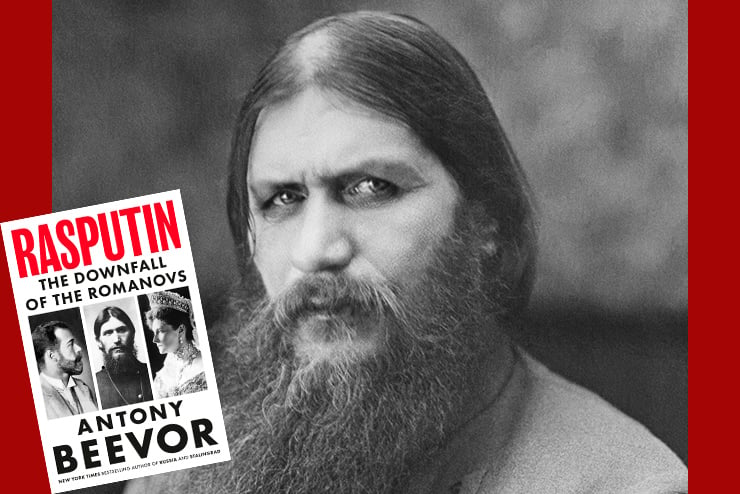
Rasputin: The Downfall of the Romanovs
by Antony Beevor
Viking
384 pp., $35.00
Few characters in the history of the 20th century embody contradiction as vividly as Grigori Rasputin. Depending on your point of view, he was either a sexually profligate charlatan or a holy man who exercised a fateful influence over Russian Emperor Nicholas II and his consort Alexandra, at a time fraught with peril both for the Russian Empire and Europe as a whole.
“A few days ago, I received a peasant from the Tobolsk district, one Rasputin, who brought me an icon of Saint Simeon of Verkhoturye,” the emperor wrote to one of his ministers in October 1905. “He made a remarkably strong impression both on Her Majesty and on myself, so that instead of five minutes, our conversation went on for more than an hour.”
Even that effusion pales in comparison with a subsequent letter Alexandra wrote to the mysterious peasant:
My beloved and unforgettable teacher, savior and mentor. How tiring it is for me without you. My soul is calm and I can rest only when you, my guide, are seated next to me and I kiss your hands and lay my head on your blessed shoulders. Oh, how easy things are for me then.
Over the years, Rasputin has lent his name to everything from a rather dubious Christopher Lee horror film to an irritatingly catchy 1979 pop hit by the otherwise largely forgotten Eurodisco group Boney M. Now, the British historian Antony Beevor, author of the magisterial narrative history Stalingrad, unpacks some of the myths surrounding the Rasputin legend.
Born in January 1869 as one of eight children to a peasant family in the inhospitable wastes of Siberia, the young Rasputin struck out on his own. Like some figure out of Dostoyevsky, he became an itinerant, unordained minister. Yet he disdained the more self-denying aspects traditionally associated with that role: there was drink, and there were women—many women! With a pale face, an unusually penetrating gaze, and a long beard flecked with stray morsels of food, Rasputin presaged some of the contradictions of the modern rock star, both physically repellent and attractive at the same time.
The immediate prewar years were a time of moral disequilibrium in Russian society, and few fashionable salons of the day were thought complete without the presence of a self-proclaimed mystic of one sort or another. Rasputin’s arrival in St. Petersburg thus met an immediately receptive audience. One highborn lady was so taken by his “shimmering eyes” that she chose to tie bits of his half-eaten food onto her belt; another volunteered to cut his fingernails so she could keep the clippings as holy relics. In one of many shows of dominance over his followers—and by no means the most physically demeaning—Rasputin would dip a dirt-caked finger into a bowl of jam and instruct his assembled female admirers to “humble yourselves and lick it clean.”
Rasputin’s arrival in the Russian capital came at a moment of acute vulnerability both for the Russian nation and the Romanov dynasty. Timid, insecure, and stubborn, with an unbending belief in his God-given right to rule, Tsar Nicholas possessed neither the temperament nor the vision to govern a sprawling empire of 175 million subjects at a time when the chancelleries of Europe were sleepwalking towards the cataclysm of world war. His German-born wife, Alexandra, was even more problematic. Not only was she politically naïve, but she became psychologically unbalanced by the hemophilia of the royal couple’s only son, Alexei.
Within days of meeting the family, Rasputin was advising the tsar on family matters, Beevor writes. The mystic’s influence at court took another significant step forward when he appeared to “heal” the young tsarevich after a leg injury caused a life-threatening hemorrhage. The doctors believed that Rasputin’s calm demeanor may simply have relaxed the boy, lowering his blood pressure and thus slowing the bleeding. But to Nicholas and Alexandra, it was proof that the dipsomaniac, sexually profligate traveler in their midst was in fact God’s instrument on earth.
Inevitably, there were rumors that he was the tsarina’s lover, which Rasputin himself never actively discouraged. Such a development would not have been inconsistent with his relations elsewhere in high Russian society. On the other hand, Beevor’s research extends to the discovery that “while Rasputin was content to lie naked with many women, he had sex with very few of them.” The author further doubts that Alexandra, a loyal and devoted wife and mother, whatever her other shortcomings, would have yielded in this way. Nor does he credit the rumor, widespread in the feverish atmosphere surrounding the Romanov court, that there had been anything improper in Rasputin’s relations with the four royal princesses, then aged between nine and 14, even if his late-night conduct in their bedchamber might have raised eyebrows in our own, more morally vigilant times.
“Rasputin was a compulsively tactile character,” Beevor writes, “so his behavior was not necessarily sexual in intent. His influence worked best if he could make an immediate physical contact with people, especially those bound by rigid conventions. ‘That’s the way I am,’ he later said to one young woman. ‘I can’t do without caressing, as it is through the body that I learn somebody’s soul, you see!’”
Why would the Emperor of All Russia have tolerated the presence of a malodorous, semiliterate peasant, who may or may not have had designs on his own wife, at the heart of his imperial court? According to Beevor, the answer lies in the emperor’s religious belief that Rasputin was a simple man of the people whom God had sent to save the Romanov dynasty.
The irony was, of course, that “Our Friend,” as the royal couple fondly knew him, proved to be the chief instrument of their downfall. In time, Rasputin would become sufficiently emboldened to offer his advice—which, with few exceptions, promptly became state policy—on matters ranging from the nation’s foreign affairs to its transportation system and food supply. In the critical period from October 1915 to December 1916, when Russia’s prime ministers were appointed and dismissed on a near-monthly basis, the tsarina sat in her drawing room in the Winter Palace, under a portrait of Marie Antoinette, busily dispatching letters to her husband, almost all of which spoke in the voice of their Friend from the backwoods of Siberia. “It is not my wisdom alone,” she wrote in one, “but a certain instinct given by God beyond myself.” Or: “We, who have been taught to look at all by Another Party, know what the struggle really is—you showing your mastery, proving yourself the autocrat without which Russia cannot exist.”
The picture of Rasputin that emerges is of a man who, like many of history’s great confidence artists, seems to have sincerely believed in his own divine gifts. It evidently struck him as only reasonable that he should extract a modest financial reward for his tireless efforts on behalf of the Romanovs, and, by extension, Mother Russia herself. His more carnal ambitions may not have extended to the royal consort, but he nonetheless cast his net with wide abandon on the streets of St. Petersburg. Among the numerous contemporary police reports dug up by Beevor, we find: “26 May. Rasputin and the prostitute Tregoubova came home in an inebriated condition. While saying goodbye, he kissed and fondled Tregoubova about her person passionately. Later he sent the porter’s wife to fetch the dressmaker Katia, but she was not at home.” Another report noted that he was quite open in his dealings with prostitutes and “not afraid to appear on the street in a drunken state.”
Nothing in the life of Grigori Rasputin became him quite like the leaving of it. Lured to a late-night party in St. Petersburg by a group of disaffected noblemen fearful of his influence at court, Rasputin was successively poisoned, shot, battered, and finally chained and thrown—possibly still alive—into the freezing Nevka river, from which his body was recovered two days later. He was only 47 at the time of his death. Originally buried with some ceremony, clutching an icon signed on its reverse side by Alexandra and her four daughters, his corpse was hurriedly exhumed and burned by a detachment of soldiers shortly after the tsar had abdicated the throne in March 1917. The royal family survived only a further 16 months until their own murders at the hands of a Bolshevik firing squad.
There may be nothing startlingly new in Beevor’s masterly account, but what it lacks in fresh historical detail it more than makes up for with storytelling élan. It might all be more than a century past, but the modern reader can surely relate to the book’s tragic protagonists as war and revolution loom over them. Nicholas, the stoic, benign, but politically naïve leader; his devout but equally inept wife; and the charismatic charlatan in their midst who came to exert such baleful influence. The unfolding tragedy doesn’t do them any credit, but Beevor is to be applauded for retelling it with such clarity, wit, and passion.
Leave a Reply