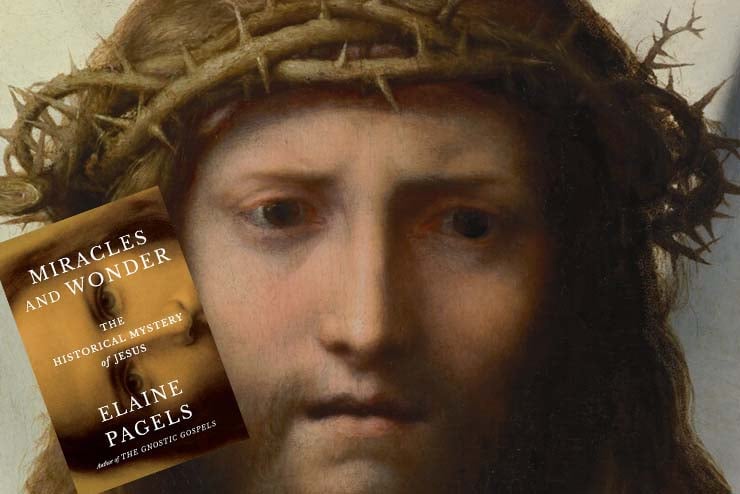

Miracles and Wonder: The Historical Mystery of Jesus
by Elaine Pagels
Doubleday
336 pp., $30.00
Elaine Pagels made her reputation by weaponizing heretical documents to suit her own materialistic purposes. In The Gnostic Gospels, published in 1979, she introduced readers to the recently translated Nag Hammadi texts, which outline gnostic beliefs that emerged a few centuries after the death of Christ, as the Christian Church was forming. Pagels did not limit herself to an objective analysis of these texts but argued for their equal legitimacy with the Gospels already accepted as canonical.
Following her usual theme, Pagels’ most recent book advances gnosticism over traditional Christianity. She starts off on the wrong foot by interpreting the Gospels through a nonreligious framework. This can only lead to failure. Those texts concern the spiritual beliefs and life of a nascent religious community. Rejecting those beliefs at the start in favor of a secular interpretation is akin to presenting a modern chemistry book through the lens of medieval alchemy.
For example, Pagels insists that the story of Jesus sending demons into pigs should not be read as a statement about the reality of malevolent spirits but as a symbolic narrative. She contends that ancient Hebrews would have understood it as a reference to the overthrow of Roman political authority.
Pagels’ refusal to read Christ’s miracles literally overlooks an obvious interpretation that is perfectly consistent with secular knowledge. Many materialists insist that madness and other psychopathologies cannot be magically healed, and yet there exists abundant evidence that they sometimes are. Indeed, even some terminal diagnoses do not lead to death. For instance, there are examples of metastatic cancers that recede even after treatment has ended.
In a purely materialistic sense, statistical probabilities of health outcomes can deviate due to the incredible biological complexity of the organisms involved. The observation of this scientific fact is indistinguishable from the witnessing of a miracle. More study in the fields of science and medicine would help Pagels see the compatibility of medical knowledge with the miracles of Jesus.
Pagels’ rejection of the spiritual meaning of the Gospels further limits her. She sees “the kingdom of God” as nothing more than a call for Jewish rebellion against political servitude. In this light, she claims that Jesus realized at the end of His life that His mission had failed.
Christianity by its very nature entails an uncompromising worldview. It is an enemy of pluralism and a challenge to overambitious conceptions of reason. There is one truth, according to the Christian Gospel, and incompatible explanations or descriptions of the world are considered wrong and to be rejected. There is no room for alternative visions in the Gospel, and there is no need to supplement faith in the incarnation with merely reasonable criteria and evidence. That Pagels has seemingly not grasped this reality gives one reason to question how well she understands Christianity.
Throughout the book, she writes as though it is a given that Jesus did not and could not know what would come after His death. The disciples thus had to “create” meaning from what they must have perceived as their movement’s failure. She repeatedly describes the Jesus of the Gospels through historical parallels. In Christ’s sense of the impending danger He faced, she writes, one can look to similarities in Martin Luther King Jr. and Alexei Navalny. For those not sufficiently up to speed on the political martyrs of the contemporary left, the latter was an opponent of Putin who died in a Russian prison. She also compares Jesus’ death and the efforts of His followers to persevere afterward to the example of Rabbi Menachem Schneerson, a Brooklyn Hasidic Jewish charismatic who died in 1994. Schneerson, you see, is still proclaimed Messiah by some of his followers, and many still talk of his purported miracles.
Pagels was an evangelical Christian until one of her evangelical friends told her that a Jewish associate who had died was in Hell. It was this assertion that drove her out of the faith. She apparently did not know that the evangelical position on the immediate and permanent fate of nonbelievers is not the traditional Christian teaching, and so she did not think to take the traditional option.
Any reading of the Gospels that blames the Jews for the condemnation and execution of Jesus deeply troubles Pagels. She believes that one can plausibly interpret John’s Gospel this way. However, John uses the Greek term hoi Ioudaioi in a way that neatly defines his intent. When the term is used to indicate those who opposed Jesus’ teaching, the context invariably makes it clear that the reference is specific, sometimes to the Judeans and sometimes to the Pharisees.
In all cases, it indicates only the subset of the Jewish population that was most viciously opposed to Jesus’ teachings and to His followers’ claims. The “Judeans” and the “Pharisees” are two ways of describing a politically dominant segment of the Jewish population that eagerly acquiesced in and even urged His execution. The one indicates the regional location of those most hostile to Jesus, and the other alludes to Jewish rejection of Jesus on the basis of a specific cultic doctrine (the fundamentalist adherence to Jewish law of the Pharisees). It is absurd to claim that hoi Ioudaioi refers to “all Jews,” when Jesus Himself and all of His disciples were Jewish.
Pagels is undeterred by such meticulous interpretive logic. “How had I failed,” she writes,
to see the way Jesus’s followers shaped these stories—casting “the Jews” as agents of Satan—opened the way for Christians to demonize Jews outside their movement in ways that have ignited turbulence, violence, even state-sponsored mass murder, throughout Christianity’s two-thousand-year history?
Here, Pagels reveals her political concerns while failing to offer a useful interpretive method.
Pagels also uses gnostic texts to reinterpret the crucifixion. The gnostic Gospel of Truth says that Paul taught two different narratives of the end of Jesus’ life. That “Jesus died for our sins” is a false version to placate the uneducated. Only those in the gnostic mystery cult can know the true Pauline Gospel. In this account, Jesus’ death is not required for salvation because God is pure love, and so the shedding of blood is not needed to redeem man. We can, in fact, redeem ourselves if we sufficiently “come to know ourselves.” Indeed, Pagels asserts that Jesus believed this version of the Gospel. She cites the gnostic Gospel of Thomas, which proclaims that Jesus said,
If you bring forth what is within you, what you bring forth will save you. If you do not bring forth what is within you, what you do not bring forth will destroy you.
This she celebrates as a “truth” of “psychotherapy.” Apparently, Christians would do better to consider Jesus as the world’s first psychotherapist.
In The Gnostic Gospels, Pagels makes clear what distinguishes the gnostic view from the “orthodox Christian” (or simply “Christian”) view:
Orthodox Christians insisted that humanity needs a way beyond its own power—a divinely given way—to approach God…. Their conviction was based on the premise that God created humanity…. But some gnostic Christians went so far as to claim that humanity created God—and so, from its own inner potential, discovered for itself the revelation of truth.
There is no claim more heretical than that God is nothing more than a human invention.
The concluding chapter of Miracles and Wonder asks, “Who Is Jesus—to New Converts, Artists, and Filmmakers Engaging Him Today?” She describes various “engagers,” including an academic anthropologist, Tanya Luhrmann, who was “changed” (though not converted to Christianity) by her study of a Southern California Protestant denomination; a Black liberation theology pastor; a Filipino indigenous group that adheres to a syncretized religion that lightly borrows from Filipino Catholicism; Dalit Indian Christians; and a few painters and filmmakers.
That last group includes Martin Scorsese, director of The Last Temptation of Christ (1988). Pagels says that Scorsese called her while he was contemplating making the film to tell her of his great interest in the heretical message of The Gnostic Gospels.
For Pagels, the answer is always anything but the established Church. Her consistent, unwavering direction over all these decades is away from, never toward, order and tradition.
The Christian might note that the faith is clear about the origins and identity of the original author of rebellion against order, and what one should think regarding his ideas.
Leave a Reply