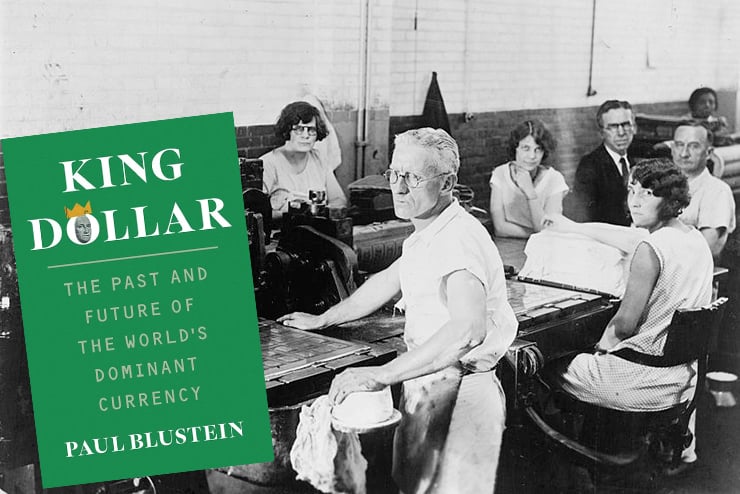

King Dollar: The Past and Future of the World’s Dominant Currency
by Paul Blustein
Yale University Press
320 pp., $35.00
Paul Blustein’s King Dollar offers an education on many themes: the history of the United States dollar, sanctions, cryptocurrencies, and the necessity of a widely accepted currency for cross-border transactions.
Blustein, now in his 70s, is a lifelong economics writer who spent decades as a reporter, including at The Washington Post’s Tokyo bureau from 1990 to 1995. His narrative in King Dollar is replete with references to his extensive travels and interviews with financial decision-makers the world over. And his intimate knowledge of the Japanese economy and that nation’s economic history is clear. Blustein draws on numerous economic episodes from the last half-century in service of the arguments presented in his book, most notably that the dollar, despite frequent fears to the contrary, is likely to retain its role as the world’s global reserve currency.
Readers of King Dollar will learn much from the book’s financial analysis, particularly concerning the dollar, exchange rates, and various potential alternative currencies. But as with any education, the journey of reading this book can be arduous. King Dollar is not a summer beach read. Nor is it one of those books that take an enormously broad and complicated subject and make it a joy to read about. Although some sections are relatively engaging, the book often feels more like a textbook than the sort of explanatory nonfiction work that has become tremendously popular in recent years.
Yet, the book is a thought-provoking commentary on a compelling subject. First, Blustein argues that it is not always in the United States’ domestic interest that it has the world’s undisputed reserve currency, even as that status offers innumerable advantages for foreign policy and geopolitical maneuvering. The most obvious and important example concerns American manufacturers, who can have a difficult time selling goods because of the strength of the dollar and thus lose out to foreign firms offering cheaper alternatives to American goods for both foreign and domestic consumers.
To this point, Blustein quotes then-senator JD Vance, who in 2023 wondered if the dollar’s supremacy resulted in “a massive tax on American producers.” Thanks to the surging strength of the greenback in the early to mid-1980s, imported goods “became more and more of a bargain” within the United States. While this was no doubt beneficial to American consumers, lopsided exchange rates were inflicting pain on American manufacturers such as Caterpillar well before the passage of NAFTA, causing layoffs in the industrialized Midwest. Yet Blustein cautions against attributing the decline of American industry to the historical strength of the dollar.
As it pertains to national security, though, Washington is able to exert tremendous leverage around the world thanks to the dollar’s global supremacy. The mere threat of being cut off from ready access to the dollar-based global financial system (particularly the Clearing House Interbank Payments System) can make wayward countries rapidly come to heel; Blustein points in particular to our ability to isolate Iran by exerting pressure on other countries.
But Blustein argues in a chapter titled “…Comes Great Responsibility” that Washington would be wise to use its great power prudently. Employing sanctions too freely, as both the Obama and Trump administrations arguably have at times done, risks overplaying America’s hand and could prompt other nations to seriously consider alternatives to the dollar. It has been supremely difficult for another currency, at least up to this point, to mount a challenge to the dollar. But, in Blustein’s view, America’s overzealous flexing of its economic power could be one of the only reasons an alternative might emerge and become widely accepted.
Because of this possibility, the most interesting chapter is “Pretenders to the Throne,” in which Blustein deftly describes the various alternatives to the dollar that were once forecasted to supplant it. Invariably, however, the shortcomings of these alternatives have been laid bare, and the chatter about the coming supremacy of other currencies, whether they be the euro, the yen, the SDR, or the renminbi, proved to be short-lived. At the height of this trend in late 2007, the Brazilian supermodel Gisele Bündchen demanded to be paid in euros. But not long after, the problems Europe faced in maintaining a continental currency became clear, as its constituent countries pursued vastly different economic policies. As for the renminbi, investors remain uncomfortable with China and the autocratic policies of Xi Jinping.
Confidence in a currency tends to run only as deep as faith in its issuer. As Blustein emphasizes throughout King Dollar, “For all the chatter about America’s decline, the dollar’s dominance is one key respect in which U.S. hegemony is undiminished.” During crises, investors rush to the dollar and not to the “pretenders.”
Over and over, many in the political commentariat and various “bears” in the financial markets have confidently proclaimed the imminent end of the greenback’s reign. In 1973, two years after President Richard Nixon discontinued the dollar’s convertibility to gold, The New York Times confidently declared, “The dollar is regarded all over the world as a sick currency.” It was a similar story in 1979 amid the inflation crisis, when OPEC countries flirted with the idea of abandoning the dollar. And in the 1980s, when forecasters said the Japanese economy would overshadow that of the United States. And yet again in 1995, when Foreign Affairs projected “The Fall of the Dollar Order.” But—at least so far—no such collapse has come.
Blustein has curiously shed some of the concern he once had about the U.S.’s mounting national debt—something that will not be a problem until the day it is a problem—but he does succeed in persuading the reader that the greenback will likely outlast its critics. Confidently predicting the future is a risky business, and Brazil’s President Luiz Inácio Lula da Silva, the Iranians, and other vociferous critics of the dollar’s primacy have little reason to believe a workable alternative will soon emerge. If the stability of the euro can be imperiled by economic trouble in one of its nation-states, such as Greece, surely the stability of a hypothetical BRICS currency would be endangered by the manifold problems associated with states such as South Africa or Iran.
Thus, the dollar still seems to make sense as a relative proposition. I argued in a column at The Hill in November 2022 that when faced with fiscal mismanagement, inflation, and a feckless administration, the United States was still performing better economically than its would-be competitors. This degree of relative global economic strength means the United States—at least up to this point—has been able to get away with making economic mistakes, even significant ones.
“The benefits that come with a hegemonic currency are America’s to squander,” Blustein writes. As such, I agree with his warning that the U.S. should not push the envelope too far regarding sanctions. Economic hegemony is precious and not easily regained once lost.
I would be remiss if I failed to mention Blustein’s careful analysis of cryptocurrency and a related phenomenon, the central bank digital currency (CBDC), which is digital currency issued by a country’s central bank. Blustein, who dedicates this book to his grandchildren, whom he promises to “love unconditionally, even if they grow up to like crypto,” describes using the Bahamian Sand Dollar, the world’s first CBDC, in 2022. He bought a salad and smoothie and paid with the Sand Dollar, despite the fact that very few Bahamian businesses were accepting payment in this form at the time. He later discusses the possibility of widespread adoption of a CBDC in other countries and rather evenhandedly assesses (as economists are sometimes wont to do) the vigorous ongoing debate about whether this would be a positive development, addressing concerns about individual privacy and the risk of government-led financial coercion of citizens.
Blustein briefly speculates at the end of King Dollar about whether some utopian future will emerge in which a veritable supranational currency will reign and sanctions will be a thing of the past. But such an outcome seems quite unlikely on this side of paradise. The world can likely either have a dollar-led global economy or one based on the currency of another major economic power, and Blustein compellingly argues that Americans would be wise to prioritize keeping the dollar king.
My late friend Luis Blasco swore that former newspaper reporters made the best novelists: They had learned how to express the essence of their subjects concisely. Whether newspaper reporters are the most effective authors of nonfiction books will not be decisively settled by King Dollar, given the technical nature of its writing. But this is a book worth engaging with for its biography of the greenback, its historical study of the currency and the various threats to its dominance, and its careful response to those who confidently proclaim that the BRICS nations are ascendant and that the petrodollar is not long for this world.
Leave a Reply