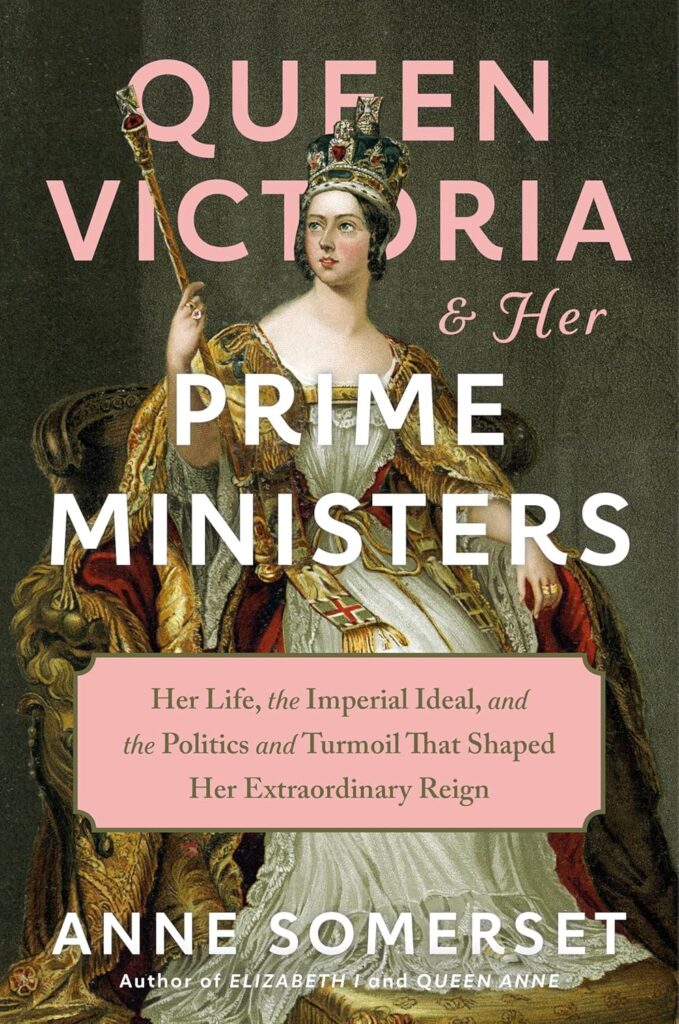
by Anne Somerset
Knopf
640 pp., $45.00
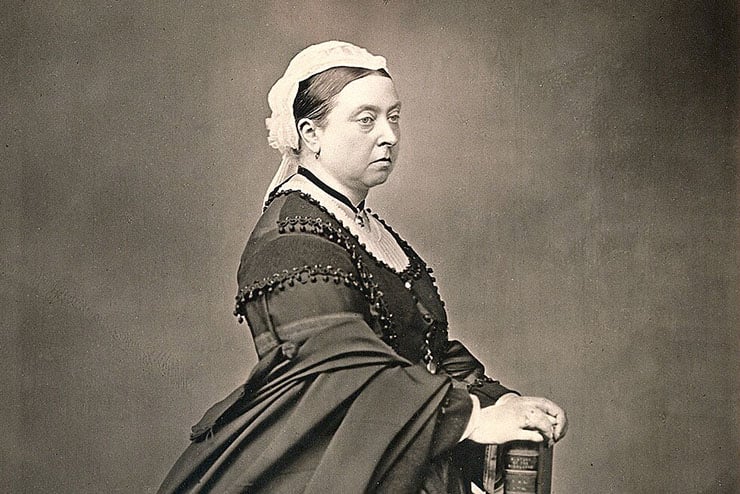
Even Queen Victoria’s staunchest admirers will admit that she was a political novice. Her understanding of political philosophy remained fairly basic throughout her life. She was an unreliable judge of character and susceptible to flattery. When she did intervene in parliamentary affairs, she undermined royal authority by threatening to veto bills and then backing down. Her harshest critics dismiss her as a lightweight with incoherent beliefs and a limited understanding of the British constitution.
In this book, one of the few political biographies of Queen Victoria, Lady Anne Somerset shows that the queen’s lack of exceptional political talents masked a common sense and intelligence that allowed her to be at least as effective as more astute politicians. Though unrefined, Victoria’s political principles were clear and coherent enough, despite the contempt of her critics. Their basic substance was comparable to Edmund Burke’s conservative Whig views and the “country Toryism” of the lesser-known 1st Viscount Bolingbroke. Essentially, she supported traditional English political and social structures and moderate reform within those parameters.
At the beginning of her reign, both the “center-right” of the Conservative Party and the “center-left” of the Liberal Party shared her outlook. Their political differences were most apparent on the enduring issue of electoral reform. Conservatives could support limited electoral reform because “pocket boroughs”—electoral districts controlled by a local notable—had historically been more quasi-democratic, and because it was useful to ally more of the middle class with the aristocracy and gentry. Liberals could support limits to electoral reform because they were truly opposed to egalitarianism, universal suffrage, and simple democracy.
Over the course of Victoria’s reign, the makeup of each party changed as the “center” moved further left—particularly as power within the Liberal Party shifted from Whigs to Radicals. However, the queen’s views never changed. She began her reign committed to the then “center-left” Whig policies of her first prime minister, Lord Melbourne. Mid-reign, she favored the then “center-right” Prime Minister Benjamin Disraeli. She ended her rule supporting the staunchly conservative 3rd Marquess of Salisbury, Robert Gascoyne. Gascoyne would have preferred reversing earlier reforms, but realized he couldn’t. He was backed by the queen to prevent reforms they both considered excessive.
Victoria’s approach to foreign affairs—one of the areas in which royal influence was least eroded—was similar. While the old order was secure, she favored moderate reform. Faced with revolutionary movements, she hoped to see them crushed. If conservatives gained control of newly established regimes, she was ready to embrace the new order.
Central to Victoria’s beliefs was her commitment to traditional royal authority. During her childhood and adolescence, royal authority was real, if diminished. For much of the 18th century, monarchs had been as powerful as American presidents, as Jeremy Black demonstrates in George II: Puppet of the Politicians? (2007). As late as 1827, a monarch’s threat to use the royal veto—last actually used in 1708—sufficed to kill proposed legislation. Victoria naturally interpreted the constitutional “Revolution Settlement” of 1688 as in accord with this precedent, which itself reflected the 150-year consensus of Tories and moderate Whigs. The monarch’s occasional threat of veto was supposed to be part of the system of checks and balances in the division of power between the monarch, the House of Lords, and the House of Commons.
Defending that tradition put Victoria at odds with the view, once marginal but rapidly gaining support, that the Commons could override both the Lords and the monarch. The theories of its leading proponent, Walter Bagehot, were rather odd. He insisted that since it was rarely possible in practice for the monarch and the Lords to block bills passed by the dominant Commons, they no longer had authority to do so. He also opposed checks and balances as such, arguing that either the monarch, Lords, or Commons must be able to overrule the others for the sake of efficiency. With the Parliament Act of 1911, Bagehot’s view became firmly established as the law of the land.
Despite her best efforts to maintain it, royal power declined throughout Victoria’s rule. In 1839, just two years into her reign, the queen demonstrated during the “Bedchamber Crisis” her insistence upon exercising what remained of royal prerogatives. The Liberal Lord Melbourne resigned as prime minister and was expected to be replaced by the Conservative Party’s Sir Robert Peel. But Peel insisted that he would not accept office unless he was allowed to remove some of the queen’s ladies-in-waiting and appoint others of his own choosing. Victoria refused, Peel would not back down, and Parliament had no alternative but to accept Melbourne’s return as prime minister.
In 1845, Victoria exercised more direct royal control over policy. Conservatives had a substantial majority in Parliament but were divided over a Liberal proposal to repeal taxes on food imports. Pro-repeal “center-right” Conservatives were willing to accept two men as prime minister—the anti-repeal Conservative Lord Edward Smith and the pro-repeal Liberal Lord John Russell. Being herself in favor of repeal, Victoria appointed Russell. The queen’s intervention decisively shaped public policy during Russell’s six years in the office.
As political parties became more disciplined—with their members increasingly unified behind a single candidate for prime minister—the monarch’s ability to play an independent role in deciding who would hold office diminished. When the parties were still closer to the loose factions of the 18th century than the party “machines” of the 20th century, men on both sides of any single issue could usually gain enough support in the House of Commons to become prime minister, allowing the monarch to exercise power by choosing between them.
By 1880, however, it was clear that the monarch would have to accept the majority party’s choice in all but the rarest circumstances. That year’s election saw the Liberal Party win a substantial majority in the House of Commons. Victoria wanted to appoint as prime minister that party’s recent leader, the Marquess of Hartington—one of the last of the old Whigs, who would later join the Conservatives as his party moved to the left. But the party insisted on its new leader, William Gladstone, and the queen had no alternative.
Despite that, Victoria remained able to take sides on and influence particular policy issues—at times building the necessary support by creating temporary “queen’s factions” on single issues—a practice that later generations would consider unconstitutional.
Victoria’s first important use of this method followed the 1859 Second Italian War of Unification. Her Liberal prime minister, Lord Palmerston, favored the left-wing revolutionaries seeking to unify Italy and took diplomatic steps that could trigger a renewal of hostilities and perhaps drag Britain into war. Victoria favored the Austrian Empire retaining control of the Italian territory, which it had ruled for centuries. She called a meeting of the full cabinet, which she personally presided over, informing the members of the dangers posed by Palmerston’s interventions. Almost the entire cabinet sided with the queen, and her position was soon backed by a strong Parliamentary majority. Palmerston was forced to back down.
After having to accept Gladstone as prime minister in 1880, Victoria used similar methods to undermine his policies when she disapproved of them, most significantly, the Reform Act of 1884 and Gladstone’s determination to avoid fighting the Dervish Rebellion in the Sudan. The Reform Act lowered the qualifications for voting and thereby expanded the franchise. In practice, it advanced a Liberal and Radical agenda. Lord Salisbury, by then leader of the Conservative Party, was determined to block it in the House of Lords. Victoria was also opposed but concerned about what might happen if Salisbury succeeded—perhaps the introduction of a bill to abolish the power of the House of Lords or, even worse, an attempt at armed revolution. Working with the opposition party, she played an important role in arranging a compromise. The franchise was expanded, but the Conservative Party gained control of redistricting, allowing it to dominate Parliament for most of the next two decades.
In the spring of 1885, Victoria used a highly imaginative method to force Gladstone’s resignation. For much of the previous year, Gladstone had been under constant fire from the public, the press, and members of Parliament for refusing to send reinforcements to the Sudanese capital of Khartoum, where the popular hero General Charles Gordon was besieged by an overwhelming number of Dervish rebels. When Khartoum fell and Gordon was killed, widespread outrage further undermined Gladstone’s already weak position.
Victoria sent her prime minister a telegram blaming him for the disaster. Ordinarily, such telegrams were coded, but Victoria insisted the code not be used. Her words were soon leaked and printed on the pages of every newspaper. Within weeks, Gladstone’s popularity plummeted. Cabinet members resigned, and his proposal to tax alcoholic drinks was soundly defeated, leading to his resignation.
Despite her diminished formal authority, Queen Victoria used her practical savvy to exert royal power. At least until her death in 1901, the British monarchy remained what it always had been—a powerful shaper of public policy and popular opinion. The apolitical and figurehead British monarchy of today is a much more recent development than is usually recognized.
Leave a Reply