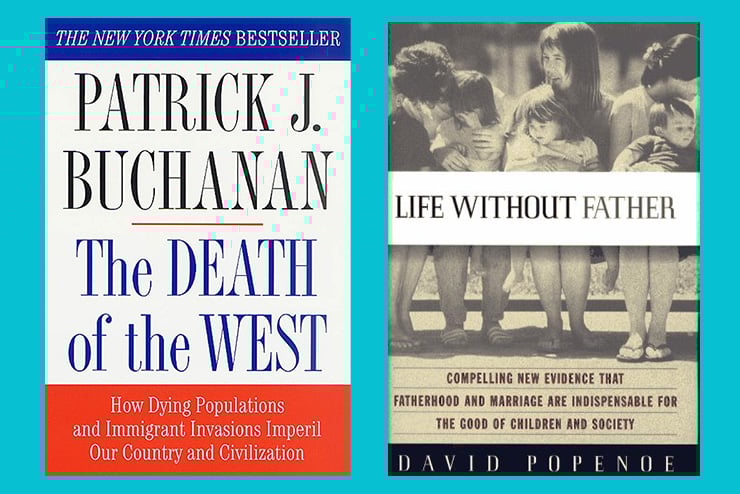
When Patrick Buchanan’s 2000 Reform Party presidential campaign ended in failure, National Review mocked the end of a “glorious career.” Not so fast. A new phase of that career—that of a best-selling author—was just beginning. Two years later, Buchanan published his blockbuster The Death of the West, which sat atop of bestseller lists for months.
The Death of the West is not typical conservative shlock. It asked what would become the most pressing question of the new century: Can a civilization survive both low fertility and mass immigration from alien cultures? Buchanan answers that question convincingly in the negative with his trademark mixture of journalism and history. The story he tells is the rapid passing away of Western Christian civilization.
The book found its audience despite uniformly negative reviews in the mainstream press. In Great Britain, it caused such a furor that leftists attempted to ban it. Buchanan had touched a nerve. Imitators followed, including Tony Blankley’s The West’s Last Chance and Ben Wattenberg’s Fewer, and Buchanan himself followed up in 2012 with Suicide of a Superpower.
When it was published, the American conservative establishment was focused on the “War on Terror.” Buchanan’s latest crusade went off script, which only solidified his pariah status. Yet his message resonated in Europe, where Jean-Marie Le Pen’s National Front Party was gaining ground in France with a Buchananite message. Today, Le Pen’s spiritual successors in countries across Europe have shocked establishment parties with their electoral gains, which started in Eastern Europe before moving westward.
The turning point came in 2015, when German Chancellor Angela Merkel allowed in more than 1 million asylum seekers from Asia and Africa. Hungary, Poland, and the rest of Eastern Europe shut their doors. Out of that struggle emerged Viktor Orbán, the Hungarian prime minister who began articulating an anti-liberal democracy message: Zero immigration, along with healthy tax credits for couples wanting more than one child.
Buchananism is triumphing in Italy, Austria, Switzerland, and Denmark. Are we witnessing the death of “the death of the West?” Perhaps, as the momentum has reached even supremely woke Germany, where the Alternative for Germany party is flourishing. The focus everywhere is on closed borders, deportation, and natalism. Quite a legacy for an entirely readable 308-page volume.
—Joseph Scotchie
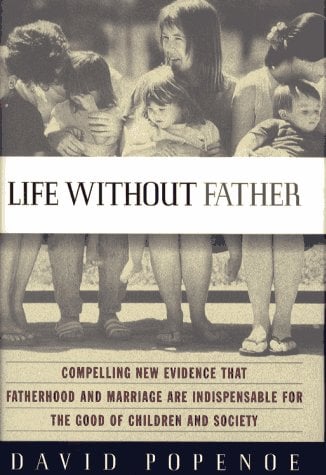
The biggest lie of contemporary social science is that single motherhood is not a social pathology. We are told that this practice has no harmful effects, that it’s just a different but equal kind of family life.
In Life Without Father, David Popenoe unapologetically calls out this lie and catalogues what he calls the “human carnage of fatherlessness.” Popenoe spent a lengthy career researching the state of modern American families, specifically the changing role of fathers. He is that rarest of phenomena in the American social sciences: A professor unafraid to challenge a false ideological consensus.
Absent fathers damage children in many easily demonstrated empirical ways. Sometimes their absence goes all the way down to biology. Research shows that girls raised in fatherless homes both enter puberty and become sexually active earlier than those living with their biological fathers. They have a higher likelihood of early pregnancy, and those pregnancies frequently involve the kind of men who flee from fatherhood, with all the predictable disadvantages for those offspring.
Popenoe distinguishes himself from his academic sociologist colleagues by his considerable knowledge of evolutionary theory. This enables him to integrate his defense of fatherhood into the evolutionary history of the human species. Of course, one can make pointed religious arguments in favor of the two-parent biological family unit, but these arguments have decreasing purchase in higher education and among elites more broadly. So, Popenoe offers readers ammunition against moral relativists in a scientific vernacular that they cannot dismiss out of hand in the same facile manner that they discount Christian teaching.
Two factors loom large in the causes of fatherlessness. First, the explosion of no-fault divorce in the 1970s; second, the equally precipitous increase in nonmarital births. Both combined to weaken the cultural taboo against the fracturing of families. We came to believe that fathers are optional—that they can, in any event, be fully replaced by the state in what feminists claim is their only productive function: a source of funds.
Popenoe does not content himself with describing the tragedy. He suggests remedies. Unfortunately, those would require changes to our divorce laws and social assistance programs that few politicians appear willing to attempt. But even if one is not hopeful that the trends can be reversed, one comes away from this book better informed for the struggle.
—Alexander Riley
Leave a Reply