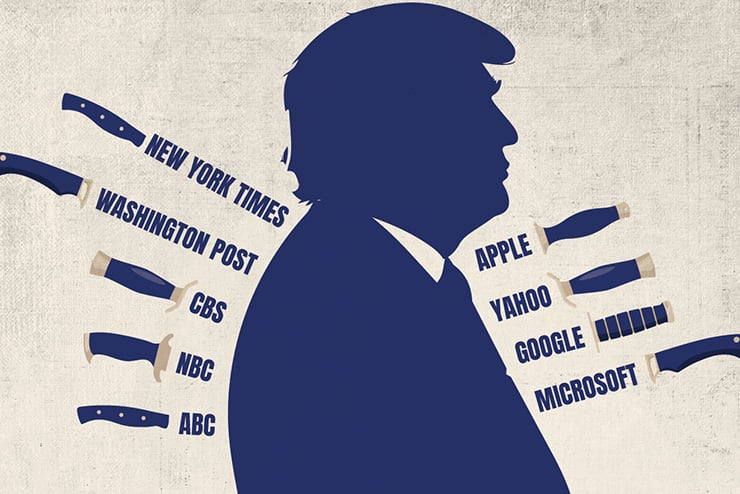
Public trust in the news plummeted as journalists became political activists. Big Tech is trying to save the media by controlling what we see, whether we trust it or not.
A Laffer Curve exists for everything, and the Age of Trump’s overlap with the most brazenly biased media illustrates this truth.
How else to explain the coexistence of two forces pulling so hard in opposing directions? The more that activist journalists try, the less they influence public opinion. The less they influence public opinion, the more they try. Instead of demonizing Trump in the mind of the citizenry, they more successfully immunize the mind of the citizenry from their demonization attempts.
The phenomenon resembles the effect on revenue of the high-income-tax rates that Art Laffer once questioned. The theory goes that a 90 percent rate, because it leaves little incentive to work, might yield lower revenue than a 30 percent rate. Similarly, a reporter going full activist, in the style of former CNN reporter Jim Acosta, advances his ends a shorter distance than did the more subtle Walter Cronkite. Sometimes less is more.
Something more powerful than a law of diminishing returns colors the pattern. And few things feel as cathartic to political fanatics as wielding journalism as a weapon. So, they compulsively indulge in the strategically foolish gambit that replaces reporting with advocacy. The former leads in unexpected directions; the latter to predetermined outcomes, no matter the facts. The fashion to announce one’s politics, to provide a visible demonstration of where one stands, and to forever imagine oneself as heroically speaking truth to power all undermine the ability of journalists to nudge news consumers to a spot more politically pleasing to them. By identifying their political allegiances, they diminish the impact of their project.
Increasingly, we take what journalists tell us with a grain of salt. The tactic of mentally prefacing the words of manipulators with “I want you to believe”—long resorted to by those frustrated in dealings with sociopaths or personality-disorder cases—subconsciously governs the receipt of news for a massive portion of the population. Journalists habituated their audience, or at least that portion of it that did not share their ideological prejudices, to distrust them. That same Laffer Curve that many journalists laughed at several generations ago when applied to economics also explains why greater bias often results in less damage for the targets of that bias.
For the portion of society that wants to believe, remaining safe within an information bubble protects their beliefs from unwanted challenges. The cloistered consumer of news media necessarily becomes further radicalized through carefully curated information. So, the skewed coverage does not entirely boomerang.
A cottage industry that began in 1969, when former Federal Reserve economist Reed Irvine launched Accuracy in Media (AIM), bemoans media bias. It has long exposed slanted coverage. It seems unclear whether Irvine’s many heirs wish to stop left-wing journalists from acting as propagandists or to imitate what they decry by establishing parallel institutions on the right.
The Media Research Center (MRC), the most successful of the organizations to sprout up in Irvine’s wake, once emphasized the Big Three networks. Now they emphasize the Big Four aggregators because consumers increasingly receive their news and headlines, passively in many cases, from Apple, Google, Yahoo, and Microsoft rather than from CBS, NBC, and ABC. Not Manhattan but an arguably more left-wing haunt—Silicon Valley—today delivers the largest share of the news that most Americans encounter. And the Big Four’s carefully curated information imbalance more effectively influences public opinion, if only because users generally do not remote-control their way to another home page. On television, viewers choose from options. On a browser home page, the Big Four present options.
The statistics show the tech aggregators harbor a clear left-wing bias. In February, Apple showcased 400 stories from left-leaning outlets, compared with just eight from right-leaning ones, according to an MRC analysis. Google News pushed 314 left-leaning stories to just 11 right-leaning stories in its morning roundup. MSN promoted stories from 68 left-leaning outlets to just two outlets to the right, Fox News and Fox Business, contributing elevated articles that month. MRC further found that when MSN highlighted Fox News stories, they almost always focused on apolitical subjects, such as Jane Seymour’s 75th birthday and the imposition of new fees by Madeira on visitors to the island. Of the 20 top daily news stories highlighted by Yahoo News every morning in February, MRC notes that 87 percent derived from left-leaning outlets. The immigration-related headlines included “Abolish ICE? Absolutely—and DHS Too” (Salon) and “How to Dismantle a Concentration Camp” (New Republic).
Though the statistical evidence of bias is clear, conservatives typically rely instead on compelling anecdotes showing the media’s unfairness. The examples they cite usually involve national stories in which reporters brazenly distort truth to a degree that it, at best, resembles truth’s reflection off a funhouse mirror. These include the prolonged dressing-up of a Hillary Clinton opposition research operation as an “intelligence dossier” that became known as the Russia Collusion Hoax; the brief CNN chyron that described a “mostly peaceful protest” over the backdrop of a Summer of George Floyd conflagration; or George Stephanopoulos, an early 1990s fireman extinguishing the flames from Bill Clinton’s “bimbo eruptions” somehow deemed fit by ABC News in the mid-1990s to cover politics, reacting in disbelief as Nikki Haley explained that Joe Biden’s age-related issues would make it impossible for him to run in 2024. Sometime after The New York Times used “fake but accurate” in a 2004 headline about forged documents that smeared George W. Bush’s service in the Texas Air National Guard, but before it titled a 2019 front-page article about the Covington Catholic School kids “Boys in ‘Make America Great Again’ Hats Mob Native Elder at Indigenous Peoples March,” the national news media lost its credibility.
Given the media’s track record of outrageous distortions in what it covers, it’s easy to forget that its most common form of bias lies in what it doesn’t cover. The March death of Kermit Gosnell provides a poignant reminder. Gosnell was an abortionist who operated an illegal baby-murder-mill in Philadelphia that was overflowing with cat mess and other detritus. He was tried and convicted in 2013, but despite its sensational, horror-movie aspects, this grotesque case of a serial killer of babies went largely uncovered by the national media for months, until columnist Kirsten Powers exposed the scandal in USA Today.
“Infant beheadings. Severed baby feet in jars. A child screaming after it was delivered alive during an abortion procedure. Haven’t heard about these sickening accusations?” she asked in 2013. “It’s not your fault… there has been precious little coverage of the case that should be on every news show and front page.”
Powers pointed to a blackout of the case on the three old-line network news broadcasts. Leading newspapers, such as The Washington Post, similarly refused to cover the story. The New York Times had devoted just one article to it, buried on page A17.
Powers’s shaming worked. Outlets that would have given saturation coverage of a pro-life activist who murdered three abortionists began to cover the case of an abortionist who was eventually convicted of murdering three babies. That initial prolonged silence illustrated a truth. Media bias is like an iceberg. One sees a fraction of it. The most damaging parts sit below the surface, unseen even by those most zealously looking.
Propaganda works when the audience does not imagine it as propaganda. More than a decade after the Gosnell media blackout, one imagines that today there would be a muted impact for an op-ed such as Powers’. The Big Four wield more power than the Big Three. Unlike individual newspapers or news programs, the Big Four aggregators remain largely immune from the shaming tactics that brought down the Gosnell blackout because we generally do not see the missing stories amid the numerous, ever-shifting array of headlines.
Where do naturally inquisitive Fourth Estate fledglings learn to lose their innate curiosity as they did with the Gosnell story?
Collegiate schools of journalism and communication offer the most obvious answer. As in education and law, J-schools have usurped the training that the fields themselves traditionally provided and still appear better suited to give. In doing so, the universities impose a homogenized progressive outlook upon an entire profession. One learns not how to investigate, report, and write, but instead how to present facts to fit narratives, to cultivate relationships with power, and to set the frame of a story so the audience knows whom to love and whom to hate.
The Associated Press Style Book, which sets the rules in American journalism for innocuous things like punctuation and spelling, also slips in subtle and not-so-subtle political diktats. It counsels scribes to capitalize “Black” but not “white,” arguing that “white people in general have much less shared history and culture, and don’t have the experience of being discriminated against because of skin color.” Journos should write “sex assigned at birth” rather than “biological sex,” and reject “illegal immigrant” in favor of “undocumented.” In other words, the Associated Press embraces the progressive buzzwords alien to the American vernacular but pervasive among leftists. American journalists follow along, most of them gladly. This seems especially true among young editors who mistake the style guide for a style edict. In their AP-inspired zeal for sensitivity, so many young journalists obtusely exhibit profound insensitivity.
When Jose Medina, a Colombian illegal immigrant with tuberculosis, brain damage, and a previous theft arrest, allegedly murdered Loyola University of Chicago freshman Sheridan Gorman during a March robbery attempt, the student newspaper quickly discarded the facts to embrace a narrative that portrayed immigrants as the victims instead of this one immigrant as a predator. The Loyola Phoenix’s headline initially read: “Immigrant Man Charged in Murder of Sheridan Gorman, DHS Involved.” It now reads: “Charges Filed Against Man Arrested in Murder of Sheridan Gorman.”
Why did the “Immigrant Man” morph into the less descriptive “Man”?
“That headline didn’t reflect the most important elements in the story,” an editor’s note explains, “and it was taken down minutes later to prevent any further harm to affected community members.”
The text of the article initially referred to the murderer of the freshman as an “illegal immigrant.” That quickly disappeared, too. “No human’s existence is illegal, and we quickly changed our wording to reflect that,” the tone-deaf editor’s note further informs. “We acknowledge the harm such language can cause and the power and importance of the words we choose to use.”
While presumably few illegal immigrants read The Loyola Phoenix, nearly all of Sheridan Gorman’s classmates do. What of the “further harm” they received, as the editor of their student newspaper wrung her hands over the proper descriptives for the alleged murderer of their classmate?
Not all young people in media mindlessly trod the path J-schools map out. The three most effective investigative journalists from the perspective of right-of-center audiences are, arguably, Antifa bête noire Andy Ngo, DEI scourge Christopher Rufo, and welfare-cheat exposer Nick Shirley. None of them entered the media through the professional school pipeline, nor do they operate from the perch of any old-line media company. It is doubtful that these journalists would have made it through the J-school-to-old-line-media pipeline unscathed, and it is certain they would not have been rewarded for the work they’ve done if they had. The career arc of a similarly effective journalist from a previous era demonstrates this. John Stossel, once the most visible reporter in the mainstream media who challenged its prevailing narratives, famously noted that he won 19 Emmy Awards as a Ralph Nader-style consumer reporter but none after his conversion to libertarianism. Big Media rarely employs heretics and never rewards heterodoxy.
While Big Conservative Media should be fostering the development of many Andy Ngos, it oftentimes defaults into a carbon copy inverse image of the very Big Media it opposes. Praise of Donald Trump on some conservative websites and cable channels feels obligatory, while criticism of military adventurism in Iran, Venezuela, and beyond is forbidden. This lockstep conservative media seems unfazed by Friedrich Nietzsche’s advice about not staring into the abyss lest the abyss stare back into you.
Nevertheless, the Trump administration’s addition of Breitbart, Newsmax TV, and other conservative outlets to White House briefings was long overdue. Why did left-wing institutions with smaller audiences get seats in the room for so long, but they were kept out? The flood of newcomers and the inclusion of a “new media” seat occur not without a downside. The notion that conservative journalists can peddle propaganda just like their left-wing counterparts do, if only given the chance, now finds periodic validation before a national audience. In terms of sycophancy, several of the conservatives in the White House’s James S. Brady Press Briefing Room more than match the worst of past progressives. Daniel Baldwin of One America News Network last year asked the president about his Russia-Ukraine peace efforts, “What gave you the moral courage and conviction to step forward and lead that?” YouTuber Benny Johnson used his time in the press room’s “new media” seat a year ago to gush over the administration’s anticrime efforts and tell White House Press Secretary Karoline Leavitt, “Thank you for making the city safe.”
What would Helen Thomas do? Not that.
Nobody has yet asked the president, “Why are you so awesome?” But more than two-and-a-half years remain in the second Trump administration. One might chalk it up to growing pains. Many of the awkward conservative voices asking questions hail from institutions heretofore barred from the West Wing. Perhaps with experience, they will become more deft interlocutors of power.
The emergence of a parallel media apparatus itself indicates the political exclusivity of the so-called mainstream media. Given the struggling status of that ideologically narrow old-line media, the thought of integrating a lineup of reporters and editors who reflect America rather than Manhattan and Washington, D.C., should occur to the shot callers at such institutions. It does not.
The consequences of credentialing the people most alienated from American communities to cover American communities should also appear obvious to members of the media, because those consequences appear so frequently in their own headlines.
In late March, CBS News announced a six percent workforce reduction. This came amid the shuttering of its 99-year-old radio division and the high-profile departures of John Dickerson and Anderson Cooper. A March message to Buzzfeed’s shareholders expressed “substantial doubt about the company’s ability to continue as a going concern.” The Washington Post laid off 300 employees, about 30 percent of its workforce, in February. Its books and sports sections no longer exist in any real form. “It’s an absolute bloodbath,” an employee told The Guardian.
The persistence of Herald Square in New York indicates that extinction events for newspapers and magazines predated both the Internet Era and the Woke Era. And now, of course, media outlets face existential challenges beyond the ideological purity tests imposed from within. But this emphasis on political correctness places an unnecessary burden on a beleaguered industry operating in a trying environment. The “go woke, go broke” phenomenon appears more prevalent for local news outlets precisely because of their already precarious situation.
The Pittsburgh Post-Gazette was scheduled for a May 1 shutdown after 240 years in business, until an eleventh hour purchase by a nonprofit. A protracted fight between the newspaper and the newspaper guild directly led to the union’s court victory that ensured a workplace defeat. The union president complained that the journalists were being punished even though they “have done award-winning work for decades,” neglecting to mention that the paper lost $350 million over the past two decades.
To complain about the greed of bosses who were losing nearly $20 million a year keeping the city’s newspaper running strikes one as a proclamation of economic illiteracy. One cannot expect the same reporters and editors, who never grasped that a Laffer Curve of sorts ensured diminishing returns for their ideological crusading, to understand that a business operating as a benefactor cannot withstand continued attacks by its primary beneficiaries.
When the obituary of the mainstream media appears, the writer might euphemistically note that it “lost its battle with depression.” In attempting to kill all that they hate, the mainstream media is killing itself.
Leave a Reply