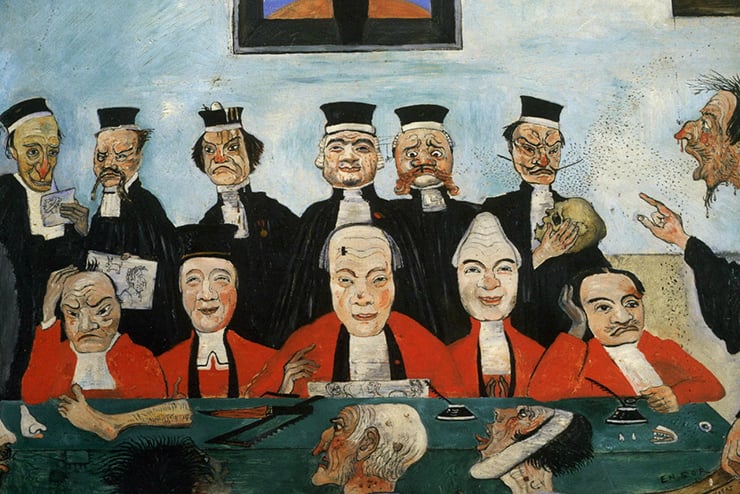
The federal courts have granted to themselves on their own authority overwhelming power over matters that before the middle of the 20th century were considered none of their business. They have turned virtually all political questions into legal ones.
I will start with an accidental prophecy from a prominent Virginian of the early republic (one of the Fathers, as Mel Bradford would say). Although he was optimistic about the success of the republican “experiment,” he had reservations.
“Perhaps, too, there may be a certain degree of danger,” the Father wrote, “that a succession of artful and ambitious rulers, may, by gradual and well-timed advances, finally erect an independent government on the subversion of liberty.” By “independent,” he meant a government free from the control of the people—the opposite of what a republican government was supposed to be.
I call this prophecy accidental, because James Madison, its author, didn’t really believe that the American people would ever lose control of their government. Or, if they did, he thought it would be so far distant in the future from 1787, the birth year of the new Constitution, that it was not worth worrying about.
Madison’s fear was rather the opposite: that the will of the people, exercised through their state legislatures and embodied in their state republics, would have full sway, trampling upon the rights of propertied minorities. “It is much more to be dreaded that the few will be unnecessarily sacrificed to the many,” he wrote, than the many will be sacrificed to the few.
The fear of state democracies running amok was shared by virtually all of the Federalists, and it was a prime motive behind their movement for a national, as opposed to the existing confederated government. That is why so many historians, Charles Beard for example, have questioned how democratic the framers really were. The short answer is: not very. But they were not closet oligarchs, either. What they wanted was a mixed republic (what the Greeks called a polity), in which the power of the people was balanced by the power of wealth. But they could not outright talk about protecting the rights of the wealthy—to do so was unthinkable even in Virginia, and certainly in democratic America. Instead, they spoke euphemistically of “men of virtue and understanding,” and “the enlightened friends of government.” But in practice, it came down to the same thing: the wishes of the people would be balanced by the wishes of the few. Whose wishes would be given their just due in each particular case was what American politics would be all about.
Madison knew that balance would be hard to maintain, and the Constitution he helped design was full of balancing features. One was the Supreme Court and the lesser federal courts. He hoped that the legal system would serve as the long-sought-after “great desideratum” of republican government, a “disinterested and dispassionate umpire in disputes between different passions and interests in the state.” And he did not worry about the possible abuse of judicial power. On the contrary, he wrote, “Were I to select a power that might be given with confidence it would be judicial power.” Why was he so confident? “This power cannot be abused without raising the indignation of all the people of the states.”
On that point, Madison was a poor prophet. His grudging admission of a distant possibility of subversion turned out to be more accurate than his confident assurances that the new government would be a perfectly balanced mechanism of impartial justice. His fear of a despotic majority trampling upon the rights of the wealthy few has proved to be groundless. And his confidence in the impartiality of an unelected judiciary with life tenure is risible, based on what we know today. What he did not consider was that if the government were to become largely independent of the people, as he admitted could happen, what would it matter if the people were indignant with the unelected part of it? What could the people do to stop out-of-control judges?
The short answer is nothing. Americans who voted for Trump found that out this past winter and spring, if they did not know it before. Wielding a power that few, if any, knew they had, federal district court judges issued scores of injunctions blocking the president’s executive orders on trade policy, border security, immigration enforcement, and shrinking the federal bureaucracy. Apart from calling their congressman to complain, there was nothing that Americans could do about it.
As a historian, I was struck by the novelty of what was happening in the courts. I didn’t remember judges hampering any previous president to such an extent in my adult lifetime. So I consulted Arthur Schlesinger Jr.’s The Imperial Presidency (1973) to see how the imperial presidents of the 20th century had overcome the judicial injunctions issued to restrain their unconstitutional usurpation of powers. There were no such injunctions issued until Nixon, who was, according to Schlesinger, the last of the imperial presidents. Until the hated Nixon came on the scene, the federal courts, including the Supreme Court, had simply acquiesced with nary a protest at the rise of the imperial presidency. Next, I turned to The Oxford Companion to the Supreme Court (1992), only to find that there were no chapters or entries for these kinds of injunctions against the executive branch. That is how little used they were.
The one used against Nixon involved a group of congressmen who filed suit against the president, charging him with waging an undeclared war in Cambodia. A federal district court judge ruled in their favor and issued an injunction against the continuance of the war—essentially ordering the president to end it. Nixon, of course, appealed the decision. Keep in mind that the practice of presidentially directed wars had never been challenged by the courts, and thus practically had their sanction up until that point. A circuit court stayed (temporarily suspended)the injunction, and then ruled in Holtzman v. Schlesinger (1973) that the dispute was a “political question” and thus nonjudiciable. The courts had instigated, and then averted, a constitutional crisis.
While leaving Nixon free to make war, the federal courts were otherwise ready to check his “imperial presidency,” which they did using the issue of appropriations. For two centuries, presidents had the discretionary authority not to spend specific funds appropriated by Congress. Thomas Jefferson, for example, had refused to spend a $50,000 appropriation for gunboats he believed were no longer necessary for national defense. Every postwar president (Truman, Eisenhower, Kennedy, and Johnson) also had impounded public funds—that is, did not spend them. Yet when Nixon dared to exercise this power, the Supreme Court ruled, in Train v. City of New York (1973), that he could not. Overnight, what had been a constitutional practice had become unconstitutional. Writing about this decision in the Oxford Companion, Stanley Kutler explains that “certain constitutional principles were inherent in the ruling, including … the judiciary’s right to compel presidential action” (emphasis mine).
The most famous judicial action taken against President Nixon occurred during the Watergate Trial in 1974, when Federal District Court Judge John Sirica subpoenaed the president, ordering him to turn over the White House audio tapes to the Watergate special prosecutor. A subpoena is like an injunction in that it is an order, but unlike it in that it orders the subject to do something rather than desist from doing something.
The Nixon administration appealed, but the Supreme Court ruled 8-0 in United States v. Nixon that the president had to turn over the tapes. He did, and three weeks later he was forced to resign. The tapes demonstrated that Nixon knew and approved of the efforts to cover up the Watergate break-in. It was a heroic moment for the Court, which had helped to bring down a president. In the Oxford Companion, John Brigham concluded that “the decision was widely heralded as saving the country from executive tyranny,” reaffirming that the Supreme Court had final say in constitutional matters.
The claim about “executive tyranny” is a great exaggeration. After all, President Nixon faced a Congress controlled by the opposing party, a hostile media, and federal courts over which he exercised no control. How tyrannical could he have been? And how heroic, really, was the Supreme Court, when it knew its action would be applauded by the press and supported by Congress? And, of course, Congress could have impeached the president without the tapes.
I also found this illuminating passage by Samuel Krislov, writing on the subject of Executive Immunity in the Oxford Companion:
It has been assumed … that the president enjoys some shield from both judicial and congressional control. If presidents were obligated to justify legally each contestable action of the executive branch, they would be subject to intolerable control and inspection by a supposedly coordinate branch and would be burdened by countless impediments to effective action.
Ah yes. So, once again, we see it confirmed that the great breaker of constitutional norms is not President Trump, but the opposition to President Trump that is coming from the judiciary.
Yet for those who believe President Trump is a mortal threat to the constitutional order and the democratic republic, then all that judicial obstruction is justified. Indeed, it is necessary, since Trump’s party controls Congress, so the legislative branch is doing nothing to stop him.
Who, then, is right? And who gets to decide? According to the prevailing theory of our government, it is the Supreme Court. But why should it be the Supreme Court? And does the Constitution even invest the Court with that role? Did not the people already vote on this question, in 2024, and decide that, no, Trump is not a dictator, not some unique threat to democracy and the rule of law?

Let’s turn to a Virginian who was a better prophet than Madison: Thomas Jefferson. He believed, along with Machiavelli, that the citizens of a republic were the safest depositories and guardians of their own liberties. How could a true republican believe otherwise? Here is Thomas Jefferson from his first Inaugural Address (1801):
Sometimes it is said that man cannot be trusted with the government of himself. Can he, then, be trusted with the government of others? Or have we found angels in the forms of kings to govern him? Let history answer this question.
Everyone at the time knew he was alluding to the Federalists, who had been quite vocal in their denunciation of “democracy” and who called Jefferson and Madison and their supporters “democrats.”
The Federalists never won another national election, yet they retained control of the Supreme Court for the whole period of Republican rule (1801-1825). What is more, their elitist mentality eventually came to dominate the majoritarian principles of the political successors of Jefferson and Jackson. By the middle of the 20th century, the Supreme Court had become, well, supreme in our system of government—very much like a council of Platonic Guardians.
Hence, it is no longer even argued, nor stated explicitly, that the Supreme Court has final say in constitutional matters and that its decisions are binding on both Congress and the president. It is simply accepted that it is the last stage in the process by which legislation or administrative decisions and changes of policies are adjudicated after being challenged in court. Within the legal profession, it is known as judicial supremacy; among everyone else, simply as judicial review. Behind these terms, however, lies the unsettling fact that the three branches of government are no longer part of a balanced system. The judicial branch has the executive and legislative branches in check.
Yet the historical record provides unequivocal evidence that the Constitution did not establish judicial supremacy. Judicial review, yes, but that idea was much more limited in scope and power than it has since become. The term “judicial review” did not even come into use until the early 20th century, and the idea was foreign to the Founding Fathers. Here is James Madison from Federalist 49:
The several departments being perfectly coordinate by the terms of their common commission, none of them, it is evident, can pretend to an exclusive or superior right of settling the boundaries between their respective powers.
Five years later, Madison could write that the several branches of government have “a concurrent right to expound the Constitution.” Today, it is held that the judiciary has an exclusive right to expound the Constitution and to declare its true meaning.
We all know that Alexander Hamilton favored a strong, independent judiciary, but even he never went so far as to claim that judicial decisions bind the president and Congress. The “judiciary, by the nature of its function will always be the least dangerous to the political rights of the Constitution,” he wrote in Federalist 78. He explained why. While the executive branch holds the sword, and the legislative branch the purse, the judicial branch can take no active resolution whatever. It may truly be said to have neither FORCE nor WILL, but merely judgment, and must ultimately depend upon the executive arm even for the efficacy of its judgments.
Hamilton’s readers would have understood him to mean that the president is not bound to obey or carry out the orders of a judge. For if he were, then why reassure readers that federal judges do not possess law enforcement powers, nor can they command the executive to supply them?
In Federalist 81, Hamilton pointed out that the Constitution conferred original jurisdiction on the Supreme Court for only a specified number of subjects (Article III; section 2). The Court’s jurisdiction in all other kinds of cases was subject to congressional control. “This jurisdiction shall be subject to such exceptions and regulations as the national legislature may prescribe,” Hamilton wrote. In other words, Congress could restrict or even deny the Court’s jurisdiction over entire categories of cases.
Even John Marshall recognized this formidable legislative check upon judicial power. When he was Chief Justice of the Supreme Court, he wrote a letter to Samuel Chase, then an associate justice, explaining that the proper remedy “for those legal opinions deemed unsound by the legislature” was not impeachment but the removal of the court’s jurisdiction over the matter. (The Republican Party had impeached Justice Chase, but failed to convict him in the Senate.) Such legislative remedies are known in the profession as “strippers,” but, like the 10th Amendment, they have become a virtual dead letter, never used and rarely mentioned as a constitutional remedy for an encroaching judiciary.
Marshall was the first to enunciate the political question doctrine, which he articulated as, “Questions in their nature political … can never be made in this court.” This doctrine guided the Court for more than a century and a half. Marshall was not the author of it, however. He had simply recognized that, in a republic, the scope of judicial power must be limited to those subjects that are judicial in nature, and not those that are essentially political. The distinction might be hard to make sometimes, but everyone believed it existed.
That quotation of Marshall’s doctrine comes from his most famous decision, Marbury v. Madison (1803). This was the decision where the Chief Justice supposedly established the power of judicial review, which is the rationale used to try to justify modern judicial supremacy. Marshall gave the concept of judicial review, which was already in practice then, explicit recognition—but we’ve forgotten that he also defined its real limits.
Marshall’s political question doctrine is not what it once was. It has shrunk considerably to matters related to foreign policy and war. Everything else has become justiciable, that is, subject to legal process and judicial resolution. The New Left famously said that “everything is political.” Now, everything is litigious—nothing is only political, and every dispute or disagreement is subject to judicial resolution. The federal courts have granted to themselves on their own authority overwhelming power over matters that before the middle of the 20th century were considered none of their business. They have turned virtually all political questions into legal ones. In the process, they have shrunk the scope of the political for citizens while expanding the scope of the political for themselves. In just that way, our self-governing republic has become a kind of Platonic guardian state.
But why have the political branches acquiesced at the rise of an imperial judiciary? We have seen that both Congress and the Executive have means of resisting an encroaching judiciary. Congress could defund the federal courts—all of them, except the Supreme Court. For the Constitution gives Congress the choice whether to institute, or not to institute, the system of lower federal courts. Congress could disestablish them tomorrow.
The president could assert the principle of concurrent review and the division of powers, and defy a judicial injunction. Instead, by merely appealing the flurry of nationwide injunctions issued against him, President Trump has essentially recognized the authority of federal district court judges to supervise his presidency.
The president could assert the principle of concurrent review and the division of powers, and defy a judicial injunction. Instead, by merely appealing the flurry of nationwide injunctions issued against him, President Trump has essentially recognized the authority of federal district court judges to supervise his presidency.
Why haven’t Congress and the president challenged the judiciary? The only answer is that they must like things the way they are. By blaming the courts, both Congress and the president have another excuse for inaction, another target toward which to direct the ire of the public for their failure to act decisively. It is also a way of evading difficult political decisions, so fraught with personal risk, by letting the courts make them, or prevent them from being made at all.
Perhaps the political branches like having an imperial judiciary because they see how it protects them. If I may recur to the Oxford Companion one more time, it says that a core mission of the judiciary is “to plan and defend institutional stability.” That is not the same as defending the Constitution, or the republic, or the rule of law. Not at all. If the institutions of the republic have become corrupt, unrepublican, unconstitutional, and lawless, its mission becomes defending those institutional abuses, not reforming them, because doing the latter would require first “attacking” them. The Companion contributor in this section, Theodore Blumoff, admits that Supreme Court justices “tend to reflect … the political views of those who control those institutions” (the presidency and the Senate). You don’t say?
William Quirk, the author of Courts and Congress: America’s Unwritten Constitution (2008), observes that the Court “centralizes decision-making to conform to elite opinion,” and “thwarts the will of the governed.” Quirk’s central argument is that America’s written Constitution has become a hollow shell, and that what actually exists is an unwritten understanding among those who control American institutions about what is to be done, or not done, and how to go about doing it.
Gore Vidal had the same image in mind when he complained, back in 1991, that the Constitution “has been so reshaped over the past two centuries that it is now a straightjacket for the people at large.” He thought the only solution was the calling of a new constitutional convention. Ten years before, in his book Prejudices, Robert Nisbet asked rhetorically why the United States should bother having elections “if after being overwhelmingly elected to the White House, the president finds himself stopped by either bureaucratic or judicial opposition from fulfilling the very policies which helped get him elected.” The answer, of course, is, for the sake of appearances. It reminds one of what Guido Cavalcanti called the republic of Florence: “A hidden oligarchy behind a republican façade.”
Perhaps the foundation of the Supreme Court’s power is the powerful fiction that it is the disinterested, dispassionate, and expert interpreter of a sacred and binding document known as the Constitution. It seems to be the common opinion of both laymen and experts that the Court embodies universal principles and values and provides answers to all our vexing questions. It does nothing of the sort—nor was it intended to!
The newest justice on the Supreme Court, Amy Coney Barrett, has just written a book titled Listening to the Law. Those words embody the myth. When Justice Barrett writes an opinion on a case, it is not her opinion, but the decision of the Law, speaking through her. (But if that were the case, then why are not all opinions unanimous?)
Someone has to decide. Who gets to decide is the essential question of politics. Thomas Hobbes understood that. So did Thomas Jefferson, who wrote, “Governments are republican only in proportion as they embody the will of the people, and execute it.” He called that “the mother principle.” Whatever then that blocks the execution of the public will defeats the republic. Another Virginian, the jurist St. George Tucker, put it even more starkly: “If the will of the majority is not permitted to prevail in questions where the whole society is interested that of the minority necessarily must.”
It’s hard to escape the conclusion that the purpose of the federal courts for decades now has been to frustrate the popular will, and ensure that a different will prevails.
Leave a Reply