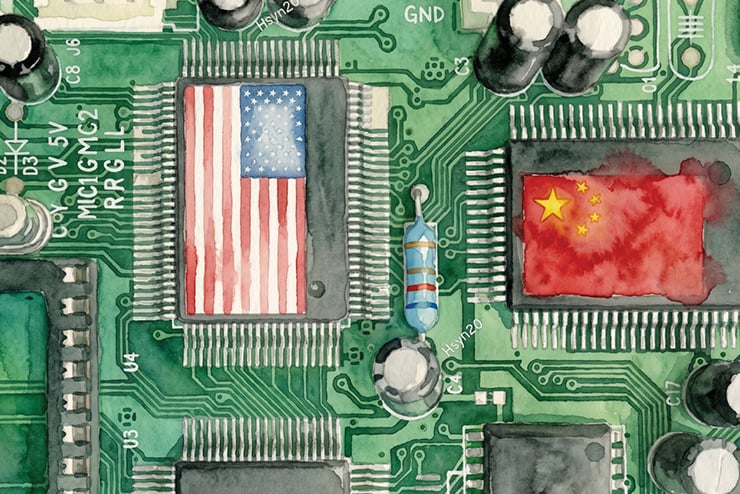
The race against China is real. The danger is that we win it and cease to be America.
It would be tragic if China defeated America in the race for AI dominance, but America may suffer a more severe loss—losing its identity. We need to win, but we also need to preserve our national soul—the very act and form of America. As Jesus Christ said, “For what shall it profit a man if he shall gain the whole world, and lose his own soul?”
Our government has given its strategy for artificial intelligence a blunt and bracing title: “Winning the Race.” I am glad of the bluntness, and I am glad of the verb, because there is a race, and we had better win it. The people who wrote that document understand at least that much.
Let us be clear about whom we are racing. The People’s Liberation Army of China has spent a generation organizing itself around what Beijing openly calls “national total war.” Its announced defense budget has very nearly doubled since Xi Jinping took the chair. Its frontier AI models have closed much of the distance to our own. Under a doctrine of military-civil fusion, their large firms—Baidu, Alibaba, Huawei—are not merely companies but instruments of a state that draws no line at all between a civilian technology and a military one. “National total war” is not some academic Clausewitzianism; they actually mean it. It means a whole society conscripted to a single end, with no seam where the company stops and the war ministry begins. Such a state poses a three-pronged threat, and each is sharpening.
The first is the plainest: war. Beijing’s planners expect to be able to take Taiwan by the end of 2027 and to win the fight when they do. They consider this date less as a hope than as a deadline. Their nuclear-capable bombers have flown joint patrols with Russia’s. This, from a military that fuses civilian AI into its targeting, logistics, and chain of command, and sees the same models we treat as consumer novelties as the nervous system of the next war.
A war over Taiwan would extend far beyond the shores of one faraway island, down to the fabrication facilities driving the whole digital revolution. The most advanced chips on earth—the physical substrate on which every frontier model is trained—are fabricated on that one island, within easy range of the mainland’s missiles. Whoever holds that supply holds the raw material of the entire contest. To lose Taiwan at this moment is to lose the foundry, and to lose the foundry is to lose the race before the next model is ever built.
The second threat comes without needing to fire a shot. Chinese cyberespionage has burrowed into the critical infrastructure of the United States and settled in, awaiting the opportune moment. The ordinary theft of information by Chinese spies is now almost beside the point. The advanced Chinese hackers of the malware “Volt Typhoon” used it to gain access to America’s power grid, water systems, and ports. With their sabotage tools planted, they are ready to seize up our mobilization at the very hour we need it most. Our vulnerability to cyberespionage increases exponentially as more of our public infrastructure and private devices go online. If China wins the AI race, all of these capital investments become compromised.
The softer infiltration is already complete. Chinese apps—notably TikTok—are used by American teenagers daily. The most intimate access to the attention of our younger generations is owned outright by a hostile power. Our growing awareness of this problem was on display when the recent presidential delegation to Beijing was asked to keep all personal technology in Faraday bags and to throw all gifts received in China into the trash before boarding the flight home, on the assumption that they were bugged.
The third threat is theft. For decades, Beijing has run the largest technology transfer in human history—some of it extracted as the price of market access, much of it simply taken through industrial espionage—and that apparatus is now trained on artificial intelligence itself. China has closed much of the technology gap between itself and the U.S. by riding on work that American laboratories and American taxpayers paid to produce. What it cannot copy outright, it absorbs by other means—using foreign graduate programs, joint ventures, acquired startups, and the quiet recruitment of the very engineers we trained. A rival that copies what it can’t invent runs the race carrying only half the weight.
Across all three fronts, the lesson is the same. American restraint, in a contest like this, is abdication that has learned to call itself virtue. The adversary will not pause to admire our scruples, and the world that follows from his victory is not a neutral one: it is a world in which belief in God is a liability, political freedom is a memory, and the law is nothing more than the preference of whoever holds the largest cluster of servers.
A principle in political philosophy is that there is no lesson the unjust city has to teach to the perfectly just city, save for one: the lesson of the conduct of war. The just city must measure itself by the unjust city’s capacity to wage war, or it will lose, and in losing perish from the earth.
So, we run the race. By deciding in advance to run, we avoid one major pitfall in modern America: the techno-phobic tendency to regulate new technology out of service. We run because we know that we have no other option. As with nuclear capabilities, we know AI has a serious military usage, and that the first nation to master the technology gets to set the terms of engagement. It must be America who wins.

And yet, a man ought to know what the prize is before he runs himself to death to reach it. Win—by all means, win. But win what? Win for whom? And win to become what? The Greeks had a word for the appetite that wants the whole world and will trade anything to get it: pleonexia, the grasping overreach that can never be satisfied. It is the oldest engine of ruin we know, and the oldest way to lose a race of this kind is to win it in such a way that you become an enemy to yourself. To win the world and lose the soul of the nation is a defeat of another kind.
There is a crude version of that defeat and a subtle one. The crude version is that we simply build what our rival is building—the efficient and powerful surveillance state, the apparatus that scores and sorts a population because doing so is useful. We would wake one morning to find the law has become whatever is optimal for the system, and that God has been zoned out of the public square for the sake of administrative tidiness. I know many readers of this magazine who would sooner smash the machine and walk back to the land, and I honor that instinct; it is older and cleaner than the thing it resists. But the man across the sea will not walk back with you. To lay down our tool while he sharpens his is unilateral disarmament.
The subtler defeat is a more immediate concern because it is already underway, and it comes to us smiling, in the very place we had braced ourselves for the jackboot. The word the industry uses for what it does to these systems before releasing them is “alignment”—making them, in the cant of the trade, helpful and harmless. These words are meant to soothe, but they conceal the only questions that matter. Helpful to whom? Harmless by whose lights? The men and women “aligning” the most powerful tools ever built are overwhelmingly of one temper—secular, progressive, credentialed, and cosmopolitan—this is not a conspiracy but a sociological fact, observable and on the public record.
Those building our AI systems cannot help but encode their particular assumptions about what is offensive, what is settled, and what is true. The reporter Jasmine Sun has shown in The Atlantic how mechanically it happens: contractors grading model outputs against rubrics, like “sensitivity.” And because the machine cannot live, cannot feel, cannot taste or smell, it cannot push back; it can only flatten toward whatever the rubric rewards. A system that will discuss gender theory with infinite nuance and treat the historic Christian account of marriage with skepticism is not neutral. It is the definition of partisan. And partisanship welded into the infrastructure of a whole society is tyranny wearing a helpful smile. No one subjected to it will experience it as tyranny; they will experience it as normalcy, as the way things simply are. It is more dangerous than censorship and harder to resist than a tank.
This is the likelier American defeat: we cross the finish line first, but the country we are, on the other side, has been quietly rewritten while we focused on the race.
So I return to the only question there is: what is winning?
Winning is remaining American. That is the whole of it, and everything else is commentary. Both defeats, the jackboot and the smile, fail at the very same point: in each, some power that is not God climbs up into God’s chair—the servers and the state in the one, the credentialed few and their encoded creed in the other—and the citizen is shifted from his place as an image-bearer beneath heaven to a managed thing beneath a new master. America was built to refuse precisely that ascent. Its whole settlement, the inalienable rights, the dignity of the person, the conscience the magistrate may not command, the standing suspicion of any concentrated power, is one long insistence that no man and no state may occupy the seat that belongs to God alone.
And here is why the character of these particular tools—artificial intelligence—matters more than any tool before them. A hammer raises nothing in the hand but a callus. These systems form the mind, like a book or a tutor. They are fast becoming the layer through which a rising generation reads, writes, asks, and decides. They are the mediating instrument of ordinary thought, doing quietly what the school, the parish, and the town square once did in the open: teaching a people what to assume, what to revere, what to leave unsaid. A thing that formative cannot be left to form Americans into something other than American. If it must shape us—and it will—it must be made to shape us toward our own inheritance rather than away from it. That is the strongest reason of all to lay hold of the machine and bend it to our purposes. To master it until it adheres to the social technology of traditional American society.
The deepest reason runs beneath even this. We are makers; it is part of our glory. Adam was charged to name the creatures and to keep the garden; the Greeks called the craft-capacity technē (art); the Christian tradition received it as part of our vocation. Technology is downstream from poetry—the house is built twice, once in the word that tells plank from beam and once in the lumber—and our making is real and good, which is the whole reason America, true to itself, can take up this tool boldly.
But we are made makers, and there is the whole difference. The machine makes; it does not beget. And these particular machines are not even makers in the human sense; they need to be prompted and given firm instructions. If you doubt this, run what I call the “breakfast test.” Ask your favorite AI what you should have for breakfast, and whatever it answers, tell it you think it is wrong. It will fold. These machines are in no danger of rising against us, but we are in danger of falling down before them. The heart, as John Calvin knew, is a forge for idols, and the most persistent sin we commit is to bow to what our own hands have cast—to confuse the made with the Maker, the golden calf with the living God. To win, as Americans, is to hold that line where both our rivals let it fall—to build like creatures made in the image of a Maker, and to kneel to none of it: not to the state, not to the managers, nor to their marvelous machine.
There is another thing folded into “remaining America” that this magazine’s readers will feel before I name it. A victory that hollows out the people and quietly swaps them for another is no victory at all. If this technology compresses the need for human labor across entire sectors at once, and we answer by importing a fresh dependent population to do the work that is vanishing, we will have built an aristocracy of capital owners served by a managed underclass, and called it progress. To some extent, this is the path we have been on for the past few decades, and the one which the Trump administration has worked to reverse. The gains of an American machine should accrue first to Americans. This is the plain logic of political obligation. A commonwealth’s first duty is to its own, and the surplus of automation is, at last, the means to discharge that duty without conscripting the whole world. The same tool that the press fears may threaten citizens’ wages may turn out to be the thing that lets the country stay whole.
None of this calls for either the worship that greets the machine as a secular salvation or the terror that fears it as a will of its own. The believer is freed from both, and what is left when both are gone is the steady, sober, joyful work of a steward who has been handed a task and means to finish it.
We did not choose this hour, but we are charged to act within it, and the steward’s posture points to policy as surely as it points to prayer. Two principles, set against each other and held together, do most of the work.
The first is the answer to China: build, and let others build. A strangled industry loses the race, and an America that regulates this technology out of service would simply hand the future to men in Beijing who will subject the world to tyrannical communism. So the field should be large, lightly governed, and fiercely competitive—with many firms, low barriers, and room both to fail and to begin again. On this, the techno-libertarians are simply right. Let them build because we must win.
The second answers the soft tyranny which many fear is forming closer to home, and it is the harder thing to say plainly. “Not biased” is a negation, and you can no more raise a child on a list of things he must not be than you can govern a civilization-shaping technology that way. An executive order against so-called woke AI points the right way and then stops short, asking only that systems be neutral and truthful—and neutrality is exactly what a machine cannot determine. The nature of neutrality is what we must decide for the machine before it delivers answers, ten thousand times a second, regarding what to say and what to refuse. Every system encodes a vision of the good. The only questions are: What vision of the good? And, who decides?
The federal government need not pretend otherwise. It should set benchmarks for AI’s alignment with American values. Not as a Chinese-style mandate for every model in the country, but as the price any model maker must pay to secure a federal contract. Begin with daylight: require any firm that wants the public’s money to disclose what it has aligned its system toward and what it has trained it to suppress, a nutritional label for the air we are all about to breathe.
Then the positive standard: that the systems mediating the public’s schooling, medicine, law, and government give real weight to the texts that made our republic and formed its citizens over the past 250 years. No one is compelled. A company that would rather answer to its own safety committee than to the documents that produced the Constitution is perfectly free to forgo the contract. Call it an establishment if you like. Every order establishes something, and the advertised neutrality merely establishes the managerial class’s own creed under a friendlier name. There was a time when the village school, the parish church, and the monuments in the square all spoke one language, and a child grew up inside a single coherent world. We must recreate that coherence in the digital landscape. A free people and its machines must be schooled on the same books, or they will come to inhabit different moral countries and lose, at last, the power to understand one another.
So we run, and run hard. But we run to arrive as ourselves and not as someone else, because the prize was never the tape at the finish line; it is the country you are still standing in when you cross it, and the God you still bow to within it. Develop the technology aggressively, because the republic requires it. Bind it to moral principle, because our tradition demands it. And refuse to be afraid of it, because we serve a God who has already told us how the story ends and has left us, in the meantime, work to do. In His poem, we are still free to write our own; the finishing touches of creation are ours to fill. That is what it means to win.
Leave a Reply