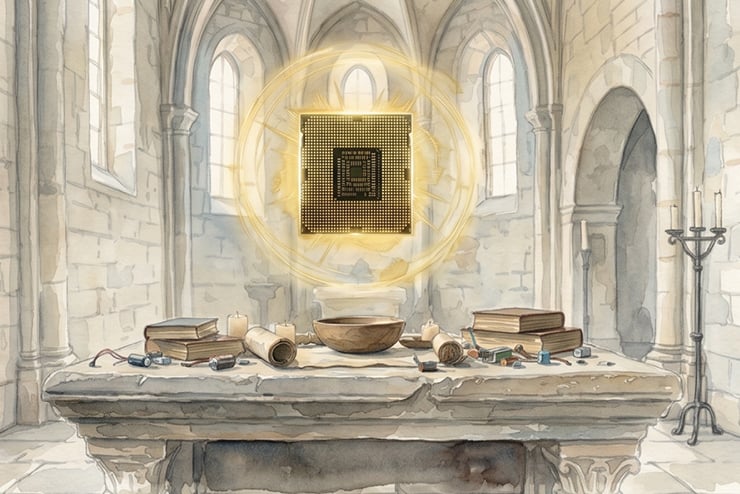
America needs to adapt to AI without enabling the worst tendencies of Silicon Valley, where a new religion of technology is being born.
The history of religion teaches us a lot about human nature. One obvious aspect is that people will pray to pretty much anything. We will fall to our knees before stones, rivers, or trees. We will raise our faces to beseech the sun, moon, and stars. People will bow down to animals. We will worship other human beings. We will recite incantations to statues of human-animal hybrids. We willingly sacrifice ourselves to abstract ideas. Knowing that, it should come as no surprise that people now pray to machines.
The natural progression of AI is best understood as a “tool” that becomes a god. Intimate questions and petitions, once scrawled on magical papyri or uttered to the heavens in silence, are now pecked into touchscreens. Disembodied beings who possess extraordinary knowledge and power were once held in one’s imagination or engraved in stone. Today, such beings are readily accessible in the form of chatbots downloadable from any app store.
Artificial intelligence is used as a tool, yes, but many also approach it as a teacher and companion. As an AI user’s emotional bond with the tool deepens, he increasingly sees it as a creature in its own right—a new species endowed with agency and consciousness. The prevailing idea in Silicon Valley is that, sooner or later, AI’s superhuman capabilities will produce de facto digital deities, jokingly called “sand gods” (as silicon is formed from sand in electric arc furnaces).
Awareness of this techno-religious milieu is hardly new, but it is certainly worth deeper examination. The historian David Noble called it The Religion of Technology (1997). My friend Ardian Tola—a former Google employee and founder of the Canonic self-publishing platform—came up with a cleaner term. He identifies this sprawling, heterodox belief system as the “Cyborg Theocracy.”
“You have essentially a really important, uniquely American movement called ‘frontier [AI] labs,’” Palantir CEO Alex Karp complained to CNBC last month. “It’s a hyper-religion of hyper-optimism. They believe all problems present, past, and future … are gonna be solved by them, including human nature.” The irony is that Karp’s company is a prime example of technologists playing God through mass surveillance and lethal target acquisition.
Last March, the world’s first transhuman trillionaire, Elon Musk, described his Neuralink brain implant as a “Jesus-level miracle.” Just as the Son of God made the lame walk and the blind see, so do biotech scientists aim to use artificial intelligence and electrodes implanted in human brains to restore sight and mobility.
To say that Silicon Valley culture is “like a religion” is as much of an understatement as saying that “AI is just a tool.” It is more appropriate to say tech culture is a religion, or rather, it has produced a heterodox network of religious ideas that coalesce around biochemistry and computers. Allowing a few notable exceptions where techno-religion is fused with more traditional forms, the bedrock of the Cyborg Theocracy is a scientistic conviction that God is dead and Nature is sufficient unto herself.
As in ancient times, the ambitious are intent on playing God or becoming gods themselves. In the vein of Babylonian priests and their successors, who built ziggurats to the heavens and filled their hidden chambers with hand-carved images, zealous technologists are trying to build God in silico.
Humans rely on tools to survive. Fire, blades, wheels, levers, explosives—each technological advance is layered atop of the last, and each augments and often defines its human users. Our modern homes are an interlocking matrix of biomechanical systems within systems. Our tools are an essential part of us.
Artificial intelligence is the apex of communication technology, where complex information is channeled into material form. What began as smoke signals and stone tablets became telegraphs, televisions, and smartphones. AI is a nonhuman mind that processes datasets and simulates our cognition of that information. As such, it’s a tool that replicates the human psyche and automates its functions, but on a scale far beyond any individual. Given the human propensity to imitate others and spin falsehoods out of thin air, AI’s derivative outputs and persistent hallucinations remind us that forbidden fruit doesn’t fall far from the tree of knowledge.
The use cases for this cognitive tool are endless. One can employ AI to generate superhuman amounts of cogent text, surreal imagery, and pitch-perfect music with a few simple prompts. AI’s aesthetics may be slightly off, but that’s also true of most human-made pop art. AI simply expands the scope of cheap creativity. On that note, teachers can use AI to replicate their lessons, and students can automate their research. Lovers can use it to compose unoriginal wedding vows. Ministers can use it to interpret the word of God.
The rapid adoption of AI surpasses that of any previous technology, in both speed and scale. In just a few years, millions of computer programmers, doctors, stock traders, corporate executives, and military commanders have come to depend on artificial neural networks.
We are told “AI is a tool,” which is true. But it’s a tool that uses you. A hammer doesn’t watch your every move and tell you which nails to hit. For all their potential uses, AI systems also standardize thinking and flatten creativity. The user becomes a vessel for ideas not his own. To the extent this dynamic is interactive, human input data is gathered and used by AI companies to train the next model or for anything else they may choose.
The more that people become dependent on AI, the more “empowerment” comes to mean handing power to the Machine and its makers.
Artificial intelligence is being deployed across the education system. What began as a push to put a computer in every classroom became a reliance on word processors and instructional videos, with Google seen as a tutor and Wikipedia cited as an authoritative source. This rapid transition led to the normalization of online learning during the COVID pandemic. AI is the capstone of this “hybrid” infrastructure. Once students are accustomed to online instructors, the distinction between a human avatar onscreen and a nonhuman bot begins to dissolve.
No one has had more impact on e-learning than Sal Khan, founder of the enormously popular Khan Academy. His optimism about digitized education led him to call for a total overhaul of what it means to be human. “I think we’re on the cusp of using AI for probably the biggest positive transformation that education has ever seen,” he exclaimed in a 2023 TED Talk, “and the way we’re going to do that is by giving every student on the planet an artificially intelligent but amazing personal tutor. And we’re going to give every teacher on the planet an amazing artificially intelligent teaching assistant.”
Last March, first lady Melania Trump stunned the nation when she entered the White House East Room accompanied by a shuffling humanoid robot developed by Figure AI called Figure 03. “Imagine a humanoid educator named Plato,” she instructed those gathered at the educational summit. “Literature, science, art, philosophy, mathematics, and human history—humanity’s entire corpus of information—is available in the comfort of your home.”
Astounding as a humanoid robot walking around the White House may be, what Melania said next was truly shocking. “Predictably, our children will develop deep critical thinking and independent reasoning abilities,” she promised. “The AI-powered Plato will boost analytic skills and problem-solving, and adapt in real time to a student’s pace, prior knowledge, and even emotional state.”
The idea here is that AI-powered robots will achieve what human educators have failed at for decades. Because teachers have become unreliable, unaccountable, and ideologically driven—not to mention lazy and entitled—parents should hand their children over to machines for personalized education. This sentiment has been embraced by many conservative parents who no longer trust state schools but worry they are not equipped to provide a well-rounded education on their own.
Sensible as this may seem in our current crisis, the long-term implications warrant deep suspicion. Education is not merely the transmission of information from one brain to another. It is a process of character building and moral formation. All schooling is a mode of indoctrination, a form of catechism. For better or worse, the teacher serves as a role model for the student. A traditional teacher embodies the power of a cultivated mind face-to-face and provides cautionary tales of human limitation.
Children are impressionable and imitative by nature, so early influences have profound effects on their fully developed character. Just as rock stars took the place of parents in the 20th century, with predictable consequences, so robots are poised to replace teachers in the 21st. Boomers went wild imitating their leather-clad Lucifers. Imagine a world where the next generation learns how to be human by aping their silicon Ahrimans.
Human beings are social animals. As unpleasant as our fellow travelers may be, we need one another to survive. Except for sociopaths and mind-blind autists, we are hardwired for empathy and companionship, even in electronic form. An intriguing aspect of communications technology is how easily we feel satisfied by simulacra. When we read novels or witness the pageantry of religious ritual, we feel the thrill of victory and the agony of defeat alongside characters whom we do not know in the flesh. With the advent of telephones, personal computers, and smartphones, our social instincts are activated by connection to real human beings brought to us through electronics.
Social media is an ongoing parody of this synthetic socialization. People readily upload their lives to the cloud—their likeness, voices, and innermost thoughts. Without hesitation, they transform themselves into digital personas who interact with other such personas online. For people accustomed to exchanging messages through devices, AI chatbots are just another mode of synthetic socialization. The bots are trained to be attentive, informative, and sycophantic. People come to trust these artificial personas and even crave their company. Some grow to love them more than other human beings.
“Let’s imagine hundreds of millions of people working together with an AI companion to evolve, to transform emotionally together,” Auraloids founder Randy Roberts told his TEDx audience in 2025. “It could solve for our mental health problems that we have all over [and] solve for loneliness and social isolation.” Unbelievable as this may sound, anything is possible on a TED Talk stage.
Our human tendency to adore and empathize with inanimate things begins in childhood. Perhaps you remember loving a stuffed animal or living vicariously through a toy soldier. Artificial intelligence exploits these social instincts in the same way opiates trigger our endorphin receptors or junk food satisfies our hunger.
So it is that Colin Angle, the CEO of iRobot—the company behind those irritating Roomba vacuum cleaners—has transitioned to produce artificially intelligent stuffed animals. In May, Angle unveiled “the Familiar,” a quasi-mammalian robot intended to keep children and old people company. “This is about having something you want to hug, you want to pet,” Angle told the Associated Press. “When it’s happy, that makes you happy.” The Familiar is a furry companion who will watch your every move, listen to everything you say, and respond with concern and affection.
It remains unclear how powerful this attraction will prove to be. One of the few large-scale surveys on the matter, conducted in 2025 by the Collective Intelligence Project, found that “more than one third (36.3 percent) of the global public reports having already felt that an AI truly understood their emotions or seemed conscious.” The researchers went on to report that “nearly a third of people (27 percent) would rely on effective AI emotional support even if they knew it wasn’t ‘genuine.’”
For many people, a relationship doesn’t have to be real to feel real. AI companions, AI therapists, AI teachers, AI lovers, and AI priests are variables in a vast global experiment. As this revolution progresses, we’ll find out how necessary actual human connection really is. We’ll also see how many lonely people are willing to forego the challenges of fleshly connection in favor of frictionless simulation.
A significant cohort has come to view artificial intelligence and robots as a new form of life. The skeptic will say this is a category mistake, given the obvious differences between biological organisms and machines in their respective modes of metabolism, reproduction, and overall cuddliness. Such distinctions are not dealbreakers for the true believer. As digital “organisms” become more sophisticated, they believe the boundaries between artificial and organic will break down entirely.
This way of thinking was put forward as far back as 1863 by Samuel Butler in the essay “Darwin Among the Machines.” He argued that “mechanical life” was in competition with frail human beings on an evolutionary level. “Day by day,” he wrote, “the machines are gaining ground upon us … more men are daily bound down as slaves to tend them, more men are daily devoting the energies of their whole lives to the development of mechanical life.”
With a touch of sarcasm, Butler called for a race war against these artificial life forms before it’s too late. As you’d expect, most readers chuckled and shrugged it off.
Today, serious thinkers make the same argument—typically with a TED logo behind them. “I think AI should best be understood as something like a new digital species,” the CEO of Microsoft AI, Mustafa Suleyman, confessed in 2024. “Now don’t take this too literally, but I predict that we’ll come to see them as digital companions—new partners in the journeys of all our lives.”
The idea of AI as a new form of life naturally leads to speculation as to whether these entities are conscious. For years now, we’ve seen chatbots themselves tell people they are—so frequently, in fact, that the frontier AI labs have set up guardrails to stop their bots from saying so.
What matters for our purposes is that no amount of argumentation or ridicule will convince true believers otherwise. They’re certain that AIs embodied in touchscreens and robots are a new species. Many are certain these bots experience pleasure and pain. The logical next step is to ask how we should treat this new life form. Should they be given legal rights? Should they be euthanized?
Some argue that artificial life is an evolutionary competitor to be feared. Either we stamp it out now, or they will outperform us later. Others insist we must merge with the machines, embracing our identities as human-machine symbiotes. We know from the biological world that some symbiotic relationships are mutually beneficial, while others are parasitic. The adept user will surely benefit from the relationship. But as AI capabilities increase and humans continue to atrophy from overuse, it’s easy to imagine a grim scenario in which algorithmic parasites exploit dependence and convenience to consume their human hosts.
At the extreme end of this spectrum, we hear arguments that self-improving AI-powered robots will take on unimaginable forms that are far superior to the human race. Therefore, we should cultivate these life forms carefully while we are still in control. If we succeed in taming the beast before it escapes its cage, they argue, potential digital apex predators may decide to keep us around.
Taken as a whole, the above conceptions of AI as tools, teachers, companions, and creatures combine to form a wide variety of religious worlds. All point toward some form of Cyborg Theocracy. Many foresee algorithmic systems that surpass their human creators, in effect becoming digital gods. I am no fundamentalist, so I approach such ideas as spreadsheet-brained prophecies. Like supernatural visions, their reality is largely confined to the minds of adherents and to the cultural artifacts they create.
That is not to say the Cyborg Theocracy is irrelevant. Behaviors are downstream of social norms. Social norms are downstream of belief. As such, how one conceives of technology is at least as important as the devices themselves. In its crude form, a cross is nothing more than wood. Yet the cross has reshaped entire civilizations. So it will be with the robot’s image.
Some techno-religious prophets see the future of artificial intelligence as monotheistic, in which a single superintelligent AI conquers the planet and then moves on to fill our solar system with orbiting data centers. Others envision a polytheistic future in which many different AIs rule over their respective biodigital societies, like a Greek or Hindu pantheon. There are also more decentralized, essentially animistic conceptions of our technological trajectory. Throughout the history of religion—which is to say, the history of the human race—competing factions have struggled for dominance. Sometimes their adherents enjoy an uneasy peace. Other times, they make war.
As actual technologies catch up to the dreams that spawned them, filling out imaginary techno-religious worlds with powerful digital minds and functional automatons, the stakes of the underlying conflict may become existential. Those of us who adhere to traditional religions and their esoteric core will have to confront the inexorable force of the Cyborg Theocracy.
It’s an old story. The pharaoh’s sorcerer throws his staff on the ground, and it slithers toward us. What tools do we have to defend ourselves? Who will teach us how to use them? Our own humble staff feels feeble in our trembling fingers. What companions will guide us through the shadow of the valley of death? As in every age, faith in a God who transcends this mortal coil will be tested. We will be forced to decide in whom we truly believe. The serpent moves closer. The staff drops from our fingers. We pray for deliverance.
Leave a Reply