There’s nothing more American than rooting for the underdog. Though, weirdly, in today’s world, that means cheering on the handsome white jock.
When Brendan Fraser made his comeback as an obese father in The Whale (2023), the press labeled it a “fatphobic” and “harmful fantasy.” In the age of DEI, it all felt like thinly veiled resentment: How dare the hunky hero of The Mummy get another chance at A-list status? The quality of his performance was undeniable, however, and he won the Oscar for Best Actor despite the carping of woke critics.
With that in mind, I headed into Fraser’s follow-up film, Rental Family, with high hopes. I wanted to love it. The premise—an American man adrift in Japanese society—grabbed me right away. I wanted Fraser to infuriate his haters yet again, carrying a film deserving of his skill as an actor. But despite my hopes and the promise of the plot, the film fell flat.
Rental Family portrayed a cultural clash between Japan’s stern, duty-based culture and America’s culture of constant emotional validation—and comes down squarely in favor of the latter. Yet Japanese director Hikari seemed to miss that the American preference is not a universal human experience. In framing the distinctly American therapy culture as the definitive answer to love, loss, and human connection, the film ultimately served as a struggle session of Japanese culture against itself.
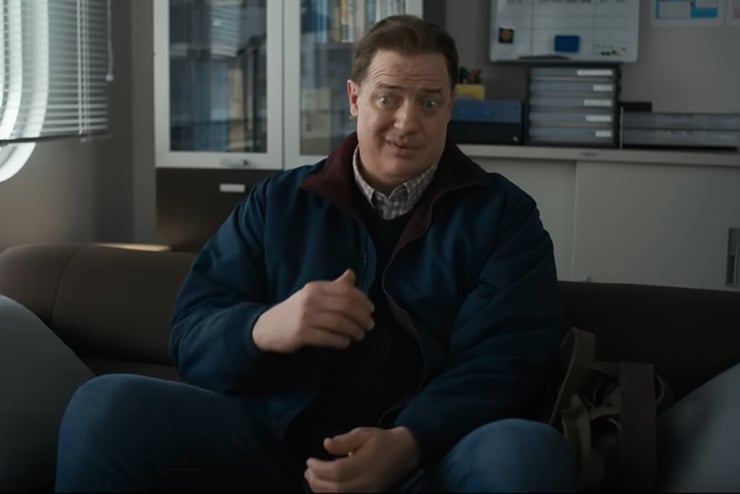
Fraser, somewhat ironically, plays failed actor Phillip Vandarploeug, who struggles to land gigs as an American expat in Japan. He’s fluent in Japanese and culturally aware of his surroundings but has only starred in commercials. Pressed for work, he accepts an unconventional acting job in which he plays real-life roles as friend, family, and lover for people struggling to find real, organic connections.
Right away, the cultural clash is clear. In Japanese culture, where emotional repression is the norm, this is a practical coping mechanism. An actor like Phillip can fill an emotional hole in someone’s life and mitigate that person’s need to ruminate on personal distractions in a notoriously duty-oriented society. But Phillip doesn’t quite get it, thinking of himself as a cure for malaise rather than just a Band-Aid. He approaches his role from the vantage point of American therapy culture, where never-ending rumination is considered a key to happy living. When he’s hired to play the role of a little girl’s father for the simple purpose of getting her into a private school, he gets too close, fostering a genuine connection and making personal sacrifices in the way a real father would. He takes it upon himself to save the girl from a culture that says she must grin and bear the trauma of life without a father.
“You could live in this country for 100 years, and there would still be things you don’t understand,” the agency owner tells him.
At its core, this is what Rental Family is all about, and it’s reminiscent of another film about American malaise in Japan: Lost in Translation. The latter works precisely because it doesn’t choose a side in the clash of civilizations. The characters played by Bill Murray and Scarlett Johansson are coddled and affluent, but the complexity of their emotional needs stand out more profusely against the backdrop of Japanese sterility. Rental Family fails for the opposite reason: it chooses the American way without even realizing it.
Hikari chooses the American way under the guise of universal human experience. The arc of the film unfolds as the agency employees and the little girl’s mother all realize that Fraser’s emotional instinct is correct—that what they’re doing is harmful and fake, and that no lie, no matter how endearing, can ever make up for the real emotional fulfilment people need in life. We’re meant to take this as simple truisms like “all children want to be loved” and “all men want to be providers,” but in reality, it boils down to the choice between one lie or another.
The Japanese lie is to convince yourself everything will be fine even when your emotional needs are not met. The American lie is to convince yourself that your emotional needs both can and must be met at all costs, and only then do you have a chance at happiness. Is one of these lies really better, truer, or more likely than the other one to lead to the good life?
That’s certainly debatable. Assessing values within their social and historical context is the basis of cultural particularism, and in the age of homogenizing globalism it’s seems a good thing that different cultures still maintain genuinely diverse thoughts about key philosophical questions like this one. But it’s not even the clear preference for liberal Americanism that makes Rental Family so annoying; it’s the process—the struggle—of positing that one must choose at all.
This struggle, more than Pepsi or pop music, is liberal America’s key cultural export: self-hatred and the valorization of the “Other.” There’s nothing more American today than to performatively dissect one’s own culture under the guise of critical rationality, only to arrive at the inevitable conclusion (really, preconception) that any culture other than one’s own is superior. Europe is clearly infected with this mind virus, and seems like it is trying to outdo America in adopting our pathologies. Third-world chauvinism persists, of course, along with the authoritarian models of China and Russia. But Japan is perhaps the only nation left on Earth that meaningfully differs from our own without threatening hostile displacement.
It’s sad to see a film enmeshed in Japanese culture cave so thoroughly to the worst impulses of American life. Because as an American nationalist, I would like to see all allied nations live on their own sovereign terms: I want to see Japan stay Japanese as much as I’d like to see American films go back to valorizing the heroic masculine archetypes of Brendan Fraser’s early films.
Leave a Reply