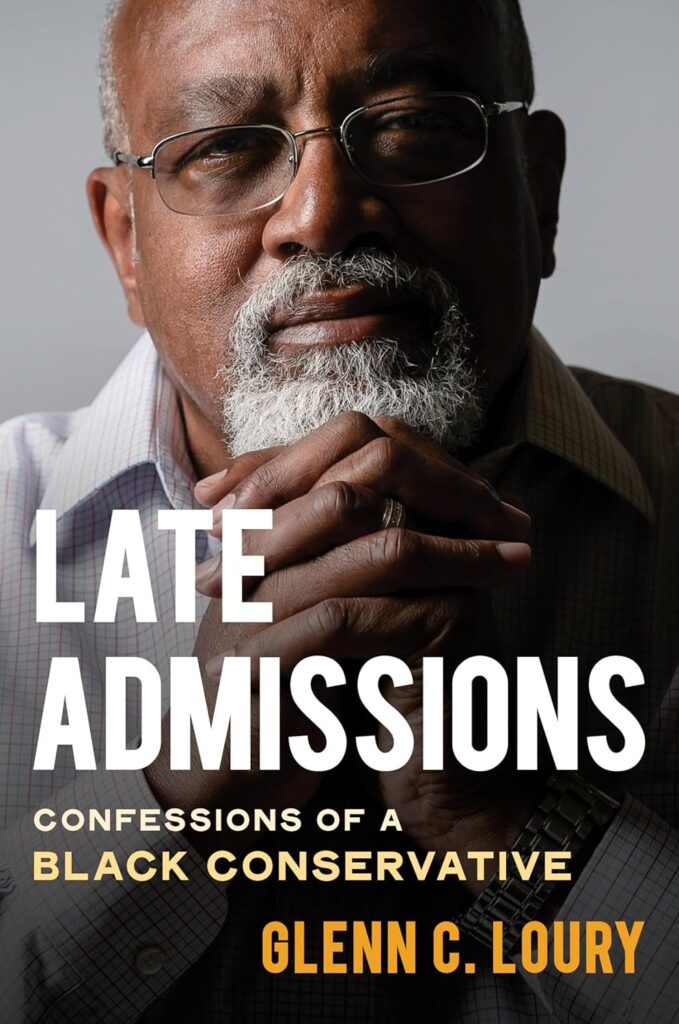
Late Admissions: Confessions of a Black Conservative
by Glenn C. Loury
W. W. Norton & Company
448 pps. $19.99
There is no literary genre I find more fascinating or, potentially, more enlightening than the intellectual autobiography. An intellectual committed to an honest interrogation of his own origins can reach heights of description and explanation impossible for another researcher. Glenn Loury, the well-known conservative economist and public intellectual, has given us a captivating example of what can be done with this genre.
Late Admissions sheds light on Loury’s experience with both sides of the divide in the black lower classes described more than a century ago in W.E.B. DuBois’s The Philadelphia Negro. There is a black underclass, which has surrendered to hedonism, irresponsible sexuality, abuse of alcohol and drugs, and criminal activity. Opposed to it is the aspiration, work ethic, and bootstrap do-it-yourselfism of the respectable black working class.
Loury’s Aunt Eloise is the chief representative of the latter in his life, and the author was fundamentally shaped by his exposure to this class and its culture. But the underclass culture marked him as well. His parents divorced early in his life, and infidelity was at the root of it. This social problem, which Loury acutely recognizes as an endemic aspect of the black underclass, would come to greatly burden his own later life. He describes his mother straightforwardly as a voluptuous man-eater incapable of commitment. His father was a stern disciplinarian who admired General Patton, but Loury’s uncles were locally celebrated womanizers whose abilities as “players” became the author’s aspirations in his early life.
Loury’s youth was marked by the promise of intellectual ability but also by the magnetic pull of the world of the pool hustlers. An early girlfriend ended up pregnant, and Loury was advised by his parents not to marry her. This was not the only questionable advice emanating from his mother and father. They also chose against sending Loury to a University of Chicago-sponsored school for the gifted to which he won a scholarship because, he suspects, they feared it would distance him from black culture.
His early trajectory, then, was away from Aunt Eloise’s world of black respectability. By his early 20s, he had had a second child with the woman who eventually became his first wife, and then a third, a son he abandoned entirely, with another woman. He dropped out of the community college he had been distractedly attending. His reflections on his abuse of drugs and his serial infidelity will sound unbelievable to readers who have not personally witnessed this kind of anti-social and self-destructive behavior. He was arrested for crack cocaine possession and subsequently smoked the drug inside the facility in which he was ordered to undergo residential rehab. He cheated brazenly on his first two wives, taking other women on foreign trips, even setting one up in an apartment for convenient trysts.
He recounts all of this in detail, knowing it reflects poorly on his early self, even including as additional ammunition for his critics the anemic rationalizations he invented at the time for the harm he did. It is remarkable that he emerged from this to become the man he is now, rather than living out that chaos to its typically sad and premature end.
But America did not doom him to that fate. Once he began to apply himself rigorously to academic work, his ability in mathematics won him admission to Northwestern, where he discovered economics. After earning a PhD at MIT, he moved quickly upward in the academic game. His early work placed him on the political left, and he made a reputation in the black leftist intellectual establishment.
One of his most significant contributions to economic theory proposed to mathematically demonstrate how income transfers from upper socioeconomic classes to those at the bottom of the hierarchy raise productivity. This is because of the improvements this brings to the early lives of poor children, who will in theory subsequently contribute more to the economy over their lifetimes.
Living near the crack-fueled criminal anarchy of Detroit in the 1980s as a professor at the University of Michigan changed Loury’s view on the legacy of the civil rights movement. There, he saw black urban violence up close, and his thinking on solutions to the disparities afflicting blacks shifted to the right. He began to more fully understand how deeply culture, so difficult to capture in economic theory, shapes the situation of black America.
Under the sponsorship of Bill Kristol, Loury transitioned from a purely academic career to that of a neoconservative public intellectual. Interestingly, his ideological transformation did nothing to alter his moral transgressions. He tried to justify his marital infidelities to his friend Richard John Neuhaus (the editor of First Things magazine) by invoking the example of Martin Luther King, Jr. Neuhaus, who had worked closely with King, would have none of it. He reminded Loury that King’s inability to control his sexual desires caused great damage to the movement. If one would move a culture, one must aspire to sainthood.
In the aftermath of the inevitable implosion of his sexual and illegal drug adventures, Loury returned to the Christianity of his youth and underwent conversion to an African Methodist Episcopal church. Though this had positive consequences curbing his drug abuse, he could not embrace the effervescent spirituality in that form of Christianity. His progressive distancing from the faith crystallized when his young assistant, a member of his church, died of cancer. Loury was unable to understand how other church members saw her death as a celebration of her transition to a better world. The ability to come to fully believe the central doctrine of Christianity, Christ’s vanquishing of death, escaped him.
In the mid-1990s, Loury moved away from the neoconservatism that had marked his thought for the previous decade. He points to the publications of three books that caused him to rethink his critique of the left’s approach to solving racial inequality: Charles Murray and Richard Herrnstein’s The Bell Curve, Dinesh D’Souza’s The End of Racism, and Stephan and Abigail Thernstrom’s America in Black and White. In Loury’s view, these books downplayed the situation facing underclass blacks and even contributed fuel to anti-black prejudice.
Post-Trayvon Martin and the rise of Black Lives Matter, Loury returned to the political right, which he says was perhaps his true position all along. And yet he admits a sense of loss in no longer having the black cognoscenti, overwhelmingly leftists, cheering him. At the end of the day, we all want to make our people happy, even when we know their imperfections well. It is a struggle to adhere to the pursuit of the truth in the face of the disappointment of those whose love we desperately desire.
There is much overcoming in this book, but also much sadness, even in its culminating pages. Loury’s long-suffering second wife Linda suffered a lengthy decline and death from cancer. He does not hide from us that he was cheating on her even while she was battling the disease. He tells us also with regret about the estrangement from his father that was not resolved before the latter’s death.
Late Admissions is not a sociological study of how underclass black culture presents obstacles to black male achievement and how those boys and men do and do not struggle against them. It does show, however, the ways such forces operated on the sample set of one, that is Glenn Cartman Loury, and how that individual responded.
Loury’s book is thus a useful illustration of a principle for which its author has long advocated in his life as a public intellectual. Yes, the black underclass faces challenges in their own subculture and the social disorganization of their communities. But determined individuals can survive that environment and right their lives. Loury’s account makes clear that familial and communal exemplars—for him, the part of his family represented by Aunt Eloise—are of tremendous help here. But it also follows from his narrative that without their own deep commitment to that work, no measure of effort by others will save those struggling in the ways he struggled.
Perhaps the most important accomplishment of Loury’s book has to do with the autobiographical truth-telling project. He knows well such a project is a gamble precisely because it reveals things about him that readers cannot but judge poorly. Telling the kinds of truths Loury tells takes considerable courage.
One source of that courage may be in the promise that such a book could potentially help other young people faced with circumstances not unlike the author’s. I certainly hope that some such readers will be inspired by this book to avoid Loury’s missteps. And if they have already made those mistakes, the book might help them refrain from blaming them on a ghostly system and instead take responsibility for all of it, as Loury does, and work to overcome those consequences and the lesser parts of themselves.
As both a writer who has tried to bring reasoned light to the question of how people at the bottom of social hierarchies can rise and someone with his own past struggles, I deeply appreciated Late Admissions. Much of it made me wonder if everything I thought I knew about Loury was mistaken. I often wished for more remorse from him, especially regarding the ways he hurt those close to him. But then I was drawn to think of how some who superficially know me might be equally shaken in their confidence and demanding of penitence were they to know of some of the foolish acts in my past.
In the end, readers will judge him as they will. My view is that he is one of the most interesting figures in American public intellectual life today, and I am thankful he made it through.
Leave a Reply