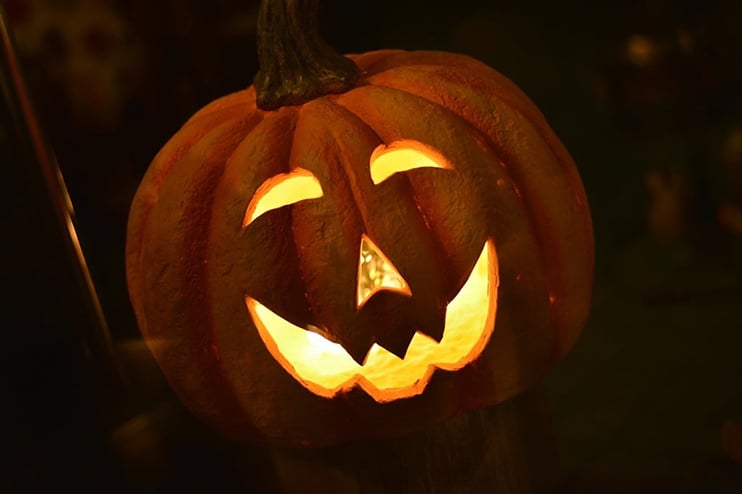
With fall season in full swing and Halloween approaching, the annual public debate over the correct way to celebrate the holiday (or not to) is raging once again. What was once a simple matter of plopping down a few Jack-o-Lanterns and strewing fake cobwebs in the trees has quickly evolved into the annual ritual of transforming one’s front yard into a fully immersive haunted house—complete with strobe lights, animatronics, life-size mannequins, and a host of other displays designed to terrify trick-or-treaters and impress the neighbors.
The excess itself is not the source of concern, but rather the explicit gore often depicted in these decorations. For the whole month of October, supposedly family-friendly neighborhoods are pockmarked with graphic exhibitions of dismembered torsos, twitching bodies, severed heads smeared with fake blood, grisly murders in action, and other scenes of horror, complete with the accompanying sound effects (screaming, stabbing, howling, etc.). While neighbors might complain about such houses, especially families with small children, they are usually forced to tolerate these miniature hellscapes for a month.
Wannabe horror film directors think they are doing their neighborhoods a service by spending thousands of dollars on a public attraction. Besides, this is America, they argue, and they should be free to indulge their passions and decorate however they wish. If people have a problem with that, these Halloween enthusiasts suggest they are guilty of being overprotective, or worse still, showing intolerance for people with different tastes.
The online public square offers little guidance for those in search of a limiting principle or appropriate middle ground between these two warring Halloween factions. The increase in the numbers of childless adults moving into communities originally designed for families assures us that things will likely get worse before they get better. This is their world now, and if the way they want to find joy in life is by blowing their whole paycheck at the Spirit Halloween store, so be it.
Does that mean that the only choice for parents not wanting to explain the disemboweled clown laughing as it scoops up its own entrails is to participate in a Disneyfied “trunk-or-treat” event? This was the other debate that popped up this Halloween season. In recent years, churches and schools have popularized these events, where families dispense candy to trick-or-treaters from the trunks of decorated cars in the parking lot. The idea is to provide a safe and wholesome alternative for families who may feel uncomfortable traversing their own neighborhoods on Halloween.
There are plenty of good reasons for people to rebel against the trunk-or-treat phenomenon, too. All too often, for example, these events veer to the opposite extreme, robbing Halloween of anything scary or distinctive. Parents of toddlers and babies might enjoy a quick candy-collecting jaunt in a well-lit location, making small talk with some church friends, and putting their children to bed at a reasonable hour, but the adventure and mystery are all but nonexistent for kids past those tender years. To put it more bluntly, trunk-or-treat is really lame, and the kids all know it.
Just as with the debate surrounding over-the-top Halloween displays, the case for and against trunk-or-treats is likely to remain unresolved. In many ways, overprotective parents who can’t resist the convenience of these anodyne events are just a counterpart to the childless adults who obsess over Halloween. For better or for worse, they make up the majority of today’s young parents—and they are usually the ones setting the terms for what is “appropriate” for children.
Lost is any serious reflection upon America’s traditional way of celebrating Halloween and what we are sacrificing in forgetting it. As I argued four years ago, when Halloween was haunted by not only by the usual ghosts and ghouls but by COVID paranoia, preserving and celebrating the holiday of Halloween in all its richness ought to be our guide. Subjective arguments about whether people are going too far with their decorations or coddling their little trick-or-treaters are far less important or interesting than striving to maintain the basic rituals and civic purposes connected to Halloween.
While the other holidays in America have fallen prey to politicization or crass commercialization, or are exclusively religious, Halloween up until now has always been the kind of holiday that brings disparate elements in a community together. It began as a religious holiday, All Hallows Eve (the day before All Saints’ Day), but it has morphed into a secular folk tradition. It’s the one time of year people from all backgrounds get to put on costumes—at least partially obscuring their true identities—and go out and actually see their neighbors in person.
More than the unhealthy extremes that some people adopt during Halloween, it is likely this very uniqueness of Halloween that bothers certain individuals about the day. Either they find it weird to visit other people’s houses and ask for candy, or they find it weird to enjoy mocking the horror and death that should have no power over us. If this is what drives their outrage, then they are wrong and should be ignored.
The ongoing atomization of America and the hollowing out of its culture make it more critical than ever to defend Halloween. This means focusing on its virtues while handling its occasional challenges with delicacy and prudence. No one should let the people on the fringes take over what is central to the holiday. In the interest of being good Americans and good people, we should decorate our houses (in moderation), give out (good) candy to trick-or-treaters, and enjoy the spookiness (and localness) of the holiday.
Leave a Reply