
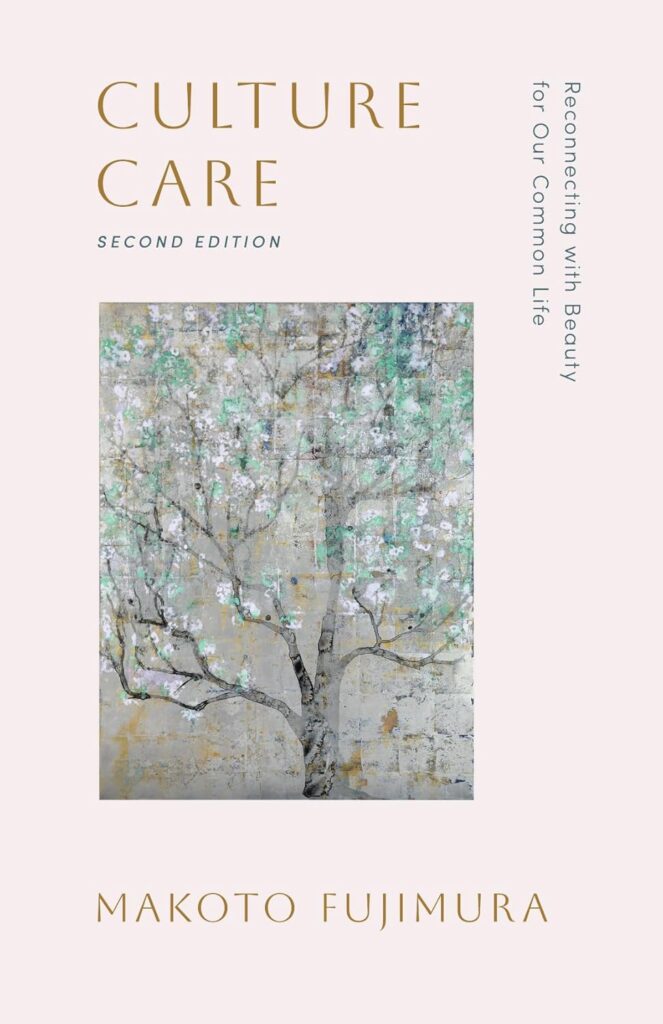
Culture Care: Reconnecting with Beauty for Our Common Life
by Makoto Fujimura
IVP
176 pps./ $22.99
In July, the second edition of Makoto Fujimura’s book Culture Care: Reconnecting with Beauty for Our Common Life will be published. I have an advance copy (the first edition can be downloaded here). Culture Care is a beautiful and important work that should be of special interest to Christians and conservatives engaged in the culture war.
The thesis of Fujimura’s book is that culture is a garden to be cultivated, not a war to be won. Human souls need culture and beauty to thrive. Culture is “generative.” Based in beauty, culture at its best produces light, heat, passion, and love. We need more of it, and we need to cross cultural boundaries to make it flourish.
Moreover, culture’s most essential element is God. Fujimura is a devout Christian who believes that the primary generator of culture and beauty is Jesus Christ, who is generative and “gratuitous” with beauty and creation. “Our sense of beauty and our creativity are central to what it means to be made in the image of a creative God,” he writes. “The satisfaction in beauty we feel is connected deeply with our reflection of God’s character to create and value gratuity. It is part of our human nature.”
Culture is generative and life-giving. “When we are generative, we draw on creativity to bring into being something fresh and life giving … What is generative is the opposite of degrading or limiting. It is constructive, expansive, affirming, growing beyond a mindset of scarcity.” He goes on:
As I’ve developed this thesis, I have come to realize that at the heart of culture care is my desire to know the full depth of the gospel of Jesus Christ. What is the “good news”? The reductionism of our modern assumptions has caused the gospel to be truncated, limited to pragmatic and tribal concerns rather than the good news of the whole of the Bible—true life, the never-ending restoration and new creation of all things in Christ.
Contrary to the usual rant on the right, when one steps away from the internet and actually goes out to explore American culture, it’s easy to find beauty, generative artistry—and Jesus. I recently saw two live music shows that had very different aesthetics but at the heart of each was the kind of generative energy Fujimura describes. One was a jazz concert by the Tord Gustavsen Trio at the Strathmore Music Center in Maryland. The other was a performance by the Barco Beat, a gritty cover band playing at Hank Dietle’s Tavern, a roadhouse joint near Strathmore.
In fact, the Strathmore Center and Hank Dietle’s are virtually across the street from one another on the Rockville Pike. The Strathmore Center is a resplendent $100 million court hall with a gleaming kitchen and wine bar. The jazz recital was in the Mansion at Strathmore, a smaller facility from the main hall. The Mansion is a gorgeous turn of the century former home that has been transformed into an arts space, with recitals and a gallery of paintings. Hank Dietle’s was described by writer Eddie Dean this way: “The bar is a dimly lit, one-room, linoleum-floored clubhouse with dark wood-paneled walls cheered by strings of low-watt holiday bulbs. The feel is midcentury rec-room deluxe, a cozy time capsule from the era when Elvis dwelt among us.”
Yet in both places, just one day apart, generative, beautiful culture filled people’s souls. On Saturday night, the Barco Beat energized its dancing audience with covers of classic blues, country, and rock ‘n roll songs—Otis Redding, Buddy Holly, “Spirit in the Sky,” Talking Heads, R.E.M., and a great cover of “Behind a Wall of Sleep” by the Smithereens. The capacity at Hank Dietle’s is about a hundred people, so on a packed Saturday night you find yourself squeezed together with all kinds—country folks, lawyers, plumbers, journalists, everybody. There’s sweat and spilt beer and laughter and fun. Personal space doesn’t really exist.
The next day, a Sunday, the Tord Gustavsen Trio played across the street at the Strathmore Center. I interviewed Gustavsen recently for Chronicles, both of us were pleased that we could have a conversation about how Christianity influences his art. Usually in the media you can’t talk about God. His concert at Strathmore was brilliant, combining gospel, blues, J. S. Bach, electronic sounds and free-form improvisation. Gustavsen told the audience his group loved to be free to explore—that, as one of their songs puts it, they like to be “wide open.” They closed with the lovely “Seattle Song.”
In Culture Care, Makota Fujimura describes people who navigate the worlds of different cultures, most notably Christians who walk in the realms of both the gospel and the art space. He calls these people “mearcstapa,” a term found in Beowulf and translated from the Old English as a “border-walker” or “border-stalker.” These are characters in medieval stories who “lived on the edges of their groups, going in and out of them, sometimes bringing back news to the tribe.” Fujimura encourages the Christian church to become a society of border-stalkers. When a group’s mearcstapas do their job well, subcultures develop empathy and seek reconciliation with others. Peace and flourishing happen. Art flourishes.
If there is a problem with Culture Care, it is that Fujimura, the leader of the IAM, International Arts Movement, and the Director of the Brehm Center at Fuller Theological Seminary, is reluctant to challenge the left and what it has done to damage culture. “It is widely recognized that our culture today is not life giving,” he writes.
There is little room at the margins to make artistic endeavors sustainable. The wider ecosystem of art and culture has been decimated, leaving only homogeneous pockets of survivors, those fit enough to survive in a poisoned environment. In culture as in nature, a lack of diversity is a first sign of a distressed ecosystem.
Fujimura writes that “culture is a garden to be cultivated,” but like the Garden of Eden, thing have gone wrong. “The paralysis stemming from culture wars has decimated the fundamental trust in ‘the other,’ and we are unable to move beyond the conflict,” he argues.
Yet the “lack of diversity” only goes in one direction. Fifty years ago, William F. Buckley was a regular guest on Johnny Carson. Today’s late-night TV is all political lectures rehashing the same left-wing talking points. Movies now are mostly garbage, despite the fact that the people still want films like Project Hail Mary, a story diffused with Christian metaphors. Novels, written by MFA feminists, don’t appeal to men anymore, which is why men flock to books like Lonesome Dove, a western that is already 40 years old. Fujimura offers this:
Reminding people of our common life—that we are neighbors first—is a task of culture care. We acknowledge openly the borders of our groups and acknowledge too the legitimate things that divide us. Our responsibility, then, is to rehumanize this divide. An emphasis on our role as neighbor as part of our identity begins this process by reminding us of our shared cultural and geographical spaces and the fact that proximity brings responsibility. Even apart from Jesus’ call to love our neighbor, we know that our common flourishing depends on each other.
Does our common flourishing really depend on each other? Or does it depend on convincing rappers to sing about something other than money and sex and places like CNN and MSNOW to convert their programming to jazz and classical concerts? How about an NPR show dedicated to novels that appeal to men?
While conservatives and Christians don’t want to censor the “art” of the left, they also don’t support the arts as well as liberals do—in fact they barely support art at all. The former head of Amazon Studios, Roy Price, recently authored a piece in The New York Times arguing that it’s time to bring fun back to movies. I’ve spoken to Price several times, and after reading Culture Care I see my role as someone who grew up with the arts and knows that world, yet who loves Ronald Reagan and Pat Buchanan and may never really fit in with the folks who dominate either space. Fujimura:
Those who journey to the borders of their group and beyond will encounter new vistas and knowledge that can enrich the group. In The Lord of the Rings, J.R.R. Tolkien introduces the shadowy figure of Strider the Ranger at an inn in the homely village of Bree, where the comfortable and hospitable innkeeper warns the travelers not to trust him. Strider is a mearcstapa, and it is in large part his ability to move in and out of tribes and boundaries that makes him an indispensable guide and protector and that helps him become an effective leader, fulfilling his destiny as Aragorn, high king of Gondor and Arnor, uniting two kingdoms. He even marries across tribes with his union to Arwen, daughter of Elrond Half-Elven. Often artists are branded as “difficult people” in society, hard to pin down and notorious for being independent. In Tolkien’s story, the travelers accept Strider as a guide only when they receive a letter that vouches for him. But Strider might speak for many artists in his comment to his reluctant new friends: “‘But I must admit,’ he added with a queer laugh, ‘that I hoped you would take to me for my own sake. A hunted man sometimes wearies of distrust and longs for friendship.”
Leave a Reply