Last week, the Vatican took the unprecedented step of excommunicating all members of its traditionalist priestly faction, the Society of Saint Pius X (SSPX), and all the Catholic laity “attached” to the society, after the society’s unsanctioned consecration of four new bishops. At the time of the excommunications, the SSPX was the Catholic Church’s fifth-largest priestly society, with more than 700 priests, more than 700 seminarians and religious, and about 600,000 lay faithful, making it one of the largest mass excommunications in the history of the Church.
This was the second time the society had incurred an automatic excommunication for consecrating bishops against the Vatican’s wishes. The first excommunication of four newly consecrated bishops and SSPX founder Archbishop Marcel Lefebvre occurred in 1988, after Lefebvre’s appeals to be allowed to create new bishops were ignored. In the Catholic Church, bishops with apostolic succession tracing back to Christ’s apostles are required for the ordination of new priests. Unlike the limited excommunications of 1988, which were lifted in 2009 by Benedict XVI, last Thursday’s mass excommunications extended well beyond what is called for in canon law, signaling the Vatican’s intention to teach Catholic traditionalists a punishing lesson.
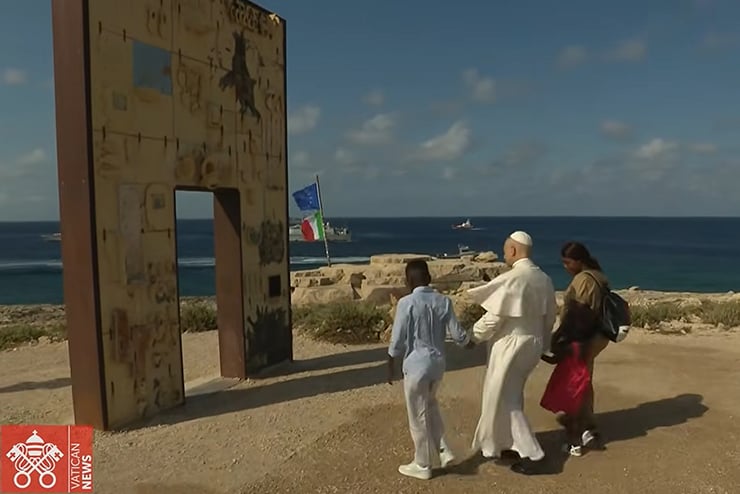
One day after the excommunications, Pope Leo XIV visited the southern Italian island of Lampedusa to stage a symbolic photo op in front of the “Gateway to Europe” monument, where he welcomed migrants from Africa to Europe. The pope chose the day of his visit, July 4, to make a political statement intended for both European governments trying to stem the flow of illegal migration and Americans celebrating Independence Day.
“Defending human life also includes welcoming, protecting and assisting immigrants, whose hopes, sacrifices and contributions have formed part of the history of this country from its very beginning,” Leo XIV said in a letter to Americans marking the 250th anniversary of the founding of the United States. “To receive them with compassion and generosity is not only an act of charity, but also a recognition of the dignity that belongs to every human person.”
The excommunications come at a time when heresy, disobedience, and scandal are rampant within the Catholic Church and almost never punished when they are perpetrated by the Church’s progressive faction. Moreover, the pope’s campaign for open borders on the island of Lampedusa comes after a decade of mass illegal immigration, migrant crises, and violence perpetrated by immigrants throughout the West. Under Pope Francis and now Pope Leo XIV, the Catholic Church has seemed more concerned with worldly left-wing political projects like mass immigration and climate change than with the Church’s traditional mission of saving souls. Even more troubling, Leo appears to be even more eager than his predecessor to crack down on Catholic traditionalists.
Consider who has not been excommunicated by the Church:
- The priests all over the world who now publicly celebrate LGBT masses, who bless unrepentant same-sex couples, and who excuse and even advocate for homosexual unions. Father James Martin has proposed rewriting the catechism to soften the condemnation of homosexuality and has been granted audiences with Francis and Leo. Cardinal Reinhard Marx, Archbishop of Munich-Freising, has instructed all priests and pastoral workers in his diocese to carry out blessing celebrations for homosexual marriages. Homosexual fornication is, according to both Christian Scripture and Tradition, one of the sins that “cries out to Heaven for vengeance.”
- The many bishops, priests, and theologians who openly reject the teachings of ecumenical councils prior to Vatican II as well as the teachings of the past popes who anathematized liberalism and ecumenism, who encourage women’s ordination, and who apologize for the Catholic Church’s proud missionary history across the world as if it were something shameful.
- The many Catholic prelates and faithful who reject all miracles, even the resurrection of Christ, and who publicly deny the true presence of Christ in the Holy Eucharist.
The SSPX, meanwhile, has attempted to remain in communion with Rome since its 1970 founding, while refusing to budge on what it says are contradictions between the perennial teaching of the Catholic Church and what the Church has taught following the 1965 Second Vatican Council. One major issue, among others, is the teaching expressed by modern popes and bishops that “all religions are paths to God,” as Pope Francis put it in 2024. It was Pope John Paul II’s 1986 interfaith religious meetings in Assisi, Italy, in which all world religions, including non-Christian and pagan tribal religions, were invited to worship alongside Catholics inside Catholic Churches that scandalized SSPX founder Lefebvre and convinced him to move forward with the first consecrations. The archbishop believed the statements and actions of the Church contradicted both the First Commandment (“Thou shalt have no other gods before me”) and Christ’s words in John 14:6, “I am the way, and the truth, and the life. No man cometh to the Father, but by me.”
Indeed, it often seems that according to the teaching of the modern Catholic Church, all men of all religions are saved, and thus there is no need to convert to Catholicism. The only people on the planet the hierarchy appears to condemn to eternal torment are the Catholic traditionalists, who affirm what the Church has always taught.
That may be why Catholic vocations outside of traditionalist groups are collapsing and Catholic parishes are consolidating to compensate for the lack of priests, such as in central Minnesota, where 83 parishes will be closed this year. After all, why undertake the long educational road to become a Catholic priest and commit to lifelong celibacy if it doesn’t really matter?
But the Holy Father seems to have different priorities. Last weekend, we saw him shaking hands with 20 migrants on the island of Lampedusa. Pope Leo’s visit retraces the steps of Pope Francis, who in 2013 also went to Lampedusa on his first trip as pope, as a symbolic gesture of the Vatican’s support for mass migration. The fact that the following years saw a disastrous influx into Europe of mostly Muslim migrants from the Middle East and Africa, particularly during the 2015 migrant crisis, does not seem to have affected the pontiff’s enthusiasm for mass migration. Nor do the suffering and cultural clashes inflicted by migrants on the native populations of what was once uniformly Christian Europe and America. This influx of Third World migrants has resulted in the deaths of many native Europeans and Americans, such as Henry Nowak and Laken Riley.
Pope Leo might have learned a lesson about the perils of blissfully receiving unassimilated immigrants from his predecessor, Pope Francis, who in 2016 welcomed the Rwandan immigrant Emmanuel Abayisenga to France with a hearty handshake. A few years following that welcome, Abayisenga burned down the cathedral in Nantes and beat to death an aged Catholic priest, Father Olivier Maire.
Such actions recall the historian Robert Conquest’s Third Law of Politics: “The behavior of any bureaucratic organization can best be understood by assuming that it is controlled by a secret cabal of its enemies.”
Leave a Reply