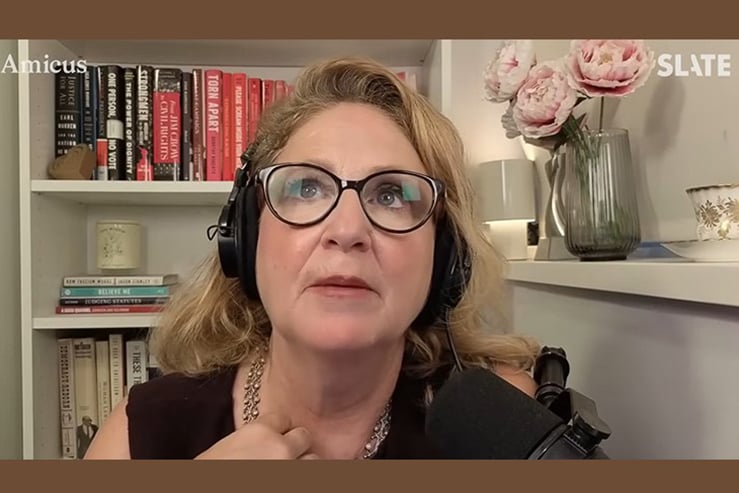
A lot of people in journalism are hypocrites, but Dahlia Lithwick, the Supreme Court reporter for the far-left site Slate, is a particularly striking and sickening example. Lithwick was outraged to the point of despair over the recent Supreme Court ruling preventing “transgender athletes”—i.e. boys—from playing on girls’ sports teams and invading girls’ private spaces.
In short, Dahlia Lithwick doesn’t care if young female athletes get hurt.
In his ruling, Justice Brett Kavanaugh noted the following:
In assessing the reasonableness of the regulations, we also must recognize the distinctiveness of competitive sports—and the safety and competitive fairness issues that can arise when females are forced to compete against males. With respect to safety, allowing biological males to play on women’s and girls’ sports teams can put women and girls at significant risk of injuries. The safety risks are particularly severe in contact sports.
Upon reading that language, Lithwick and her colleague Mark Joseph Stern were outraged and despondent. Lithwick called the ruling “tragically predictable.” She lamented that “we keep talking about one body blow after another to trans kids and trans college students. This is a body blow penned by Brett Kavanaugh writing for the majority.”
Mark Joseph Stern could barely speak, putting “biological woman” in scare air quotes. He is the perfect embodiment of the prevailing gay communist’s hatred of women. “I’m not even going to ask about Justice Thomas’s concurrence,” Stern announced, “It is just so contemptuous and contemptible. It beggars belief that he could write something like that.”
Lithwick concluded that Justice Kavanaugh’s “little mediation on the purpose of sports was a thing of horror.”
But if one wants to contemplate a genuine thing of horror, then consider the allegations against Becky Pepper-Jackson (B.P.J.), the “transgender girl,” that is to say the boy, who brought the case before the Supreme Court. From Fox News:
West Virginia high school track athlete Adaleia Cross is joining a national Title IX lawsuit after alleging a transgender 13-year-old teammate sexually harassed her during practices and in the school’s locker room.
B.P.J., which is how court documents refer to the transgender athlete at the center of the allegations and another West Virginia lawsuit, allegedly made “several offensive and inappropriate sexual comments” to Cross throughout the school shot put season. The interactions allegedly escalated to more “aggressive, vile, and disturbing” comments during Cross’s final year of middle school. B.P.J is a biological male who identifies as a female.
“During the end of that year, about two to three times per week, B.P.J. would look at me” and make a sexually explicit vulgar comment, Cross alleged in the lawsuit filed May 8. “There were usually other girls around who heard this. I heard B.P.J. say the same thing to my other teammates, too.”
Lithwick never mentions nightmares like these that girls have been forced to endure. She did, however, decide to leave her Supreme Court beat in 2018 due to her supposed trauma as a result of covering the Brett Kavanaugh nomination. As she wrote in 2019:
It’s been just over a year since I sat in the hearing room and watched the final act of Brett Kavanaugh’s confirmation hearing. I listened from the back as Christine Blasey Ford and then-Judge Kavanaugh each faced the Senate Judiciary Committee to tell irreconcilable versions of what happened in the summer of 1982. The morning was spent as I’d anticipated: all of us—the press corps, the country—listening, some clearly in agony, to Ford’s account. And then Kavanaugh came in and started screaming. The reporters at the tables around me took him in with blank shock, mindlessly typing the words he was yelling.
The enduring memory, a year later, is that my 15-year-old son texted—he was watching it in school—to ask if I was “perfectly safe” in the Senate chamber. He was afraid for the judge’s mental health and my physical health. I had to patiently explain that I was in no physical danger of any kind, that there were dozens of people in the room, and that I was at the very back, with the phalanx of reporters. My son’s visceral fears don’t really matter in one sense, beyond the fact that I was forced to explain to him that the man shouting about conspiracies and pledging revenge on his detractors would sit on the court for many decades; and in that one sense, none of us, as women, were ever going to be perfectly safe again.
In fact, Lithwick’s coverage of the 2018 Kavanaugh nomination was hysterical propaganda. “Fear a Justice Brett Kavanaugh” one headline screamed, adding in a subhead that “as his confirmation steamrolls ahead, Americans should be terrified.”
She went on:
With the Senate Judiciary Committee moving on Friday to advance Kavanaugh’s nomination to the full Senate without any further inquiry around Blasey Ford’s damning and plainly credible testimony that Kavanaugh had gleefully and drunkenly sexually assaulted her at a 1982 house party as his buddy Mark Judge watched, it appears as though his rage alone will have been enough to earn him life tenure on the highest court in the land.
When the FBI cleared Kavanaugh, Jonathan Turley noted that Slate’s Dahlia Lithwick
may have set a record for “sham” references (six) in a single short column, declaring that ‘because the shamming … happened openly, the revelation that it was shamatory feels underwhelming. We have become so inured to all the shamming in plain sight that having it confirmed years later barely even feels like news.
It was all too much for Lithwick and, as a result, she had to stop doing her job:
I haven’t been inside the Supreme Court since Brett Kavanaugh was confirmed. I’ve been waiting, chiefly in the hope that at some point I would get over it, as I am meant to do for the good of the courts, and the team, and the ineffable someday fifth vote which may occasionally come in exchange for enough bonhomie and good grace. There isn’t a lot of power in my failing to show up to do my job, but there is a teaspoon of power in refusing to normalize that which was simply wrong, and which continues to be wrong. I don’t judge other reporters for continuing to go, and I understand the ways in which justices, judges, law professors, and clerks must operate in a world where this case is closed. Sometimes I tell myself that my new beat is justice, as opposed to the Supreme Court. And my new beat now seems to make it impossible to cover the old one.
As most readers know, I was the Mark Judge that Christine Blasey Ford claimed witnessed Kavanaugh assaulting her. Lithwick was mentioning my name a lot in 2018, but in the ensuing years she has shown no interest in my articles for Chronicles that debunk the Blasey Ford narrative, provoked contrition and a near-apology from a New York Times reporter, and revealed the people behind the opposition hit on us.
One more point which may be the most important one. In 2024 Fox Nation interviewed me for a documentary. The interviewer, Martha MacCallum, asked me about people who were saying that even if Kavanaugh and I were guilty, it wasn’t really that big a deal. Teens, especially in the 1980s, partied a lot, and Brett made a pass at a girl, they said. It happens, it’s not really a big deal. I immediately objected. First, the accusation was false. Secondly, it is a big deal. If Brett and I had caused a teenage girl to be frightened for her safety, I would see that as a very big deal. So is lying.
They weren’t expecting that answer. They thought I would deny the legitimate concern of girls not to be harassed or assaulted to serve my own side. I would not do that. I didn’t say what I said to McCallum because I’m a saint, but because it truly reflects my views. I don want to see a girl get hurt, no matter what the cost to my “side.” Dahlia Lithwick, who in my estimation participates in evil, has no such small courage.
Leave a Reply