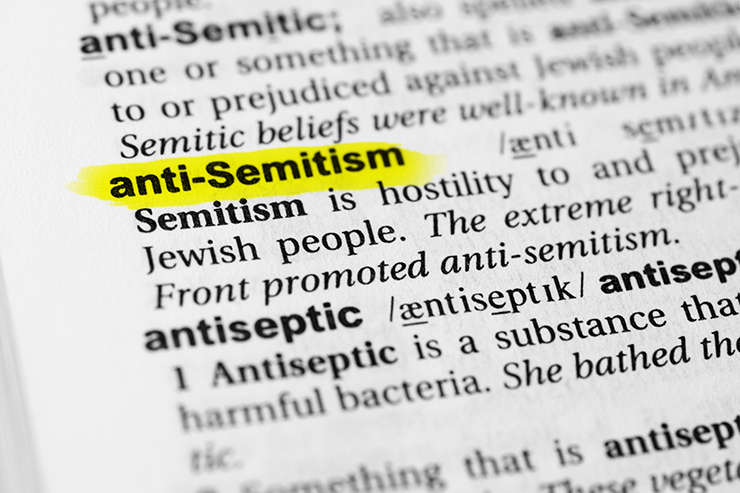
Since Israel’s long-time supporters like Mark Levin and Douglas Murray have recently been charging its right-leaning critics with “anti-Semitism,” it might be helpful to investigate their use of that term.
Given that the slur “anti-Semite” is being flung around with increasing frequency, one might think anti-Semitism refers to a readily identifiable phenomenon, a recognizable thing. When, however, we consider that everyone from Adolf Hitler and Adolf Eichmann, to the (overwhelmingly Jewish) authors of the New Testament, to Ron Paul, Tucker Carlson, Candace Owens, and Dave Smith are now said to be anti-Semitic, it becomes obvious that anti-Semitism is not a singular entity, but something else.
Anti-Semitism has been identified as the cause for the systematic elimination of Jews by the Third Reich. Yet it is also assumed to be the cause of all the following:
- any questioning of the official number of Jews murdered in Nazi Germany;
- criticism of the Jews in the New Testament;
- criticism of Israel for its post-Oct. 7, 2023 actions in Gaza;
- criticism of Israel for America’s military interventions in the Middle East;
- any unfavorable reference to Israel;
- not liking the lobbying activities of the American Israel Public Affairs Committee (AIPAC);
- merely believing “neoconservatives” exist, (unless they themselves say that they exist);
- Mel Gibson’s The Passion of the Christ;
- noticing that Jews are disproportionately represented within culturally influential institutions;
- believing that America’s alliance with Israel could involve it in otherwise avoidable wars;
- opposing all foreign aid—including aid to Israel; and
- university administrators allowing pro-Palestinian protests on campus.
It should be obvious that this list of activities and thoughts said to be anti-Semitic consists of things that have no necessary relationship to one another. Hitler and Eichmann don’t seem to have much in common Ron Paul or Tucker Carlson, regardless of anything else one may think of them.
For that matter, it is ridiculous to suggest that an American citizen who doesn’t want his hard-earned dollars used to subsidize Israel (or any other nation) must be guilty of the same thinking as Nazi mass murderers. But this conclusion arises from the belief that anti-Semitism is a unitary corruption of the soul.
Anti-Semitism, however, doesn’t seem to refer to just one thing. It appears that there is no essence here, no oneness. We are speaking rather about a label that’s ascribed to a multitude of utterances and behaviors that all decent people are supposed to condemn—at least once they are told that these things are “anti-Semitic.”
Unquestionably, there are some indecent critics of Israel. Those who harass, intimidate, threaten, and assault Jews and others, who wreak havoc on university campuses, block traffic, and fight with law enforcement officers while waving the Palestinian flag and chanting pro-Palestine mantras are guilty of crimes. Among their number, there certainly exist some who possess a little more than raw hatred of Israel, and perhaps of Jews generally.
Even so, the label of anti-Semitism, to the extent that it merely impugns the character of those at whom it’s been hurled, contributes little to the discussion. Even if every critic of Israel’s campaign in Gaza, or every critic of “Jewish influence” more broadly, is a ravenous despiser of all things Jewish, the label does not necessarily give us any informational or logical bearing on their critiques.
Finally, imagine that you were informed that someone dislikes you and that this person wishes for every manner of harm to befall you. Do you think your immediate response would be to say, “Ah, ha! Well, there you have it! That person is a Me-hater! That explains everything!” It’s true that the person may hate you and that he may be quite irrational in that hatred. But if one has any hope of dissuading him, one might also be interested in finding out the reasons for his hatred.
Those reasons, mind you, may be warranted or unwarranted. The person who hates may be misinformed, deceived, or even demonically possessed. Still, hatred is the effect, the consequence, of other considerations that the person being targeted may want to investigate, if only for his own safety.
It’s not that hatred can’t be a cause of the actions the hater takes. Of course, it can and often is. But it is not a “first cause,” or an “uncaused cause”—even when the hatred is completely irrational. However, this is how anti-Semitism is depicted when people are deemed guilty of this enormity. They are carrying a deadly and unexplainable disease and should be immediately quarantined.
For several generations now, the inhabitants of the West have been conditioned to think that the appeal to anti-Semitism, like appeals to “racism,” “sexism,” and a plethora of other “-isms” and “phobias,” is in itself a substantive, thoughtful replacement for sober intellectual analysis. If not for this intergenerational conditioning, those who fancy themselves adults, to say nothing of those who pride themselves on being intellectuals, would be embarrassed by this attempt to prevent exchanges over complex issues by engaging in name-calling. Exchanges here, as in so many other cases under the reign of political correctness, have come down to attacking one’s opponents as “hateful.”
First year college students enrolled in Logic 101 learn quickly about the ad hominem (“to the person”) argument Aristotle long ago numbered among the logical fallacies. It seems the agenda-driven influencers of our day would have us think that they are oblivious to this illogic.
Leave a Reply