Billionaire philanthropist Marc Rowan published a “guest essay” last week in The New York Times with the title: “Academia Is Broken. Trump’s University ‘Compact’ Can Help Fix It.” Rowan, a University of Pennsylvania graduate and trustee who helped push the resignation of disgraced former president M. Elizabeth Magill after her disastrous response to the Oct. 7, 2023, attack on Israel by Hamas, has been instrumental in formulating terms of conduct that the Trump administration offered to nine universities earlier this month.
Rowan’s essay is blunt. He says our system of higher education is “broken”—that it neither educates students nor serves the public good. As it no longer accomplishes either of these missions, he questions whether it should be entitled to the multibillion-dollar gravy train of taxpayer funds and other privileges it has enjoyed, without question, up till now. He gives a sharp critique of the sick culture of ballooning costs, poor practical outcomes, overreliance on foreign enrollment, ideological conformity, and hostility to dissent. He presents the compact—a widely denounced Trump initiative—as a surefire way for institutions to “return to their proper mission.”
Only a few months ago, the former paper of record might well have denounced Rowan as a dangerous right-wing radical and accused him of calling for higher education’s abject surrender to the dictates of an authoritarian regime. This is, after all, the same New York Times that in February accused Trump of wanting “to destroy all academia, not just the woke parts.” It is the same outlet that hailed Harvard’s president Alan M. Garber as a “hero” for initially resisting Trump administration demands on its governance (Harvard, which has already caved to some of those demands, is now in talks with the administration to pay a fine of up to $500 million to atone for its sins).
In May, the same editorial page on which Rowan excoriated higher education, platformed Harvard professor Steven Pinker who, despite his own critiques of the industry, concluded in a gushing essay that Trump’s policies would “cripple the institutions that acquire and transmit knowledge.” Pinker called Trump’s policies “a tragic blunder and a crime against future generations,” an attitude he mocked as “Harvard Derangement Syndrome.” Now, however, it is Rowan and his Trump-aligned ideas that the leftist paper is platforming, despite the unhappiness of a staff not much changed from the one that in 2020 forced out former Times opinion editor James Bennet for having dared to publish a discordant op-ed penned by a sitting U.S. Senator.
In August, readers of The Atlantic may have raised their eyebrows at a scathing investigative account of how university presidents are reacting to the new challenges they face. Finding higher education’s leaders “frustrated, embittered, and paralyzed by disagreement,” the article features an unflattering blow-by-blow account of a closed panel session hosted in April by the American Association of Universities, where Princeton’s President Christopher L. Eisgruber, who chairs that organization’s board and is now widely identified as the leader of academia’s anti-Trump opposition, reportedly started a “confrontation” with the more reform-minded chancellors of Vanderbilt and Washington University in St. Louis. The article’s tone is far more sympathetic to the reform camp of (largely southern) university presidents and portrays their arguments as more reasonable and convincing than Eisgruber’s. This piece sharply diverged from multiple earlier Atlantic articles which whined about Trump’s supposedly “authoritarian” attacks on academic freedom. One such diatribe compared his administration’s higher education policies to dictatorial abuses in Vladimir Putin’s Russia.
It was likely no accident that Eisgruber visibly winced in a recent CNN appearance, when host Fareed Zakaria confronted him with some surprisingly tough questions, including whether radical leftism has estranged the American public from academia. At one hilarious moment, Zakaria asked Eisgruber if he could defend Harvard’s recent hiring of a drag queen who calls himself (or “herself?” Zakaria wondered aloud) “LaWhore Vagistan” as a visiting professor to teach classes on “drag” and “power” to America’s best and brightest. Eisgruber droned on in the affirmative, strangely musing that such courses could be “ok” and even “inspiring,” while also uncritically praising a wide variety of offerings as an advantage for students whose parents would probably prefer to pay over $82,000 per year for them to study something more substantive.
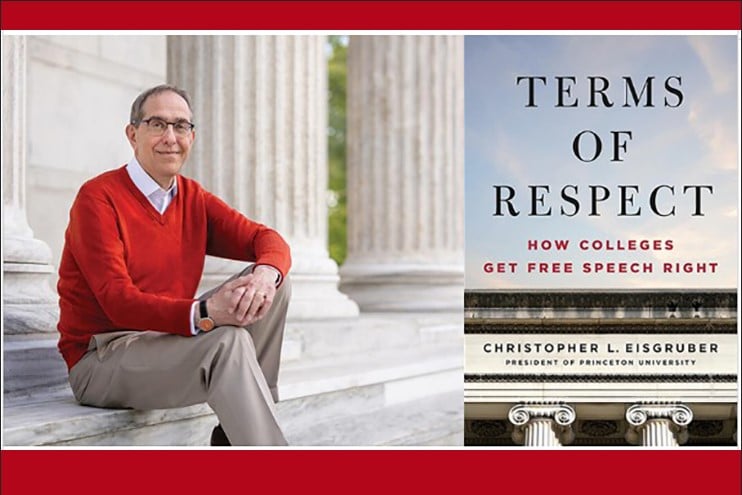
Eisgruber is hawking a new book absurdly claiming that colleges and universities currently “get free speech right.” His public pronouncements on the subject make him and his university seem unconvincing. But even he may well have been struck by the irony that as recently as June, Zakaria passionately defended the current state of academia on his Sunday program as integral to American greatness and insisted that it would be foolhardy to punish it. But with declining ratings and with only 31 percent of Americans professing faith in the mainstream media, journalists may finally be noticing what is happening.
Leave a Reply