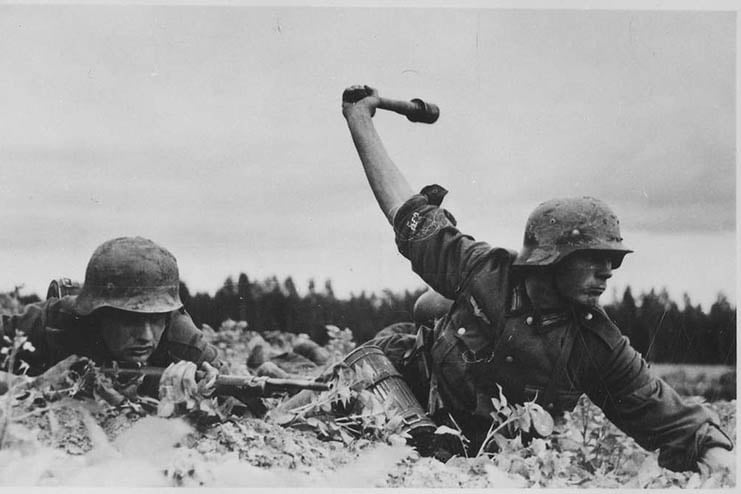
This week marks 85 years since the Third Reich attacked the USSR and unleashed one of the most destructive conflicts in history. Operation Barbarossa ended in the mutual near-destruction of the two mightiest European powers.
Conceived as a “masterpiece of conquest” and based upon the proven effectiveness of the German Army, the attack entailed 3 million men, 600,000 vehicles, and half a million horses. It may have been the most formidable fighting force in history, but the plan was extremely optimistic in its basic assumptions. These forces were to advance in three columns along a front of almost 2,000 miles—a front that widened as the attackers pushed eastward.
The attacking force eventually proved inadequate for a successful and permanent advance into the vastness of Russia’s land mass. As I pointed out five years ago in an article marking the attack’s 80th anniversary, Hitler made his prospects worse by violating an old adage of Carl von Clausewitz: Define your principal target, do not deviate from it, and do not divide your forces.
Contrary to these maxims, and contrary to the advice of his generals who wanted to remain focused on Moscow, Hitler wavered on the focus of the attack. In September 1941 he weakened the Army Group Center to encircle a Soviet force in and around Kiev—a force that presented no threat to the German advance on the Russian capital. The result of the Battle for Kiev was the spectacular capture of over 600,000 prisoners but also a situation in which the German army could not reach the capital before the bitter Russian winter set in.
Hitler ignored Clausewitz in another important respect: he disregarded the Prussian military thinker’s critique of Napoleon’s Russian campaign in 1812. Clausewitz, who participated directly in that campaign as a staff officer in the Russian army, criticized Napoleon for his fatal overreach. He pointed out Napoleon’s failure to recognize the culmination point. Since an offensive inherently weakens as it advances—due to casualties, overextended supply lines, and the need to garrison conquered territory—the attacker must eventually stop and revert to the defense when their forces equal the defender’s remaining strength.
In Clausewitz’s own words, this is the point when “the remaining strength is just enough to maintain a defense and wait for peace.” Once past, the chance of victory would be foreclosed unless an enemy yielded without engaging in decisive combat. An enemy would prevail if it chose to fight. Ever since Clausewitz, this element of operational theory has demonstrated utility in explaining the conduct of campaigns. It is an essential construct for understanding wars.
Clausewitz argued that Napoleon reached this culmination point when he took the city of Smolensk, 260 miles west of Moscow, on Aug. 18, 1812. Instead of stopping, consolidating his forces, securing supplies, and waiting for spring, Napoleon stubbornly pushed toward Moscow in a desperate bid to force the collapse of Russian will. It was a collapse that never came. Napoleon thereby turned a possibly successful invasion into a deadly debacle.
Mutatis mutandis, Hitler should have halted at the outset of the autumn rains in mid-October 1941, which initiated the infamous rasputitsa (mud season). By that time Leningrad was already under siege. Smolensk and Kiev, large and mostly undamaged cities, could have provided railheads for distribution of supplies and adequate logistic infrastructure for the winter break.
The catastrophe at the gates of Moscow could have been avoided, because the collapse of the German offensive in December 1941 was due largely to the collapse of logistics. Specifically, winter clothing and felt-padded boots were available for the Wehrmacht front line units at rear depots, as night temperatures plunged way below zero, but it was impossible to get them to the front lines. This is not to say that Hitler could have prevailed over Russia in the long run, but his obstinate attempt to force his will over and against reality cost Germany the battle for Moscow in 1941—and the war itself in 1945.
Clausewitz had also pointed out Napoleon’s failure to comprehend Russia’s strategic depth. The country’s sheer size allowed Russia’s defenders to trade space for time. The deeper the French marched, the more their supply lines were stretched, then harassed by Russian guerrillas, and worn out by the harsh climate. The resolve of the Russians awed Europe: when it was all over, even Austrian Chancellor Clemens von Metternich admitted that he had neither expected such tenacious Russian resistance nor the steadfastness of Emperor Alexander.
Clausewitz also noted that military genius requires sound temperament and intellect, qualities he felt Napoleon abandoned by 1812. Napoleon’s traditional formula for success—the rapid, overwhelming knockout blow—clouded his judgment. His arrogance and blinding ambition drove him forward when caution was required. But, above all else, Clausewitz faulted Napoleon’s political judgment for starting the war without a realistic aim.
These judgments also apply to Hitler, and with an almost uncanny precision. When Barbarossa ran out of steam, the Soviet Union was just beginning to realize its industrial and military potential. By the end of 1941, the strategic initiative in the East was lost forever. The Blitzkrieg technique of operations, which worked wonderfully against Poland, the low countries, and France, lost its effectiveness in Russia. The Reich managed to fight on bitterly for several years, but only by enduring supreme yet futile sacrifices along the ever-tightening fronts outside its borders.
Like Napoleon, Hitler had no grand strategy. Like his French predecessor, he attacked Russia while his British enemy remained undefeated in the West and in the Mediterranean. It almost defies belief that he neglected the possibility of reaching the Caspian Sea through North Africa and the German-friendly Mesopotamia, which would have made a two-pronged attack on Russia possible.
Until Barbarossa, Hitler was a successful opportunist who achieved a host of bloodless or cheap victories. After the attack on Russia, he became a doomed dilettante. Conquering an unconquerable Lebensraum in the East, while murdering and enslaving millions of people in the process, was not a grand strategy. It was a grim, nihilistic vision doomed to failure.
And finally, after 85 years, it is high time to dispel an old red herring. Most modern historians, regardless of ethnicity or ideological hue, agree that the USSR did not plan a preemptive attack on Germany immediately before the implementation of Operation Barbarossa. The claim that Hitler “preempted” Stalin’s preparations for the attack was put forward by German propaganda immediately after the attack on June 22, 1941, and was later popularized by non-academic authors, notably by journalist Viktor Suvorov in his 1989 book Icebreaker.
This thesis has been comprehensively debunked by Gabriel Gorodetsky in his monumental Grand Delusion: Stalin and the German Invasion of Russia. Gorodetsky’s book has been praised for its meticulous research, which also debunked the “preventive war” thesis advanced by David Costello in his review of the book, and by among others Roger Reese.
In a nutshell, the Soviet leadership, instructed by Stalin, sought to avoid or delay war as much as possible to finish the ongoing rearmament of the Red Army and—no less importantly—to complete the replacement of its decimated senior ranks after the Great Purge. The purge of the military, insanely rampant in 1936-1938, had killed most generals and admirals and removed a large chunk of experienced middle-grade officers.
Soviet military plans did allow for a retaliatory or preemptive strike later, but certainly not in 1941. The available evidence clearly shows that the Soviet political leadership’s main goal was to keep the USSR out of the war while strengthening its western borders, consolidating its acquisitions under the Soviet-Nazi pact, and creating a defensive buffer zone.
The Soviets developed various options for defensive strategic troop deployment and possible counterattacks in the event of aggression. Some suggested operation plans, and notably the “Considerations on the Strategic Deployment Plan,” did provide for the possibility of launching a powerful counterattack and transferring combat operations to enemy territory as soon as possible. The “Considerations,” drafted in mid-May 1941 by General Georgy Zhukov and Defense Commissar Semyon Timoshenko, suggested a massive counterattack through occupied Poland to destroy German forces and break into East Prussia. This plan was retaliatory in nature, however, and viewed as a means of defense, not as a preparation for an invasion, then or at any other time.
It is indeed remarkable that a serious disconnect could be detected in the year leading up to Barbarossa between Stalin’s political strategy and the Red Army’s operational doctrine. After the fall of France, even more decidedly than before, Stalin insisted that any hint of a provocative posture vis-à-vis Germany must be avoided and that no pretext for an attack should be provided. The military accordingly could not even prepare a timely clandestine mobilization if it concluded that German aggression was imminent.
To add to the confusion, the Soviet armed forces were undergoing a large-scale reorganization and rearmament in early 1941. Many new types of equipment and weapons were just beginning to arrive in significant numbers (notably the iconic T-34 medium tank), and new fortified areas were being built. An offensive under these conditions would have been unimaginable in principle and catastrophic in consequences. In any event, Hitler signed the Führer Directive 21 (Operation Barbarossa) on Dec. 18, 1940, long before any Soviet plans for proactive defense were either suggested or developed.
This is not to say that Stalin was a principled Molotov-Ribbentrop Pact keeper, let alone a pacifist. Had he been able to attack Germany in 1941 with a reasonable chance of success, he would have done so. But Stalin was also a pragmatic realist—much more so than Hitler the would-be artist, whose bohemian nature all too often made him impervious to rational calculus.
By the end of 1941, Hitler’s dream of speedy eastern conquest had turned into a nightmare. It was a massive minus-sum game from which neither Germany nor Russia may ever fully recover. That makes the normalization by German media of some notion of “our war against Russia idiotic and criminal in equal measure.
Leave a Reply