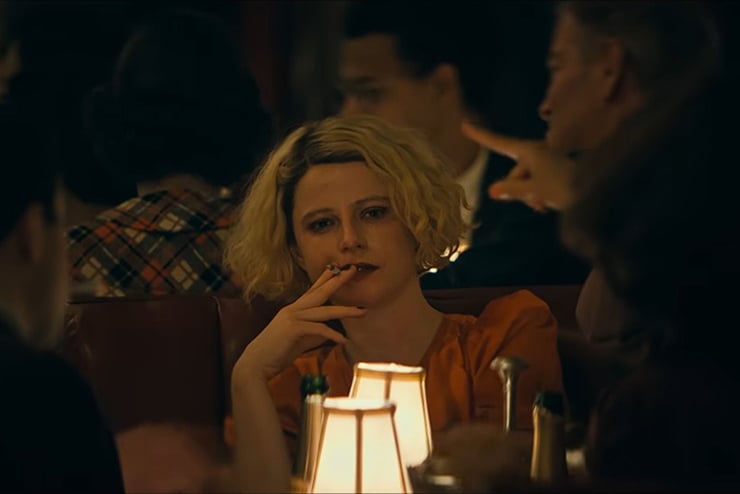
Take the rage of modern feminism, the scourge of pornography, and add classic Hollywood movie musical and horror elements, overlap with an insane storyline, sew them all together, give the resulting monster a jolt of pointless modern violence, and you’ve got the new movie The Bride! It is, quite possibly, the worst film I’ve ever seen.
Here’s the plot—and no, this is not a joke. The Bride! is set in 1930s Chicago. Frankenstein’s monster (Christian Bale), or “Frank,” is living in the Windy City. Suffering from loneliness, he visits Dr. Euphronious (Annette Bening), a surgeon who specializes in reanimating the dead. Frank is matched with a recently murdered woman named Ida (Jessie Buckley). Ida, it turns out, was murdered shortly after she was possessed by the spirit of Mary Shelly, the original author of the novel Frankenstein. The resuscitated couple go on a Bonnie and Clyde-style road trip, committing crimes that attract the attention of Detective Jake Wiles (Peter Sarsgaard) and his assistant, Myrna Mallow (Penelope Cruz). The couple gets caught, shot down—and then reanimated … again. The Bride! is the kind of film where you sit in the theater, incredulous both about what you are watching and the fact that you are bothering to watch it.
The film is directed by Maggie Gyllenhaal, who, through this film, may be signaling that she needs professional help. The point of the movie, as far as I can tell, is that patriarchal society abuses women, kills them, and drives them mad. The only way to cope is to become a kind of punk rock mercenary (Buckley’s makeup and electroshock blonde hair is pure 1980s LA). The only acceptable male companion is an obedient monster who, like you, is an outsider—or “a non-compliant,” as Dr. Euphonious puts it. Gyllenhaal is a Hollywood A-Lister, so she was able to attract the best actors for her movie. Jessie Buckley switches between Ida, who has a Yonkers accent, to Mary Shelley, who was British, to the Bride, who falls somewhere in between. Buckley gives the performance her all. It’s just sad that her dynamic energy wasn’t put to use for something that makes sense. Ditto for Christian Bale.
There is something deeply disturbing at the heart of The Bride!, but it has nothing to do with the so-called patriarchy. It is more about the corrosive effects of our porn culture.
Every male character in the film has, in some way, abused a woman. The men in the 1930s nightclub at the beginning of the film are not the mannerly companions one might expect from that era, but leering, aggressive abusers with dirty minds and dirty mouths. The dialogue is pure 2026—I don’t think anyone during the Great Depression, for example, regularly used phrases like, “What the actual [expletive]!” Frank is a huge fan of the movie star Ronnie Reed (Jake Gyllenhaal), but even Reed turns out to be a jerk. When Reed dismisses an emotional Frank with a quip about the monster “not being my type,” Frank implodes, crashing a chandelier and helping the Bride escape after she shoots a cop. Did I mention that this might be the worst film I have ever seen?
The depressing takeaway from The Bride! is a theme that conservatives have been warning against for decades. Namely, that we now have multiple generations of young people who are so emotionally fragile that the smallest criticism becomes a mental health crisis and turns them into raging monsters. Take Ronnie Reed’s innocuous line about Frank not being his type. Reed is not even rejecting Frank outright, just offering an innocent quip. Yet it is somehow portrayed as an excuse for monstrous behavior.
If America’s pornography culture really has corroded sexual relationships and men to the degree portrayed in this film—where they cannot be with women in any social situation, or any situation at all, without acting like Patrick Bateman in American Psycho (Christian Bale’s true monster role)—then we do, indeed, have a crisis. But it’s worth noting that that crisis, like American Psycho itself, is about the gay culture’s hatred of women, and something that Hollywood will probably never confront honestly. If you want to see real toxic misogyny, gay Hollywood is where you’ll find it.
Around the same time that The Bride! was released, the DVD of Little Trouble Girls was also released. Little Trouble Girls is everything The Bride! is not—subtle, well-written, and dealing with female sexuality in a way that is insightful, spiritual, and powerful. Little Trouble Girls is the feature debut of Slovenian writer-director Urška Djukić and Slovenia’s submission for Best International Feature Film at this year’s Academy Awards. It is yet another reminder, as I noted in a review of Koln 75, that Americans appear to have forgotten how to make great films. Scripts are underwritten or just bad, wokeness still rules the day, and unlike their European counterparts, American actors are all Acting with a Capital A. It’s become tiresome.
Little Trouble Girls centers on Lucia (Jara Sofija Ostan), a shy 16-year-old who is a member of the all-girls choir at her Catholic school. Things heat up when the class takes a trip to a convent to practice for an upcoming swing competition. Lucia is drawn in by a charismatic older girl named Ana-Maria (Mina Švajger), who initiates Lucia into typical teen rituals like spin the bottle and truth or dare.
If Little Trouble Girls had been an American film, the conclusion would have been predictable after that set-up: the rebellious young budding feminists take on the starchy Catholic establishment, showing themselves to be free thinkers and breaking out as sexual libertines. However, this is not an American film, which gives Djukić much more to work with. Ana-Maria makes a pass at Lucia, and when Lucia rejects her, Ana-Maria turns into a mean girl, ruining Lucia’s world with gossip. When Lucia talks to a nun about celibacy, and the nun tells her that “God’s touch” is as rich as that of a man, indeed, that it is even more total and enveloping, both women are treated as complex and intelligent people, each with a valid point of view.
Jara Sofija Ostan is wonderful as Lucia, perfectly capturing a teenager’s alternating rebellion, confusion, and desperate desire to fit in. Moreover, the men are also mostly treated fairly. The choir conductor played by Saša Tabaković genuinely cares about the girls and getting the best performance out of them, even if he becomes a bit of a villain when Lucia’s budding sexuality is distracting her from singing. When Lucia becomes mesmerized by a construction worker, there are none of the porn tropes that would be brought to bear if the same scenes were in an American film. The cinematography shows his face, or a sinewy muscle as he works, or lingers on Lucia’s face or on the beautiful scenery around the convent. It treats young female sexuality as something beautiful and powerful but, above all, sacred.
The spiritual high point of Little Trouble Girls comes when Lucia, torn between curiosity about God, rejection by Ana-Maria and the cool girls, and her desire for the construction worker, wanders into a cave beneath the grounds. She comes across a candlelit scene of nuns singing beautifully before an altar. Here, there is real joy and freedom, not the kind forced at school or crushed by cliques. As in the rest of Little Trouble Girls, the Catholic symbolism is heavy and poignant. A cave is where Christ was born, early Christians had to hide out in caves to say mass, and in Jungian terms it represents the subconscious where the “shadow” of our sexuality and creativity lies hidden. The Bride! tries (and fails miserably) to offer a similar dynamic, but in that unfortunate mess, the “cave” is an anachronistic punk and transgender nightclub in 1930s Chicago.
After seeing the choir of nuns, Little Trouble Girls cuts to a scene of Lucia on her bike, back home, riding free in the summer air, her arms stretched out in a Christ-like pose. Between the strict pedagogy of the choir director and the sin of Ana-Maria lies freedom. It is not a rejection of sexuality or of the Catholic Church, but a realization that our sensuality and the love of God are connected—that sex untethered to rules destroys, but that, likewise, too many rules can smother us instead of liberating us.
Having once been told to eat unripe grapes as punishment for sinful sexual thoughts, Lucia buys herself grapes at a market and enjoys them in their sweetness without shame.
Leave a Reply