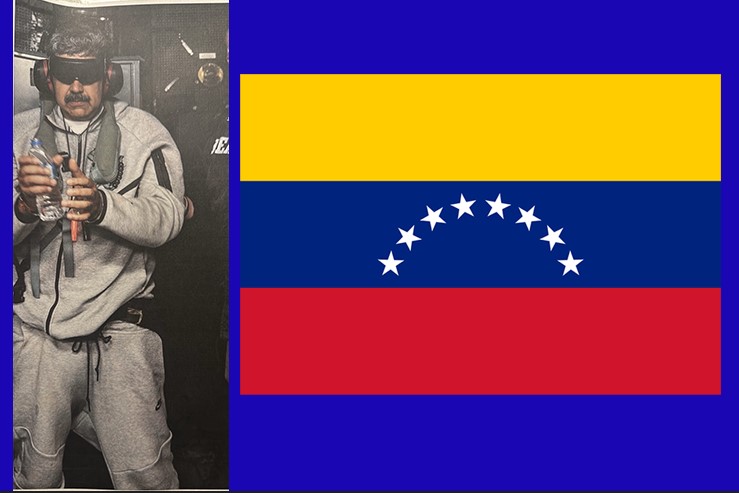
The arrest and detention of Venezuelan strongman Nicolás Maduro could well be the beginning of a Pax Trumpiana, a new international order that will transform relations between nations. Under this new order, concepts of international right and wrong are based on both realpolitik and natural law theory, in which tyrants who usurp legitimate authority may be overthrown.
The key facts regarding Maduro are twofold: first, that he is an indicted narcotics trafficker involved with well-known cartels and other noted miscreants. Second, that he wrongly hung onto power even by the laws of Venezuela, failing to leave office after his opponent defeated him in a presidential election.
There was no way, of course, that Venezuela would cooperate in an extradition with Maduro in power, even if it were so obligated by treaty. Accordingly, only an act of force by the United States could bring Maduro to justice. President Trump now needs to finish the job by aiding the installation of the actual winner of the last election. There is a good case to be made that would have been María Corina Machado, the leading opposition candidate before she was barred from running by the Maduro regime. In December, she escaped with aid from the U.S. military to Norway, where she won the Nobel prize for her efforts on behalf of Venezuelan democracy.
If Trump successfully begins a federal prosecution of Maduro and helps install a replacement government friendly to the United States, it is not inconceivable that Cuba—which is deeply dependent on Venezuelan oil and now may be cut off from that resource—could also undergo a regime change.
Other international actors involved with Venezuela, including Russia, China, and Iran, may also suffer adverse effects. In Iran, the economic dislocations and the popular demonstrations occurring now may lead, after decades, to the toppling of that country’s theocratic regime—perhaps even the restoration of government involving the son of the late Shah.
Ironies abound here: President Trump ran as an America First candidate, but his legacy may be that of a president who dramatically reconfigured the international order. That reconfiguration could well trigger massive gains for American corporations, perhaps beginning with the restoration of American petroleum assets in Venezuela. The possibilities for lucrative American investments in Cuba, Iran, and other nations are also dramatic.
Nation-building, as neoconservatives learned in the George W. Bush years, is a risky enterprise. Still, something close to a democratic, self-governing regime once existed in Venezuela, and perhaps it is not too far-fetched to think that a popular constitutional monarchy in Iran, or a democratic republic in Cuba, may yet be possibilities.
What we are seeing in the Trump administration could be and undoubtedly will be condemned at home and abroad as “gunboat diplomacy,” a strategy employed perhaps without significant amounts of honor previously in American history. And yet, with the arrest of Maduro and the blows the Trump administration has struck against the cartels, there is some sense that what is being implemented is the rule of law—that there is, perhaps, some firm basis for what is happening in the centuries-old law of nations.
The law of nations is that body of principles, drawn from notions of a divinely inspired law of nature, put forth by great scholars such as Hugo Grotius, Emerich de Vattel, and Cornelis van Bynkershoek, as well as William Blackstone and the Baron de Montesquieu.
One could argue that the law of nations can serve as a basis for the restoration of legitimate governments where tyrants have usurped them. That is presumably what is happening in Venezuela and may occur elsewhere.
It is a very nice question, of course, to what extent the law of nations will (you’ll pardon the expression) trump the positive requirements of domestic law. If, for example, what happened in our police action against Iran’s nuclear program, or what we are doing in Venezuela, were to be interpreted as acts of war, one could argue that Congress, which is given the sole power of declaring war by the Constitution, should have given prior authorization for what the president has done. The Democrats will inevitably make this argument.
The president, however, is vested with the power to enforce the laws. Thus the arrest and detention of Maduro, following his indictment during the first Trump administration in the Southern District of New York on drug-trafficking charges, has been invoked as supplying the needed legal authority for Trump’s incursion into Venezuela.
Traditionally, Americans have cherished strong presidents, particularly those perceived as acting in accordance with the highest principles of the American founding. None ranks higher than popular sovereignty and the rule of law itself. The president should be able to neutralize his critics by invoking those principles in this instance, and, in the process, advance both America’s interests and the law of nations.
Leave a Reply