It’s rare to find a good children’s movie in the streaming age.
Rebooted plots draw on nostalgia but offer little else. Animation has embraced the total Pixar-ification of the medium. And too often, the films become battlegrounds in the culture wars as committed ideologues seek to influence the next generation.
That’s why I was surprised to discover that Netflix’s new animated musical, K-Pop Demon Hunters, is a rare exception.
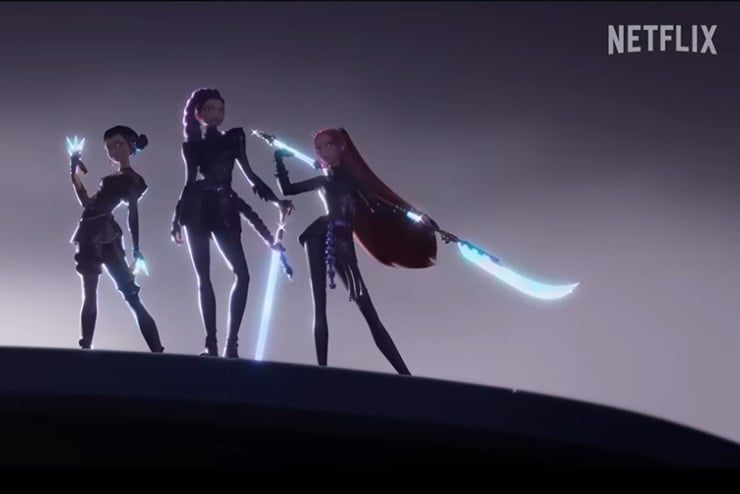
Demon Hunters crafts an original narrative from Korean folk stories, weaving together a tale of three magical singers who use their talents to protect humanity from soul-sucking demons. The Grammy-nominated soundtrack has some of the best original music since the 1990s Disney classics, and the animation innovatively fuses Western animation and Asian anime styles. What is perhaps more important, however, is that the film rejects the rehabilitative villain-as-victim trope that drives much of children’s storytelling today. Instead, the demons must do good deeds if they hope to redeem themselves.
The plot revolves around singers Rumi, Zoey, and Mira as they form a girl group called HUNTR/X—international pop sensations by day, magical demon slayers by night. Their hit new single “Golden” is set to seal the human world off from the demon world for good, until the demons mount a counteroffensive and form their own boy band to steal HUNTR/X’s fans, and with that fan base, the source of HUNTR/X’s power. The film plays out as a relatively straightforward tale of good vs. evil with some novel Korean elements folded in.
Demon Hunters capitalizes on the global K-Pop (Korean pop music) craze, with a soundtrack inspired by Korean bands like BTS and BLACKPINK. K-Pop builds on the sound and structure of Western pop, with catchy hooks, polished production, and the genre-blending of rap, electronic dance music, and bubble-gum pop. Yet with a mix of Korean and English lyrics, hyper-synchronized choreography, and an embrace of distinctly Asian fashion and beauty standards, the genre, though somewhat familiar, remains unmistakably Korean. And the songs are still stuck in my head.
The animation captures the spirit of the music. The standard 3D animation of Disney and Pixar, with its doughy and expressive features has become ubiquitous in the industry, if not a little tired. Although Demon Hunters draws on the lifelike depth that modern 3D technology provides, it also folds in 2D animation to capture a traditional anime feel: “chibi-style” exaggerated expressions, oversized eyes, and detailed outfits. The result, especially in the dance and fight scenes, makes the story feel like a comic book come to life.
As good as the music and animation are, the film still almost lost me halfway through. Through flashbacks, we see how the demons used to be human, but due to the misery of the human experience, they were forced to sell their souls to survive.
This is a common trope in the movies today, most notably and recently in Wicked. Oz’s Wicked Witch of the West isn’t evil per se, but a victim of bullying and oppression, which ultimately forces her to do bad things. Villains from Cruella de Vil to the Joker have had their images rehabilitated in this way over the past decade. Thematically, we see how this removes agency from the human experience, neutralizing the ability to see the difference—let alone choose—between good and evil, right and wrong. There’s no one to blame, no one to punish, and worst of all, no genuine chance at individual redemption; we’re all just victims in the cycle of circumstance.
While Demon Hunters flirts with this trope, it does so only to reject it. Demons don’t get an image rehab because of their hard-luck stories, but merely the chance to redeem themselves.
Shame is the film’s central theme. The demons, we see, remain demons because of the deep sense of shame they feel about selling their souls; it’s how the demon king controls them. Yet this isn’t their inevitable fate—they still have the agency to own this shame and atone for it. When the demon popstar sacrifices himself to save HUNTR/X’s mission, he earns a release from his eternal suffering, and the demon king loses his control over the human world. The viewer is not ultimately meant to feel sympathy for this character because of his past struggles and obstacles, but to accept his noble effort to reject his poor choices and strive for redemption.
The film, like the real world, hinges on the human capacity to choose. We are not evil by default; we choose to embrace it. Neither is evil inevitable; we can always choose to reject it. Even the worst of us still have the agency to decide.
Interestingly, the free-will position is considered naïve by our cultural arbiters. Every sophisticate is supposed to know that our circumstances are beyond our control, especially for those deemed morally worthy through their victimhood. The idea of controlling one’s own destiny is scorned as hopelessly romantic at best, and perpetuating oppression at its worst.
Yet it’s worth considering whether this smug cultural tendency is the cause of the issue it claims to assess. There’s no doubt we’ve become a far more passive culture in recent decades, looking to blame personal failures on political forces. But the answer to our stalled sense of agency might be to start believing again that we have it.
Leave a Reply