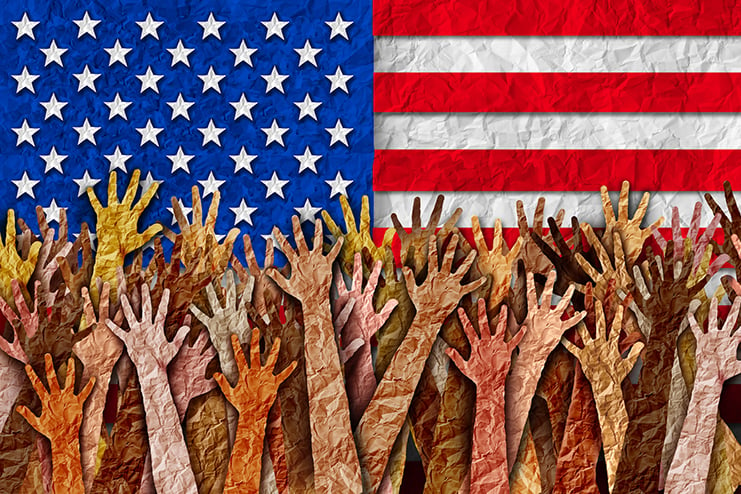
For the past few decades, advocates of multiculturalism sold the idea as something soft and mild. Schools and popular media reinforced the message that being American meant happily accommodating other cultures, offering abundant public services to immigrants, prioritizing their holidays (even non-holidays like Cinco de Mayo and Kwanzaa), and striving to simply “live and let live.” Naturally, noticing certain patterns of behavior, good or bad, within immigrant communities was strongly discouraged, while open dialogue and celebrating differences were aggressively promoted.
So long as immigrants represented a minority of the population and most of them assimilated into American culture, multiculturalism didn’t really bother most people. It also helped that incoming migrants (mostly from Latin America) came from a Christian culture and shared a moral outlook similar to that of their northern neighbors.
Even after the terrorist attacks on the World Trade Center on Sept. 11, 2001, and the quixotic War on Terror that followed, the notion of a soft and mild multiculturalism continued to dominate. True, Americans learned the hard way that certain cultures were not quite as compatible with our traditional political and moral order as previously believed, but criticism of Islam was nonetheless censored, and because the number of Muslim Americans was comparatively small, claims about the problems with Islamic culture carried little weight
It has only been in the past decade that Americans, broadly speaking, have begun to reconsider their former indulgence of multiculturalism. It turns out there are limits to how many strangers, even a large, diverse country like ours, can properly welcome and include. Far from being soft and mild, multiculturalism can be rather hard and rough—depending on the quantity and quality of the people coming in.
Americans might be fine with an extra TV channel in Spanish and spotting the occasional street taco vendor, but how do they feel about gangs of unemployed young men roaming the street, harassing and occasionally sexually assaulting native residents? How do they feel about whole ethnic communities ripping off the public entitlement system for billions of dollars? How do they feel about the ongoing threat of terrorist attacks, vandalism, and organized crime in their once quiet and boring suburbs?
Many European citizens (as opposed to their elites) had already realized this a decade earlier as their nations took in ever-larger numbers of Muslim migrants from the Third World. Unlike Americans, most Europeans grew up in highly homogenous communities and thus have a lower tolerance threshold for outsiders. In theory, many Europeans believed that if immigrants could see the benefits of Western culture, they would begin participating in society by cultivating marketable skills and giving up their old barbarous ways. Sadly, in the real world, most of these migrants did not bother to acquire useful skills, became permanently dependent on the generous welfare systems of these Western societies, and formed their own segregated slums.
As native Europeans began to understand what was happening to their communities, they also discovered that the elites who had preached multiculturalism and generous public benefits were, in fact, intolerant authoritarians who preferred the new people because they ushered in a dysfunctional anarcho-tyranny which was easier for them to manage than a functioning democracy. As sociologist Karl-Olov Arnstberg recounts in his recent book The Sweden Syndrome, this has especially been true in Sweden, where the once-famed Scandinavian utopia was eaten away by its Muslim immigrants who refused to assimilate and placed a massive burden on native Swedes. Simultaneously, anyone who dares to speak out against these changes, as Arnstberg does, is swiftly canceled.
A similar situation obtains here in the U.S., at least for the time being. Conservative voices are not shy about condemning non-Western immigrants, particularly those who engage in mass fraud. This was obviously the case with Somalian immigrants in Minneapolis (a.k.a. Little Mogadishu) who collectively scammed a whole bevy of government entitlement programs to enrich themselves and, worse still, funded terrorist activity back in Somalia. Shortly after this scandal broke, investigations were initiated, politicians were disgraced, and people are now looking to other states where this is happening.
More importantly, the happy-clappy myth of unchecked multiculturalism is now getting a thorough reexamination in public. Not only can Americans openly discuss the trade-offs of letting so many foreigners into the country, but they can also appreciate the significant differences between various groups of foreigners. This understanding, in turn, helps people see the complex nature of immigration and its many implications, rather than mindlessly applying simplistic moral formulas such as “welcoming the stranger” and “fighting for the oppressed” to the issue.
Today, blissful ignorance is no longer an option. At all levels (federal, state, and local), immigration has proven hugely disruptive to the economy, our politics, and our culture. Even if individual immigrants may have sympathetic stories and prove to be educated and productive, large waves of immigrants are raising red flags. Consider the recent wave of South Asians moving into the Dallas-Ft. Worth area of Texas, where there is a host of problems it is now permissible for Americans to notice: fewer job openings, depressed wages, soaring housing prices, strained public services, and a less cohesive local culture. And this is to say nothing of the likelihood that most of them entered the country through some form of visa fraud.
This predictably causes friction between otherwise friendly neighbors who have seen their suburbs transform into something unrecognizable. Perhaps over a few decades and in smaller numbers, this transition could have worked better for all parties involved, but when change happens virtually overnight without any forewarning, it fosters hostility and instability. What was once a recognizable community united by a shared history and values, as well as common pastimes, is now quickly dissolving into a fractured, stressful collective. Of course, the first step to fixing this problem is simply identifying it. After so much denial and propaganda, Americans and the rest of the West should be growing up about this issue. And while there are growing pains that accompany this development, there is also the prospect of a more mature populace better equipped to regulate who enters the country. For the moment, this adjustment obviously clashes with conventional scripts for welcoming immigrants, but that may be changing. We can only hope that soon Americans will begin calling for rewriting these scripts and do what it takes to build a more united and thriving nation.
Leave a Reply