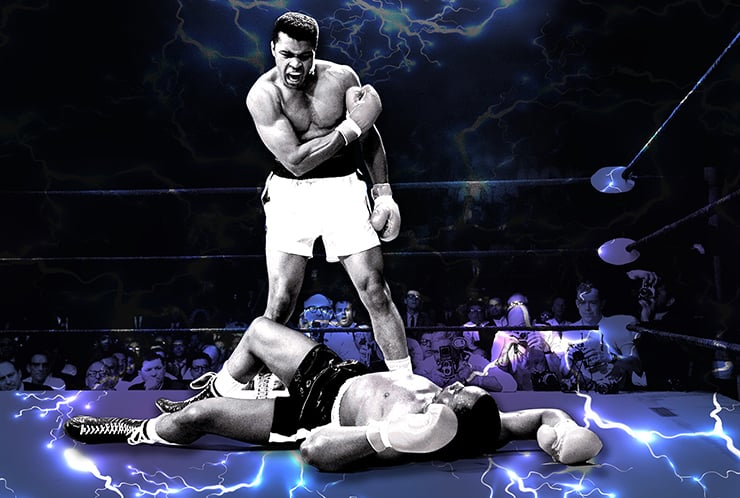
Growing up in the 1970s, I admired the boxer Muhammad Ali more than I can easily articulate. It would not be too much to say that, at age 10 or so, if someone had asked me what living or deceased historical person I would have most liked to have been instead of myself, his name would have been the one that most readily dripped from my lips.
I am sure I was not unique among American boys of that era, not even white American boys. It is difficult for even a careful cultural historian to understand fully Ali’s larger-than-life significance in that period for anyone who followed sports, which back then was close to every single American male. His audacious voice thundering out “You’re next, Cosell!” after a win, or taunting Joe Frazier mercilessly before one of their three magnificent bouts still rings in my head a half century later.
In passing, it is perhaps worth noting that this truth gives the lie to Chris Rock’s bit about how the proof of the total racist contempt of American whites for blacks is that no white person would willingly change places with any black person. In my youth, my admiration was such that there were at least a dozen or more black men on my lists of heroes with whom I would have gladly changed places. Among them were figures like Reggie Jackson; Julius Erving; O.J. Simpson (the before he did it O.J. Simpson, of course); Lynn Swann (superhuman hero of the first Super Bowl I ever witnessed, a man who seemed capable of levitation); Walter Payton (the most exciting player in the NFL in the later ’70s as O.J.’s career waned); any one of the black starters for my local professional baseball team, the Cincinnati Reds (Ken Griffey Sr., Joe Morgan, George Foster); Bill Cosby (the before we knew what he had been doing Bill Cosby, of course); George Foreman or Joe Frazier (two equally iconic heavyweight fighters Ali battled in that period); and Richard Pryor (whose stand-up I had memorized as a teenager, though the performance of it today by any white teenager surely would get him summarily cancelled unless he carefully and extensively censored all the words you are no longer allowed to say).
There was Linc Hayes the unbelievably cool, majestically Afro’ed and permanently sunglass-wearing black detective on The Mod Squad, played by Clarence Williams III. And if we add comic book characters, The Black Panther and Luke Cage, Power Man, would have made the list. I repeat: This is a partial list, assembled without more than five minutes of reflection. If I put more time into jogging my memory from that time of half a century ago, it would doubtless grow substantially. I had many white male friends who, I am certain, would have shared my feelings on this matter. Chris Rock was about as wrong as it is possible to be about this.
But I idolized Ali perhaps above any of these mentioned above. Why did I love him so profoundly? He was a dazzling boxer, to be sure. One of the all-time greats, certainly.
But just as important, perhaps more so for me, he was preternaturally self-confident, verbally lightning quick with hilarious observations about how good he was and how inevitably he would destroy all opponents, who were ridiculed with devastating rhymes and nicknames.
Back then, in the mid-1970s, I did not know anything about his personal beliefs or about his politics. I don’t believe I even knew then about him being stripped of his title for refusing to serve in the military during the war in Vietnam. I don’t remember ever remarking to myself in that time that his name was an odd one in the American context. Probably I had heard of other black Muslims who had changed their names in this manner, though I knew of none personally or even what it meant for them. All the black folk I knew personally had names just like mine.
I wonder. If I had known then that at one point he considered all white people to be devils, would my opinion of him have been different? I’m sure it would have mattered to me that at some point he had realized how ignorant and racist that opinion is and that he had given it up, but I’m also sure I would have been shocked and hurt to hear this man I so idolized talking in this way about me and others who shared both my skin color and my love for him, which I saw as no problem for me at all.
Contemporary radical racialist activists such as Michael Eric Dyson continue to cite him with admiration for having said things like this: “My enemies are white people, not Viet Congs or Chinese or Japanese. You my opposer when I want freedom.”
Or this classic when Ali did not mince his words. “The white man is the devil.”
Of course, Ali had lived as a black man in the Jim Crow South, so he had been mistreated by many white people. But how could he have come to believe that one could group all white people—every single one of us—into the category of those who had mistreated him? Wasn’t that just the reverse of the move made by crude white racists? And how could he have come to believe the evident falsehoods he utters here?
How, indeed? Because the ideologues of that time were spreading that simple-minded, mendacious, venomous message, and plenty of people who had had some bad experiences in their lives and did not spend enough time fact-checking these propagandists, fell under their sway.
Now, tell me how the claims of today’s Black Lives Matter and the so-called “antiracism” cult are any less distant from reality than the things Ali was saying during the height of his brief period of Elijah Muhammad insanity.
Police are systematically murdering innocent black men? The evidence shows that it’s a tiny number of blacks who are killed by police every year, and nearly every one of them was wielding a deadly weapon when he was killed. Blacks are being prevented from economic success solely by racists and racist “structures?” The evidence shows that black educational achievement, which is strongly correlated with position in the income hierarchy, is well below that of the groups that rank above them in income position, and even though race-based affirmative action based has been exercised throughout society on their behalf for the past half century.
Tell me how the BLM beliefs are less malevolent than the things Ali once believed about white people, i.e., that all whites, whatever their own beliefs and practices in the world, are inevitable participants in the crushing of black people, beneficiaries of “white privilege,” and in collusion with white supremacy no matter what they think about black people. How is it any less pernicious to believe that the only way white people can escape this fate is, apparently, to give up all their social standing and all their wealth and recognize that going forward a completely new social system must be put in place—one in which individual merit is meaningless and what matters is group identity.
I am not suggesting Ali’s memory should be reduced to this moment in his life when he believed venomous things about whites. It is encouraging that he realized at some point how gravely wrong those beliefs are. Nor it should not be whitewashed, as it were, from his legacy, as it has been. It is important to remember that we’ve been down this poisonous path before and it leads us nowhere. The views Ali once held, then, are the same as those that currently being drummed into children in American schools today. We need to remember this history clearly and understand it if we want to avoid a repetition of the same mistakes that have been holding us back for half a century.
Leave a Reply