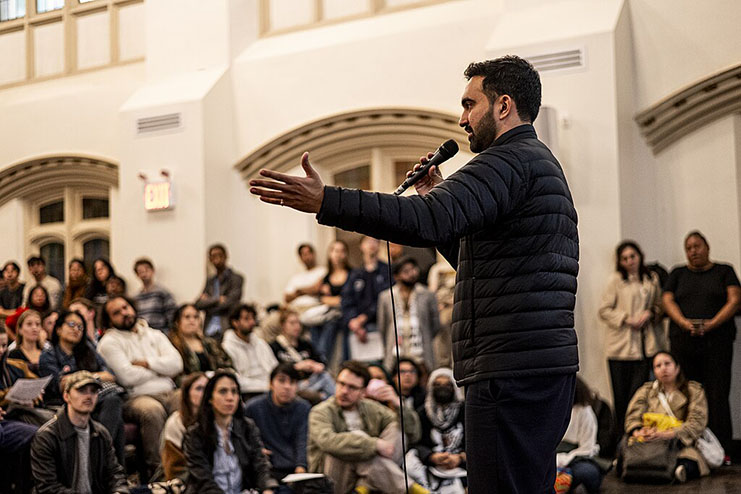
Headlines brimmed last week with speculation about inducements President Trump might offer to the multiple New York City mayoral candidates running against surging Democratic nominee Zohran Mamdani to leave the race. The hope is that by consolidating support around one challenger the anti-Mamdani vote might prevail over the self-described “democratic socialist” in November.
According to a CBS poll released last week, Mamdani commands a winning 42-percent plurality of the vote, outperforming his nearest opponent, disgraced former New York state Governor Andrew Cuomo, by 16 points. Cuomo, who unsuccessfully challenged Mamdani for the Democratic mayoral nomination, is now running as an independent. Polling at 26 percent, he is trailed by Republican nominee Curtis Sliwa, the eccentric founder of the Guardian Angels, who polls at 17 percent, and incumbent New York City Mayor Eric Adams, who dropped out of the Democratic contest before the party’s primary, and, with just 9 percent of the vote, is also now running as an independent. Attorney Jim Walden, another independent candidate, whose results were marginal, dropped out of the race after the polling data was collected.
Ever since Mamdani emerged as the Democratic nominee and mayoral frontrunner in June, apoplectic foes have devoted enormous energy to devising a strategy to head off his prospective victory.
Some in New York’s business community, including many of its Republican members, have urged rallying behind Adams, who split from the Democratic Party’s line on illegal immigration in 2022 and has adopted tougher policing policies since Trump’s reelection last November. Adams, however, is unpalatable to many New Yorkers due to his closer relationship with the president, who has urged tougher crime policies, and whose Justice Department in April secured dismissal of Biden-era corruption charges against the mayor (Trump says he “helped out” Adams “a little bit”).
Other anti-Mamdani forces favor Cuomo, who enjoys much more popular support despite his checkered record as governor, which included no-cash bail, controversial public health policies, and multiple allegations of sexual harassment. The Republicans who support Sliwa, who ran unopposed for his party’s nomination, are significantly—if no longer overwhelmingly—outnumbered in New York City, where Trump won about 30 percent of the vote in 2024.
Last week, Trump said that two of Mamdani’s opponents need to drop out in order for the radical candidate to be defeated. He did not specify which two, but observers widely believe that he meant Sliwa and Adams—the two less well-performing candidates. The same CBS poll showing Mamdani’s commanding lead in the crowded field suggests Cuomo could prevail in a hypothetical one-on-one contest.
Adams admitted that he has been in touch with the Trump administration, but did not divulge the content of those discussions, which reportedly included a tentative offer to appoint him U.S. ambassador to Saudi Arabia (two Muslim Democratic mayors who endorsed Trump in Michigan—a critical 2024 swing state—have been nominated for the ambassadorships to Kuwait and Tunisia). Sliwa denies having held any discussions. Both he and Adams claim they are focused on New York City and have said they will not drop out.
Even if Trump’s reported gambit eventually succeeds in changing the race, his plan can only defeat Mamdani if both Adams and Sliwa drop out, assuming the polls are accurate and do not change before the November election. If only one of them departs, Mamdani would still win with a plurality, albeit a diminished one.
If Trump can convince both to go and Cuomo wins, however, the president may regret getting what he wished for. Trump has known Cuomo and had various levels of interaction with the former governor for 40 years—almost all of Cuomo’s adult life. One observer has called their relationship a “dysfunctional marriage.” Their most recent political interactions, especially during the COVID-19 pandemic, were highly contentious, and Cuomo is campaigning in part by touting himself as the best candidate to stand up to Trump, whose policies toward Democrat-run cities are increasingly tough.
Should Cuomo find a path to victory because of Trump’s intervention, of course, the thinking may be that Cuomo would owe Trump some loyalty. But there is little guarantee that Cuomo, a highly experienced and infamously abrasive politician from a major New York political dynasty, would act as gratefully as Adams has done.
Mamdani’s election now appears to be the likeliest outcome. If elected, he will almost certainly continue the radical leftist policies that inflicted massive damage on New York. He pledges an expensive expansion in social services that he plans to fund with yet more city tax increases—already the nation’s highest burden—and has suggested that he will extract some of that revenue discriminatorily from white neighborhoods.
Mamdani has stated his support for globalizing the intifada in a city where anti-Semitic sentiment and violence have become facts of life. He believes billionaires should not exist, one reason among many that observers believe his prospective election will renew the flight of New Yort City’s high-income earners, and the dollars they now supply, to Florida and other friendlier jurisdictions. Mamdani has dialed down his anti-police messaging, but it remains a fact of his political biography. Bill DeBlasio, Adams’s much-despised predecessor who is widely blamed for New York’s decline, has endorsed Mamdani. So have many other radical leftists, whose progressive faction is increasingly ascendant in the national Democratic Party.
As unpalatable as Mamdani’s administration might be, it would have one discreet benefit for Republicans: it would effectively broadcast the worst features of the Democrats’ platform, and their very real effects, from the day he is sworn in on Jan. 1, 2026, through the congressional midterm elections next November. As New York groans, the rest of the country will have 10 months to watch and listen before casting ballots for control of Congress. The lessons they draw from New York’s continuing plight could redound to the GOP’s national benefit.
Leave a Reply