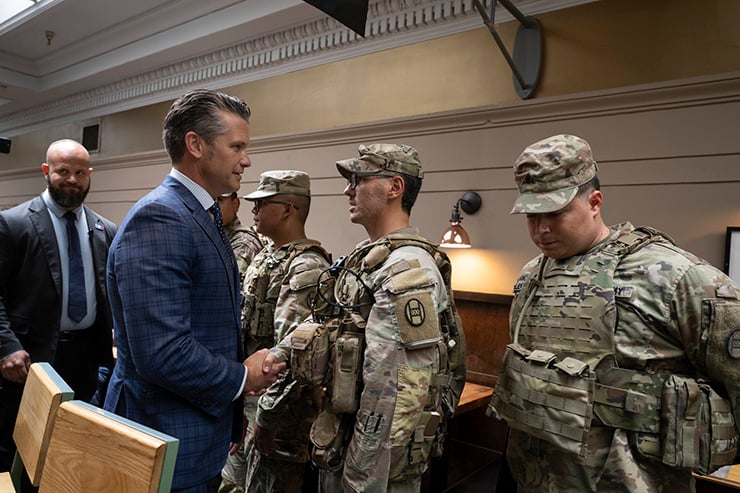
“We greatly appreciate the surge of officers that enhance what MPD has been able to do in this city,” Washington, D.C. Mayor Muriel Bowser said last week, acknowledging that President Trump’s federalization of law enforcement in the nation’s capital has significantly reduced crime there. On Monday’s Labor Day holiday, Trump in turn praised Bowser, exclaiming “Wow! Mayor Muriel Bowser of D.C. has become very popular because she worked with me and my great people in bringing crime down to virtually nothing in D.C.”
In early August, Trump announced a surge in federal law enforcement to tackle Washington’s high crime rate and general urban blight. On Aug. 11, he invoked a clause in D.C.’s Home Rule Act to place Washington’s police department under federal control for 30 days and then used his presidential authority to engage some 500 agents from various federal law enforcement agencies and D.C.’s National Guard, which is under federal command, to police the capital alongside Guard units from Republican-led states whose governors sent forces to join the deployment.
On Tuesday, Attorney General Pam Bondi announced on X that these measures have resulted in the arrest of 1,669 criminal suspects and the removal of 168 illegal firearms from D.C. streets. District of Columbia U.S. Attorney Jeanine Pirro has instructed prosecutors to seek maximum sentences for transgressions, including assaults on federal agents, and lobbied the D.C. government to move away from Washington’s notoriously light criminal sentencing and low-grade prosecution policies. In her remarks last week, Bowser, who was initially critical of Trump’s law enforcement surge, admitted that crime was down 15 percent compared to a similar period last year, with particularly sharp drops in violent crime. Carjackings, she noted, had fallen by 87 percent, while the capital enjoyed a rare period of nearly two weeks without a single homicide.
Trump’s critics have huffed and puffed—contradictorily arguing that his federal policing measures are both ineffective and a dangerous threat to democracy. Few, however, have seriously questioned the legality of most of his actions in the District of Columbia, which has a unique constitutional status that includes broader executive branch authority than is the case elsewhere in America.
Other blue city and blue state leaders, however, have questioned whether Trump can extend these measures to their jurisdictions, as the president has threatened to do. On Tuesday, a Democrat-appointed federal judge in California ruled that Trump’s deployment in June of 4,000 National Guardsmen and 700 U.S. Marines in response to violent protests against immigration enforcement in that state was illegal. California Governor Gavin Newsom praised the decision, saying that “the court sided with democracy and the Constitution.”
Whether the Constitution supports the judge’s and Newsom’s interpretation is doubtful, however. The ruling, which is subject to appeal by the administration and possible final adjudication by the Supreme Court, only applies to California. This means that Trump can presently deploy federal forces, including state National Guard forces taken under federal command, anywhere else in the country without legal prohibition, unless and until a judge in the jurisdiction in question issues a similarly adverse ruling, which would also be subject to appeal.
The federal court’s ruling in California, moreover, is based on the judge’s poor interpretation of the Posse Comitatus Act, a federal law passed in 1878 to prevent U.S. military forces from intervening in southern states that were then enforcing post-Reconstruction Jim Crow segregation laws. The law includes an explicit provision that allows federal forces to act “in cases and under circumstances expressly authorized by the Constitution or Act of Congress.” Both of those authorities include U.S. Code as written, which currently notes such deployments are allowed if “the President is unable with the regular forces to execute the laws of the United States.”
Broadly interpreted and supported by numerous precedents, that means the president can deploy federal forces to enforce federal law if state and local law enforcement are unable or unwilling to do so. Failure to enforce federal immigration laws, for example, whether through “sanctuary city” policies, noncooperation with federal law enforcement, or simple ineffectiveness—all of which are widely evidenced throughout Democrat-run jurisdictions—ought to constitute just cause.
Even if the entire federal judiciary overturns that longstanding interpretation, however, Trump has at least two alternatives. Following the language of the Posse Comitatus Act, the Republican-controlled Congress could simply pass legislation authorizing the use of federal forces outside of the Act’s prohibitions, either generally or in specific locales. Indeed, under the D.C. Home Rule Act, Trump would have to obtain such authorization from Congress if he wishes to extend the federalization of Washington’s police department beyond the initial 30-day period he announced on Aug. 11.
Trump also has the power to invoke the Insurrection Act of 1807, a law that allows the president to deploy federal forces either upon the request of a state governor or without such a request if conditions obstruct federal law. Although Trump, who has suggested he might invoke the Act in both of his presidential terms, has not yet done so, historically it has been invoked by presidents of both major parties. It’s been used to quell civic unrest, prevent looting, stop a prison riot, desegregate schools, protect protest marches, end gang violence, and for other reasons of lesser or commensurate importance with our current immigration crisis and the urban crime waves it encourages, which claim the lives of hundreds of citizens every year.
If blue jurisdictions do not shape up, they should expect a visit from the feds—secure in the knowledge that is all nice and legal.
Leave a Reply