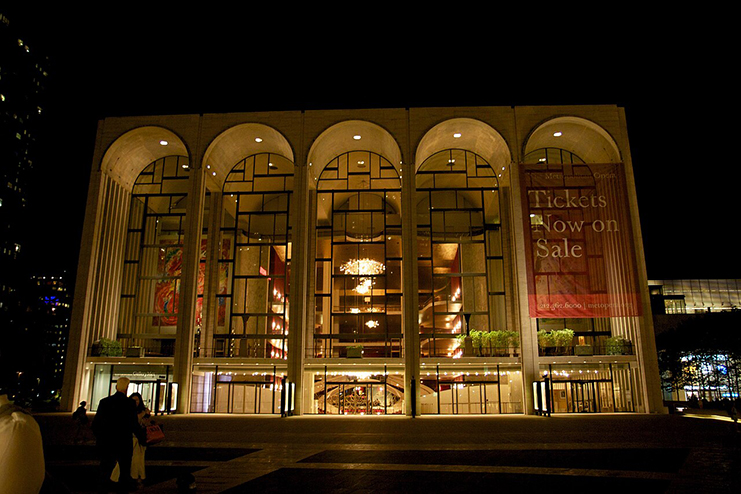
American performing arts aficionados leapt for joy last month, when the general manager of New York’s Metropolitan Opera, Peter Gelb, announced his retirement. Relief will not be immediate, as Gelb will remain in the post for another four years.
Under Gelb, attendance has lagged at what was once the world’s leading opera company. The current season has reached only 72 percent capacity, and the Met’s coming 2026-2027 season will be its smallest program in 60 years, with just 17 productions. These results lag far behind European opera houses, such as the Vienna State Opera, which has been filled to capacity in its recent seasons, or the Hungarian State Opera, which will produce 56 operas next season, more than three times as many as the Met.
A few weeks ago, the Met announced 22 administrative layoffs, salary cuts for employees earning more than $150,000 per year, and the postponement of a new production of a traditional opera to a future season. Gelb is also selling naming rights for the theater and ownership of the house’s iconic Marc Chagall murals (which would be left in place, but with a plaque attributing ownership to the new owner). The Met will also open to other art forms when it is not performing opera.
These measures follow reported drawdowns of about $70 million from the Met’s $310 million endowment—a giant no-no in arts administration—along with two downgrades in the company’s credit rating. As a result, last fall the Met entered a tentative $200 million deal with Saudia Arabia, in which it will perform in Riyadh for three weeks every winter beginning in 2028. Recent reports, however, suggest that deal may be on the ropes.
Wounded ego has been an unfortunate theme in Met history since Gelb arrived at the house in 2006. Even in those early years, reports held that the industry’s leading publication, Opera News, was barred from reviewing Met productions because it criticized Gelb’s leadership and harshly reviewed a new production of Wagner’s The Ring of the Nibelung that he had personally championed. Now defunct, Opera News was published by the Met’s own philanthropic guild, a network of supporters that raised millions of dollars for the company every year. In 2023, Gelb abolished both.
Artists who have reportedly clashed with Gelb, no matter how famous or how great a box office draw, have been cast out, usually at high cost. Longtime music director James Levine, one of the world’s greatest conductors, was fired in 2018 over unproven sexual harassment allegations but sued for breach of contract and defamation and won a $3.5 million settlement. Superstar singer Plácido Domingo was also removed from the Met’s roster in the #MeToo era, even though none of the unproven allegations against him involved any alleged incident during his 51-year Met career. He has continued to perform around the world, where he remains a huge box office draw. In 2022, the Russian soprano Anna Netrebko—widely hailed as the world’s most popular opera singer—was removed for failing to denounce Vladimir Putin over the war in Ukraine. Netrebko won more than $200,000 in arbitration (and her suit is ongoing) and continued to have a stellar career without the Met. The celebrated German tenor Jonas Kaufmann recently announced he will not return to the Met, in part due to Gelb’s treatment of artists during the pandemic.
Gelb’s declaration in 2021 that the Met would be an explicitly “anti-racist” institution alienated many cultural traditionalists who object to the “anti-racist” movement’s ideology, which holds that all whites are inherently racist. Frontloading “new” operas, which are often imbued with a progressive social valuation, has also proved a bust despite Gelb’s unevidenced protestations that they are “the only path forward.”
Most of the “anti-racist” and other new works introduced at the Met since 2021 have been critical and popular failures, in most cases underperforming the average box office and ticket sales of time-tested classics. Terence Blanchard’s Fire Shut Up in My Bones, which opened the 2021-22 season, is a tedious adaptation of former New York Times columnist Charles Blow’s memoir about growing up black and LGBTQ in the rural south. Anthony Davis’s X: The Life and Times of Malcolm X recounts the life of the radical black Nation of Islam activist. Jake Heggie’s Dead Man Walking is a preachy indictment of the death penalty. Jeanine Tesori’s Grounded is about a female Air Force pilot who is reassigned to drone duty after she gets pregnant.
If these topics haven’t inspired New Yorkers to plan expensive nights out in a city beset by heavy crime, who can blame them? Grounded sold just 50 percent of its seats after its opening during the 2024-2025 season. Even Gelb seems to accept the folly of such programming. Next season will have just two “new” operas, while a traditional work—Verdi’s Macbeth—will open the house for the first time since 2022.
The COVID-19 pandemic looms large in collective memory, and blaming it for the Met’s woes is a readymade straw man. Other companies have returned to, or exceeded, their pre-pandemic audiences and revenues. Gelb has also absurdly blamed suffering attendance on President Trump’s immigration policies—as if illegals ever made up a notable percentage of the Met audience. He might have done better to look at the politics of his own city, where defunded law enforcement accompanied a scary spike in crime. Some 400,000 mostly well-off people recently moved out of town, and those who remained elected an anti-Semitic, socialist mayor. In his recent vicissitudes, Gelb has further suggested that opera, as an art form, is simply less present in the popular conscience, despite his apparent success in lowering the average age of Met audience members to 44 from 65.
As Gelb looks toward the end of his tenure, he may want to consider more self-reflection, beyond the revealing gaffes he’s already admitted to the press. In October 2023, he told an interviewer that he has no access to high-value donors. He followed that whopper in February 2025 with a bleak claim that for him “it’s impossible to predict hits.” If either statement is true, it should immediately have disqualified him from any further role in arts administration, especially a role that pays $1.4 million a year to do precisely those things.
A recent New York Post exposé suggests that the Met’s finances may now depend on just nine benefactor families, while America’s hundreds of billionaires, thousands of centimillionaires, and nearly a million decamillionaires do other things than spend quality time with Peter Gelb. Meanwhile, this season alone, the Lyric Opera of Chicago received a $25 million philanthropic gift, one of the largest in its history, while Nvidia CEO Jensen Huang pledged an annual $5 million gift to the San Francisco Opera. The Dallas Opera was given a $25 million matching gift, which it exceeded by millions of dollars, yielding over $54 million for that regional company. The most press-worthy individual gift to the Met in the past year turned out to be a fraudulent $10 million pledge from a would-be donor who later took his own life.
If the Met survives beyond Gelb’s departure in 2030, a new general manager may take stock of Gelb’s many failures and massive limitations and chart a new course. The finer points of Western civilization in America may depend on it.
Leave a Reply