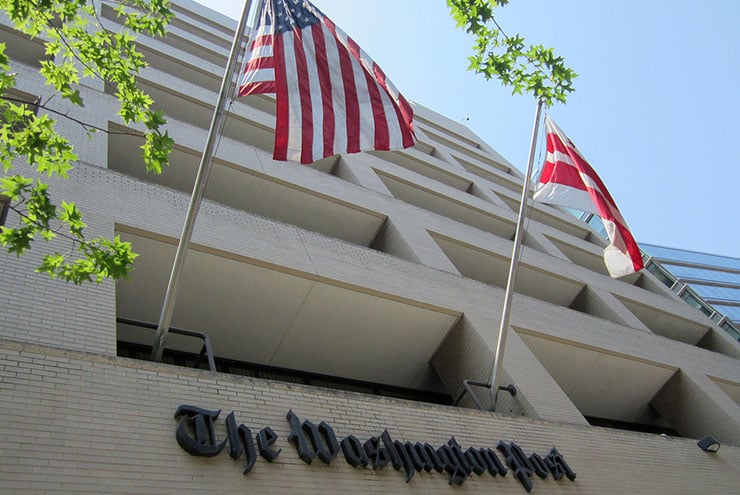
Last Thursday, the radical-left, Jeff Bezos-owned Washington Post, announced the layoffs of 300 of its 790 unionized newsroom staff, along with several dozen other employees who work as editors, managers, or foreign correspondents. Entire sections of the paper, including its anemic “Book World” and its sports page, which had covered the city’s rarely triumphant athletic teams, were eliminated. Its illuminating “Metro” section, which reports on Washington’s local news, including its until-recently alarming crime scene and the city’s corruption-ridden politics, lost most of its staff, as did its lively, if biased, foreign bureaus and arts section.
Steep cuts are hardly shocking for a business that reportedly loses a staggering $100 million every year. To give perspective, Bezos bought the then-troubled Post in 2013 for $250 million, meaning that his investment has been and, without the cuts, would likely have remained, a heavy loser despite more than a decade of futile attempts to reverse the cash flow.
Still, legacy media journalists often believe they are special and serve a higher moral purpose that should place them above the normal rules and practices of labor economics. Nowhere is their massive sense of entitlement more palpable than in Washington, where government workers have led the way, suing our democratically elected government, arguing that it has no right to fire them, even in cases of gross incompetence and inefficiency. This is the same crowd of feds who routinely demand and receive full backpay for work they did not do during legal government shutdowns.
Indeed, among a crowd of hundreds of protestors who appeared almost on cue and in freezing temperatures outside the Post’s iconic Washington headquarters late last Thursday, many objected to their separation from job-issued accounts and devices and decried that they are no longer permitted to enter their former place of work. Nobody seemed to be on hand to tell them that is what normally happens when one’s job ends. Nor can millions of other laid off Americans expect to benefit from the over $700,000 in donations raised over the past week by two separate GoFundMe accounts to support the “moving costs, visa expenses, childcare, healthcare, meals and more” that are apparently required by former Post employees now that their time and skills no longer are.
Journalists are a chatty lot—perhaps not chatty enough to explain why they need childcare if they are unemployed—and many of those affected, along with their sympathizers, took to surviving legacy publications and more immediate social media platforms to blame their woes on the capital’s villain-in-chief, Donald Trump, who had no known role in the layoffs. The Post’s former executive editor Martin Baron complained in the Guardian about the sobering event, which he claims, “ranks among the darkest days in the history of one of the world’s greatest news organizations.” If the layoffs happened because of the Post’s staggering nine-figure annual losses, he may be right, but is rightsizing the paper really a “sickening effort to curry favor with President Trump?”
A more rational explanation came from Matt Murray, Baron’s successor as the Post’s executive editor, who reportedly told a company-wide call the day before the layoffs “that the company had lost too much money for too long and had not been meeting readers’ needs.” “Today is about positioning ourselves to become more essential to people’s lives in what is becoming a more crowded, competitive and complicated media landscape,” he continued, “after some years when, candidly, the Post has had struggles.” Its hundreds of former employees would do well to stop whining and look within to discover why their paper’s readers no longer wished to read their work. Of course when the chips are down, they can always blame a president they loathe.
Leave a Reply