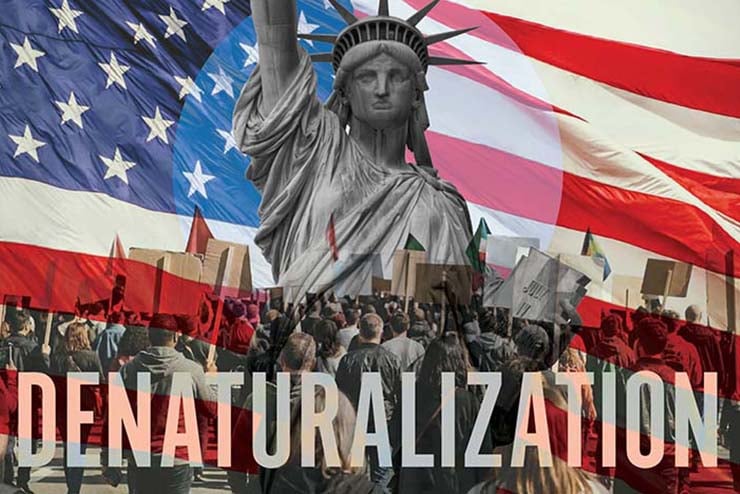
The Case for Enforcing Denaturalization
The 20th century was the American century, when the United States was the dominant, unchallenged power and the place where everyone wanted to live. Citizenship was the first casualty of that success.
At the start of the 1900s, the U.S. government was appalled at the rise of fraudulent naturalization claims. In 1906, Congress passed the first naturalization act to protect the integrity of republican government. At the end of the 1900s, the U.S. was eager to expand the citizenship rolls. In 1996, the U.S. government naturalized a record 1.1 million people to send a message about the American dream. Over 180,000 were naturalized despite improper background checks, 16,000 had criminal records, and 5,000 had lied under oath. The Clinton administration conceded it made a mistake; it promised to denaturalize the 5,000 most obvious abuses. Almost none ever were.
The failure to enforce denaturalization law marks a sea change in the way America’s leadership classes treat citizenship. At the start of the century, America was a republic, and naturalized citizenship was conditional upon meeting a set of responsibilities agreed upon at the moment when one became a citizen. The denaturalization process followed from the failure to honor those terms. At the end of the century, America’s leadership classes had reimagined the country as a universal nation. They were eager to secure U.S. citizenship for the world as expeditiously as possible.
Instead of mending breaches within the American social contract caused by lax immigration law, officials were more concerned about protecting international human rights. They relentlessly pursued purported enemies of humanity who violated human rights, but ignored violations of our immigration law.
Enforcing denaturalization should be a straightforward process. Our denaturalization statutes are still on the books and are legally sound, even if rarely used. It doesn’t require any complicated, comprehensive reforms to revive them. Yet because of the legends surrounding old court decisions and the imaginary fiction of America as the universal nation, we have grown squeamish about enforcing our existing statutes, and clarifying that American citizenship is not a universal right, but a privilege—one that can be taken away from immigrants who do not uphold their oaths to their adoptive nation.
The principle undergirding the old system is clear. Some naturalized citizens have broken the rules they promised to abide by when they became citizens. They should lose their citizenship. When they retain it, they cheapen its worth. The naturalization process is the place where the social contract theory that fascinated early modern thinkers makes the most sense. Via Congress, the members of a community—the republic—set explicit terms for membership in the republic. Citizenship is the offer of legal and political equality; the community agrees that any new member has the same rights as the older members. Individuals who wish to become members of the community read the terms of the offered social contract and accept them. On oath, they swear to uphold them for the rest of their lives.
This is the closest thing the secular republican world has to a marriage covenant. As in a marriage covenant, if you show you failed to understand the vows, they are voided. Love may be unconditional. But marriage is conditional on understanding the nature of the bond.
After she was denaturalized by the American government in the early 20th century, the Russian-born anarchist Emma Goldman complained in her essay “A Woman Without a Country” that citizenship “has lost its essential meaning, its one-time guarantee.” This free-thinking feminist interpreted citizenship as even stronger than the marriage bond—proving that she didn’t have a good grasp of either. No compact, not even marriage, is a one-time guarantee. Your past and future actions can be brought to bear on the question of whether you understood your duties. One who marries, then promptly abandons her spouse, likely didn’t grasp the terms of the agreement in the first place. The same can be said of one who conceals important material facts from her spouse before marriage. Both can be used as evidence in a proceeding to dissolve the marriage, so that the spouse is not held hostage to a capricious actor for the rest of his life.
Courts have long recognized that the actions of a signatory at a later point can serve to demonstrate that she never grasped the meaning of the contract in the first place—that she failed to understand its terms, or never met one of its underlying conditions. In these cases, the contract is null. The same logic applies to naturalization.
When you become a citizen of the United States, you are making a solemn pledge of attachment to the constitutional order of this country, demonstrating sound character, and signaling your intention to make this nation your permanent home. If it later emerges that you never meant any of that—that you concealed crimes, harbored contempt for the nation you swore to defend, or planned to collect your papers and depart—then your citizenship was procured fraudulently.
The present three statutory requirements for naturalization in the Immigration and Nationality Act make this concrete.
First, an applicant must show good moral character. Crucially, the good moral character inquiry is not confined to the narrow window of the application itself. The law explicitly permits the attorney general to consider an “applicant’s conduct and acts at any time prior to that period.” The question is not merely who you are now, but who you were before you came to this country, and whether you were honest about it.
Second, the applicant must show a genuine attachment to the principles of the U.S. Constitution.
Third, the applicant must be well-disposed to the good order and happiness of the United States.
On these last two points, the current United States Citizenship and Immigration Services policy manual is admirably direct: an applicant who is “hostile to the basic form of government of the United States, or who does not believe in the principles of the Constitution, is not eligible for naturalization.”
Denaturalization is the corollary of Congress’s power to establish naturalization rules. The Supreme Court recognized as much in 1917: “No alien has the slightest right to naturalization unless all statutory requirements are complied with; and every certificate of citizenship must be treated as granted upon condition that the government may challenge it.” If a certificate was procured through false evidence—or the omission of evidence—then it was illegally obtained.
It was the concern about fraud during the great wave of early 20th-century immigration that impelled a fierce riposte from the U.S. government. “We poison the sources of our national character and strength at the fountain,” President Theodore Roosevelt told Congress in 1903, “if the privilege is claimed and exercised without right, and by means of fraud and corruption.” The 1906 Naturalization Act, which was passed thereafter, was the first comprehensive federal effort to address this. That statute has provided the template for naturalization and denaturalization ever since.
Leftist and liberal critics of denaturalization see this as the beginning of a more sinister trend. In the early 1900s, with anti-immigration discourse on the rise, denaturalization, they argue, had racialist connotations. Federalizing naturalization law went in tandem with a growing call to purify the citizenry of its corrupt elements. Coupled with national security fears, an imperious executive branch used its discretion to target naturalized Americans for their political beliefs and intensify an environment of insecurity, where even native-born Americans feared losing their citizenship.
Fortunately, the courts rode to the rescue. In Schneiderman v. United States (1943) and Baumgartner v. United States (1944), the Court safeguarded the free speech of naturalized citizens. Then in the 1960s, the Warren Court issued a series of decisions to prevent citizens who lived abroad from losing their rights, culminating in Schneider v. Rusk (1964), which ruled that a naturalized American who married a foreigner and moved abroad should not lose their citizenship, and Afroyim v. Rusk (1967), which said that a naturalized American who participated in foreign politics (voting in the Israeli election) did not lose their citizenship.
Over a few decades, citizenship went from being conditional on government discretion to something unconditioned, thereafter secure from the executive branch. Patrick Weil, the author of the most detailed monograph on U.S. naturalization, The Sovereign Citizen, provides the standard narrative of this process, in which denaturalization takes its place alongside Jim Crow as another outmoded artifact of a primitive America, reformed by a progressive Supreme Court. It tells how a sovereign state was replaced by a sovereign citizen.
The details Weil draws out complicate his own tale. The Court’s decisions, even if taken as canonical for constitutional law, were narrower than they appear. None of them threatens the three principles framing denaturalization law.
Consider the details of the four Court cases mentioned above. William Schneiderman was a member of the Communist Party who had not disclosed his involvement prior to naturalization. The Court had to consider whether membership in the Communist Party itself qualified as exhibiting hostility to the U.S. Constitution. At the time, multiple, conflicting interpretations of the Communist Party existed and were not covered by statute. Schneiderman himself had never been arrested and had never delivered statements advocating violence.
Carl Wilhelm Baumgartner, naturalized in 1932, had expressed sympathy for Hitler. The government argued that he had therefore taken a false oath in 1932. But to protect his political opinions, the Court’s majority pointed out that he was a supporter of Hitler only before the 1933 Nazi takeover of Germany. In 1932, being pro-Hitler was advocating for a political party not in power. It was not advocating for a foreign government hostile to the United States.
Both cases left considerable room for Congress to exercise its own statutory authority and clarify the requirements for denaturalization, which it did thereafter. An overbroad interpretation of the First Amendment does not get the last word on de-naturalization; Congress does. The McCarran Act of 1950 defined membership in certain organizations as evidence of a breach of the naturalization compact, including criminal and Communist organizations.
Finally, Schneider v. Rusk and Afroyim v. Rusk were narrowed by Rogers v. Bellei (1971), which ruled that residency requirements for citizens born abroad were constitutional. It was Congress that later abolished residency requirements; a future Congress could reinstate them, and even accept Schneider v. Rusk by carving out an exemption for Americans married to foreigners.
Moreover, citizenship remains conditional; there is still room for executive discretion. In 1979, the Carter administration tasked the Department of Justice with denaturalizing and often deporting naturalized American citizens who had failed to disclose some aspect of their Nazi past. This program targeted 86 Americans. In 2004, the second Bush administration expanded the program’s purview to include those involved in war crimes, extrajudicial killings, and other acts of genocide. In this case, the executive branch applies the good moral character standard more widely to exclude those guilty of genocide. In his book, Weil celebrates this, but for one celebrating the “sovereign citizen,” it leads to a curious paradox. It is not the individual citizen but international human rights law that decides the exception. The state tasks itself with enforcing that.
The Warren Court helped change the perception of citizenship. A few judges stressed the rights of citizenship at the expense of its responsibilities. This displaced the republican ethos of a bounded community with the imaginary universal nation, where documented Americans strode about the world, did what they pleased, and lived where they wanted, permanently protected from their government’s sanctions by their immigration papers. It’s no surprise that as that universal nation myth took hold, denaturalization has been weakly enforced. But citizenship is always conditional on something. The rise of denaturalization for war crimes and genocide was a way of confirming the idea of the universal nation. Only the official enemies of humanity can be cast out of the bounds of the deterritorialized American community.
Denaturalization cases are still processed, though rarely. More than 22,000 Americans were denaturalized in the 20th century, mostly for moving back to their home countries after becoming citizens. In the 21st century, there are only a few hundred, mostly for fraud, such as concealing a crime committed before naturalization. The Trump administration has promised to step up enforcement efforts, and there’s plenty of room to tackle the obvious cases. For instance, Elliot Duke became a U.S. citizen on Jan. 18, 2013. Five months later, he was arrested for distributing child pornography; he had been doing this before and after naturalization. Despite the narrow timeline involved, it took 12 years—until Feb. 19, 2025—for the Justice Department to file for denaturalization (Duke’s citizenship was revoked four months later).
As the Carter administration’s 1979 innovation shows, the executive can expand denaturalization. A republic can ask its members to uphold moral standards more comprehensive than those of international human rights law. The next step would be to address those whose actions pose a real, existential danger to the good and happiness of other Americans. A place for executive discretion would be to denaturalize those who committed any serious state or federal crime shortly after becoming a citizen—say, within the first year. This, one can argue, should count as prima facie evidence that they lacked the good moral character to become citizens in the first place.
Another step would be to denaturalize those who were involved in, or associated with, organizations that manifest open hostility to the United States before they became citizens. This could cover affiliations with Islamic terrorist organizations; Western European countries have been adapting their denaturalization statutes to do exactly this for the past two decades. A U.S. list of organizations that can trigger a denaturalization process should include cartels. Last November, the Department of Justice sentenced Julio Cesar Orozco-Gomez, a member of the Jalisco New Generation Cartel, for dealing methamphetamine, marijuana, and fentanyl in North Carolina. He was a naturalized U.S. citizen. Anyone who joined such an organization demonstrates a singular incomprehension of the requirements of citizenship.
The surest path to strengthen denaturalization is through Congress. A bold step would be for lawmakers to clarify which ideologies, groups, or loyalties demonstrate hostility to the Constitution, just as Congress did in the 1950s with the Communist Party through the McCarran Act. It is important to protect First Amendment rights concerning free speech. But this shouldn’t stop one from scrutinizing past activities hostile to the Constitution. This is one of the best avenues available to target the expected growth of Islamism in the United States over the next two decades, which will begin carving out parallel social, legal, and political structures within American borders.
Most ambitious of all would be for Congress to restore residency requirements and reterritorialize citizenship. Globetrotters need to decide which country they belong to. This is particularly important to tackle because American birth tourism has become a lucrative industry. Taking advantage of loopholes in current U.S. jurisprudence, cosmopolitan parents who never intend to reside in the United States can confer U.S. citizenship on their children. Moreover, birth tourism can be mass-produced in America through lax surrogacy laws. The absence of any serious regulatory framework around surrogacy effectively means that rich foreigners can rent the womb of an American woman to breed hyphenated Americans. Plucked out of their birth mother’s arms to be raised abroad, there will be no question where they will be trained to place their primary loyalties.
The large number of those U.S. citizens living abroad, particularly in China, poses risks to national security, allowing a foreign-based voting bloc to gain leverage and influence over the U.S. electoral process. All Congress has to do is dust off the old statutes. If you fail to maintain continuous residency in the United States during your youth (the Immigration and Nationality Act of 1952 requires five years between the ages of 14 and 28), you should not retain your citizenship.
Enforcing denaturalization statutes reconnects the law to the core republican themes at the heart of the American way of life. When Abraham Lincoln’s valet, William Johnson, died, Lincoln ordered a simple inscription for his tombstone. Not “servant,” not “freedman,” but “citizen.” Lincoln believed in the republic. For him, the highest honorific the community could bestow was the title that ensured political equality amongst members. It carried the full weight of what it meant to belong to this nation, to share in its promises, and to accept its responsibilities.
We have traveled a long way from Lincoln’s world. Yet we don’t have to wait for a major reform or a new political alignment to move the system in the right direction. The tools are right in front of us, ready at hand. We just need our historical memory to remind us how they should be used.
Leave a Reply