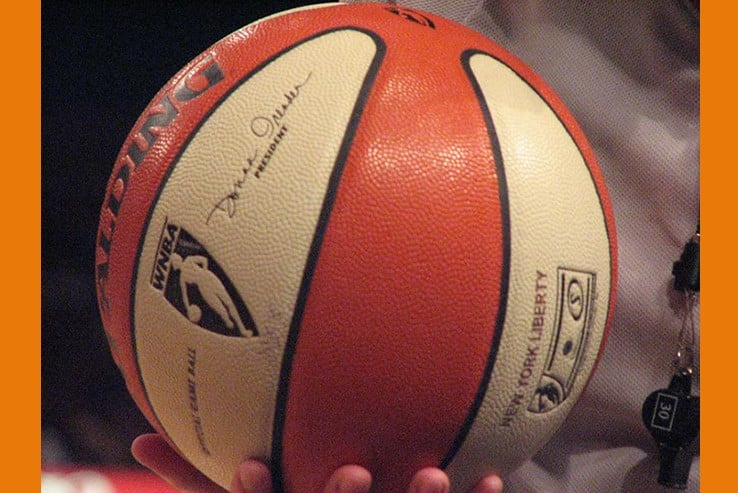
After dropping my daughter off at school one recent morning, I listened to an NPR report on the WNBA players’ new contract. I do not follow professional basketball, either women’s or men’s, but I played and dearly loved the game as a youth. So, I listened avidly to the report.
It was NPR, so the reporting wasn’t objective. The clear intention was to promote the WNBA and, more importantly, the feminist agenda of “equality of the sexes.” The NPR interviewer, A Martinez, risibly gushed over the virtues of the league, and his reporting was clearly skewed in the direction of “Look how exploited these poor female athletes are!”
Annie Costabile, a reporter with Front Office Sports, an online news site covering the sports business, described the pay raise WNBA players are getting as something that would finally allow an immiserated population to reach a minimal level of human dignity. “For the first time, this is really a livable wage,” she responded to Martinez’s question about whether, finally, finally, the struggling WNBA players would be able to survive on just their league salaries and not be required to work (that is, play) in Europe over the summer. In other words, to work year-round like the rest of us do.
What is the “livable wage” WNBA players will now receive? Costabile gave the negotiated minimum salary as $270,000 a year. The average American might be interested to hear that number given as merely “livable,” when the national average annual salary is somewhere south of $65,000. And someone should tell most of my tenured faculty colleagues at the private university at which I teach, because they make considerably less than that.
What Costabile did not mention about WNBA salaries would probably interest the average American still more. Again, $270,000 is the guaranteed minimum under the new deal. The expected average in the WNBA in the coming year under this agreement is more than twice that figure, or $583,000.
And what are the specifics of the wage slavery under which WNBA players have been toiling prior to this deal? Just for reference, the average WNBA salary this year is $102,249. That is a low six-figure salary, a little under twice the national average, which is now being raised to more than half a million dollars a year for the average WNBA player, for … throwing a ball into a hoop.
Or for trying to do so at least. Many WNBA players, and even some acclaimed stars, have demonstrable difficulties getting the thing to its appointed position, which may have something to do with the objective evaluation of their financial worth. Angel Reese, for example, who is constantly the subject of fawning media attention for her supposedly scintillating skills, has a dismal shooting percentage of 42 percent.
Let me extend the point. The WNBA uses the same rim size as the NBA but with a smaller ball, which theoretically should make it easier to score baskets. And yet, NBA team shooting percentages are significantly higher than those in the WNBA. The WNBA keeps stats on team shooting percentages by distance from the basket, and WNBA shooting rates are favorably comparable to overall NBA rates (for all shots from all distances), only from inside five feet from the basket. As soon as WNBA players are more than five feet from the basket, their shot percentages typically fall in the 30s, which is awful.
It is not just because there are no dunks that fans massively prefer the NBA to the WNBA. It is because WNBA players cannot shoot the ball as well as NBA players do. The product is simply not that great, and though attendance has grown, it is hard to see how that growth is sustained unless the WNBA game improves significantly. If there is reason to believe that is going to happen, I have not seen it.
I suppose I should not belabor the point. WNBA players demand (and their demands are now being met) to be paid exorbitant amounts of money to play games. The same thing happens in men’s sports, of course, and the salaries are still higher. Much higher, in fact. In all frankness, I do not see a moral and ethical justification in either case for paying people much more to play a game than we pay people to educate our children, or to attend to the ill in hospitals, or to ensure that the various mechanical and electric systems in our homes work safely and properly.
But in purely economic terms, there is a dramatic difference between NBA players asking for a raise and WNBA players doing the same. You may already know—and everyone who wants to have an opinion on this matter should know—that the WNBA still cannot pay its bills. Even after its most profitable year in history, it did not break even, and the NBA will again subsidize it, as it has done since the WNBA began.
Next season, when the huge new salaries start being distributed, attendance and merchandise sales will not change markedly. Even if the WNBA could manufacture 20 more Caitlin Clarks in a lab somewhere, the league’s earning potential is limited because public interest in women playing basketball is low. And I would also bet that this new pay contract turns out to be unsustainable unless the NBA is obliged to step up and cover an even larger WNBA deficit.
Nevertheless, for some voices in our culture, there is nothing that cannot or will not be sacrificed for the feminist ideal.
Leave a Reply