The Hungarian intellectual Ferenc Hörcher recently lamented that conservatism suffers from a dearth of serious theorists. This is not, it must be admitted, a new problem, if it is a problem at all. “It is commonly sufficient for practical purposes if conservatives, without saying anything, just sit and think, or even if they merely sit,” the historian F.J.C. Hearnshaw wrote in his 1933 book Conservatism in England. Thoughtful conservatives have, in fact, often cautioned against too much political theorizing—against what Michael Oakeshott called “rationalism in politics” and the speculations of those Edmund Burke identified as “sophisters, calculators, and economists.”
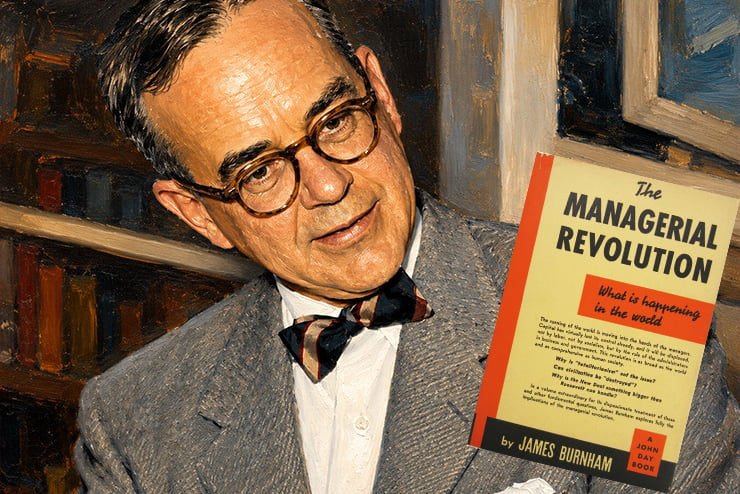
Yet there have been some men of the right who have attempted to theorize in much the same way radical system-builders do. James Burnham was one of them, perhaps the most illustrious of the 20th century. Burnham learned to think in world-historical terms from a youthful infatuation with Trotskyist Marxism. Burnham, one of the founding editors of National Review, was for a time in the 1930s a theoretician arguably second only to Trotsky himself.
But in 1941, the book that made Burnham famous also announced his rejection of Trotskyist and Marxist orthodoxy. Communists were supposed to believe that the Soviet Union was truly a workers’ state, though Trotskyists insisted Stalin had perverted it. Burnham argued that it was not and never had been. The class that ruled in the USSR was neither capitalist nor proletarian, but managerial, and the same class also held power in Nazi Germany and New Deal America. Burnham called his book The Managerial Revolution.
The managers were not the corporate middle managers common in offices today. The new class identified by Burnham was the masters of industrial production—logistics men—some of them trained as engineers. They were more than mere bureaucrats. These were men who knew how to coordinate the masses in industry and government alike. During the Vietnam War, Burnham scandalized readers of National Review by publishing an unexpected encomium to a figure who exemplified the managerial ethos: Defense Secretary Robert Strange McNamara, a “whiz kid” who’d been brought into the Lyndon Johnson administration from General Motors.
Longtime readers of this magazine are already familiar with Burnham and his concept of the managerial revolution, which was central to the theoretical work of Samuel T. Francis and continues to inform the outlook of many editors and contributors to these pages. Francis addressed a vital question that Burnham’s own work left undecided: Was America entirely in the hands of the managerial ruling class, and if so, could anything be done about it?
Burnham seemed to believe that the managerial revolution was unstoppable, yet in 1959, he published Congress and the American Tradition, which made the case for the bourgeois, classically liberal institution of the legislature against the centralizing “Caesarism” of the presidency, which was more commodious to the managerial class. His 1943 book The Machiavellians, the immediate sequel to The Managerial Revolution, appeared to sidestep the question of managerial rule and instead explored how rivalry and divisions within a ruling elite—not a specific “class,” in the Marxist sense, but the ruling clique during any phase of social and economic development—could create conditions for liberty and avoid absolute tyranny.
The alternatives Burnham put forward look something like this: either the managerial revolution can be thwarted through a vigorous reassertion of the powers of Congress and the defense of private property, or the revolution cannot be stopped any more than the industrial revolution could be stopped, but the remnants of the old regime can do some good by resisting it, however futile that resistance might be.
Francis seemed to endorse the first view, with a twist. The old regime was unsalvageable, and the conservatives who thought otherwise were at best “beautiful losers,” but a mass movement galvanized by hatred of the managerial elite, a movement of “Middle American radicals” (MARs) could succeed. Yet, in places, Francis says otherwise: MARs can only replace a soft, progressive managerial elite with a “hard” right-wing managerial elite. The managerial revolution could not be stopped, but its political character could be changed.
A serious theory should not be treated as one man’s possession. Francis built on Burnham’s foundations, and others must do the same while also repairing any cracks in those foundations. A good theory makes predictions—how do those of Burnham and Francis stand up, decades later? Francis is a prophet of the populism that fueled Donald Trump’s rise. The Rust Belt voters who delivered him the presidency look very much like the MARs Francis predicted. Trump’s politically incorrect behavior also lines up with what might be expected to appeal to MARs.
Whenever I question whether Burnham was right about the managerial revolution, I consider China: if there’s room to doubt whether America is truly “managerial” in the way Burnham imagined, the PRC appears to vindicate his predictions. China’s ruling class and political-economic system—neither capitalist nor communist in the classical sense of either term—closely match Burnham’s outlines.
There are sound reasons for conservatives to be wary of theory. Yet Burnham has given the right a very good one, and it deserves as much attention from the wider conservative world as it has long received in these pages. ◆
Leave a Reply