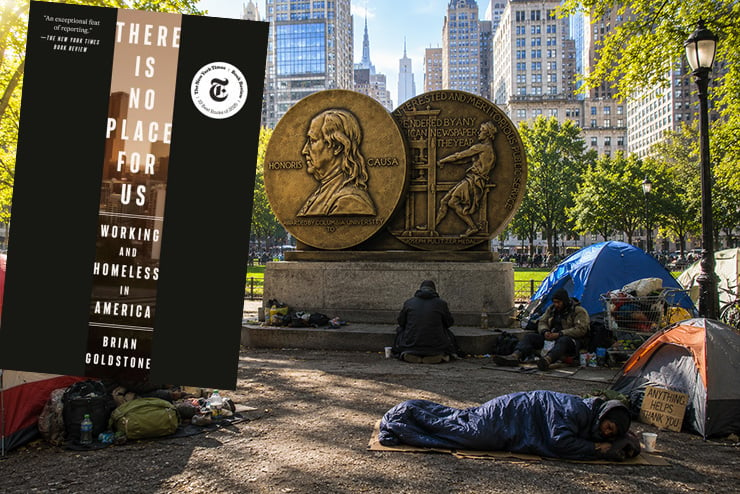
The Pulitzer Prize Board has long valued liberal credentials and left-wing narratives over substance. A Harvard degree and socialistic politics will get you further than your actual prose or journalism. The list of 2026 winners provides evidence of the Board’s typical cronyism, which we can carbon-date back to 1932. That year, the Board smugly bestowed its accolades on New York Times correspondent Walter Duranty for his hagiographic reporting on Joseph Stalin and his cover-up of the deadly effects of Stalin’s economic policies. Long before Lindsey Graham and the chickenhearted EU declared Ukraine the world’s most important country, Stalin’s Holodomor starved between 3.5 million and 5 million Ukrainians to death.
Of course, the Pulitzer Board never revoked Duranty’s indefensible award. You also won’t be surprised that this year’s journalism winners—The Washington Post (twice), The New York Times (thrice), The San Francisco Chronicle, and ProPublica—make one wonder if the Board had just asked former Harvard Law professor, Cherokee wannabe, and now Senator Elizabeth Warren to list her four favorite publications.
Meanwhile, it looks like the Board chose the book awards by pilfering Harvard Law alumnus Barack Obama’s annual top reads. The winners included Harvard historian Jill Lepore’s anti-originalist screed We the People: A History of the U.S. Constitution, for which reviewer Paul Moreno suggested a more fitting subtitle: The Anatomy of Constitutional Despair.
Those who learned their constitutional history from the Broadway smash hit Hamilton can decide whose rendering of the Schuyler sisters they prefer: Lin-Manuel Miranda’s rebellious musical version, or Harvard-educated Pulitzer winner Amanda Vaill’s speculative one, as detailed in this year’s biography prize winner, Pride and Pleasure: The Schuyler Sisters in an Age of Revolution. Better yet, go reread your high school history textbook—especially if you attended Harvard.
Coincidentally, the award for general nonfiction went to the book I chose for my undergraduate book club this spring, There Is No Place for Us: Working and Homeless in America. Lucky for the winning author, Brian Goldstone, the Board charitably decided his PhD from Columbia papered over his embarrassing lack of a Harvard degree. Based on my cursory judgment of the book’s cover, Dr. Goldstone’s text appeared to tackle a troublesome population my New York City students must contend with every day—the “homeless,” although they’re not necessarily “working.”
Atlanta’s homeless, Goldstone’s focus, differ from transients in New York. The Big Apple’s largely mentally ill homeless bed down across multiple subway seats, verbally—and, often, physically—assault passersby under what the legal system dismisses as free speech, and can’t tell the difference between a toilet and a sidewalk. By contrast, the Big Peach’s largely mentally stable homeless struggle to subsist, according to Goldstone, under the combined effects of “poverty wages, out-of-control rents, greed, racism, [and] gentrification.” Or in NPR-speak, capitalism and white supremacy.
Goldstone’s work looked promising. Sounding almost Pulitzeresque, reviewerChristina Sharpe deemed his text a “profound reckoning with housing inequality.” Sharpe, author of Ordinary Notes (a book about black life in the United States) and proud holder of three de rigeur Ivy League degrees—though regrettably none bear the crimson Veritas stamp—further praised Goldstone’s “indictment of the narrow definition of homelessness.” That supposedly limited definition of homelessness has clearly deluded me, my students, and New York City’s 8 million other residents since the state deinstitutionalized the mentally ill in the early 1970s. Our half-century of fending off aggressive panhandlers and pirouetting over human excrement duped us into thinking paranoid schizophrenia, drug abuse, and familial collapse landed you on the street.
Other reviewers have parroted Christina Sharpe’s obtuse misinterpretation. Author Roxanna Asgarian wiped away her crocodile tears just long enough to complain about Goldstone’s indictment of “a system that refuses to help” Atlanta’s “struggling families.” Kim Kelly, author of Fight Like Hell, a book about “marginalized” members of the American labor movement (by which she means women, racial minorities, and the LQBTQ+), warned that any one of us could end up in the same predicament “unless something changes on a structural level, and fast.” A nameless but probably not homeless writer at Kirkus Reviews described Atlanta as “an increasingly gentrified city that prizes property above people.” And author Jonathan Wilson-Hartgrove, who has more hyphens in his name than Goldstone’s characters have homes, reminded loyal Pulitzer prize-winner readers—who need no reminding—that “Dominant myths blame the victims.” Meanwhile, The New York Times employed a tautology from Economics 101 to describe Goldstone’s book as a study of “people with low paying jobs who can’t afford housing.”
But unlike in Walter Duranty’s dreamworld, at least no one’s starving in Atlanta. I imagine one of my (formerly) naïve book club members who emigrated from Hanoi will now feel empowered to tell her grandparents to “Get over it!” next time they brood about the enormities they endured under the Vietcong. This unwitting student almost got massacred after our session. She altruistically offered some of our leftover food to an unstable elderly vagrant who preferred some cold, hard cash to her cold, hard pizza.
The man’s culturally insensitive overreaction demonstrated society’s pressing need to educate the homeless. He could have better proclaimed his personal agency when he rejected her selfless gift by paraphrasing Ho Chi Minh’s cry for national autonomy: “I prefer to sniff French shit for five years than to eat Chinese shit for the rest of my life.” The derelict’s attempted My Lai redux on a Vietnamese student reflected poorly on all Americans. Anyway, you’ll be partly relieved to know my student regained enough composure to put the pizza box in the “mixed paper and cardboard” recycling bin, even though the half-eaten crusts inside it really belonged in the “food and garden waste” bin.
My Vietnamese student was one of just four out of 20 book club members who bothered to read the book. The media never tires of telling us that college students don’t read books. I’m here to tell you that the media is finally telling the truth. Even worse, America’s aliteracy plague has spread far beyond university walls, ivied or not. After reading the book itself, numerous reviews, and the Pulitzer Board’s praise, I’m convinced that my four students and I might be the only ones to have actually read it.
In his introduction, Goldstone foreshadows the book’s unintended conclusion when he writes, “This is a book about what we’re not seeing.” But only those who read the book rather than just skim it will avoid “not seeing.” Goldstone claims there are six times as many Americans “living in cars or hotel rooms or doubled up with other people” as government data indicate. The other “most visible manifestations” of homelessness, which only the willfully blind can miss, include “sprawling tent encampments [and] makeshift dwellings on sidewalks and under overpasses.” Goldstone suggests we replace the “hard work will lead to stability” myth with “a new narrative, a new perspective” of how our nation’s precariat “toil in vain” for housing, “one of the most basic human necessities.”
Speaking as one non-Harvard PhD to another, I humbly suggest Goldstone reread the mountains of evidence he compiled in his book and then rewrite his conclusion to comport with the cold, hard facts.
My book club members who read the book saw little common sense, let alone wisdom, in the Enlightened Class’s support for Goldstone’s argument. Instead, they harped on the destructive personal choices Goldstone’s subjects made, every single one of which was counter to what they had learned growing up. The book’s reviewers, the Pulitzer Board, and even Goldstone himself didn’t seem to notice the book’s 365-page nauseatingly detailed chronicle of the effects of out-of-wedlock births, fiscal profligacy, and physical violence as a suitable response to every problem. My students noticed. In fact, that’s about all they noticed, as proven during our discussion of Atlanta’s homeless crisis.
Club members who hadn’t read the book gasped in disbelief to learn about one homeless Atlantan, Kara, whose most recent one-night stand had unsurprisingly led to her fourth child. Each of her children has a different father, only one of whom had attended his child’s delivery. They breathed easier when Kara’s own father had demanded to know, “Where’s the father?” after her first child’s birth. But they nearly suffocated when he then warned her, “Don’t expect us to pay for your irresponsible choices,” after the fourth child. I pointed out that someone wouldpay for those four children, and gave them a hint as to who it might be: “Look in the mirror.” My students couldn’t understand why another Atlanta single mother described in Goldstone’s book rented a bouncy castle for her (illegitimate) child’s birthday party, or took out a 26.84 percent auto loan when she had no money to pay her apartment rent.
The most aggressive behavior my students engage in is when they casually snub their frenemies at parties or use mean words on social media. They couldn’t believe a pregnant woman “had been kicked and punched by her boyfriend.” No one carries an “Uzi-style weapon” in their dorms, or even in the scary drug-dealing zone of New York’s Washington Square Park, our makeshift university quad. They’ve never heard “a volley of automatic gunfire.” Then again, none of them has spent time in the Atlanta precincts where Goldstone did his research. I love to ask them how their parents would react if they had an unintended pregnancy by an unknown father and, as a result, planned to drop out of college. I then suggest they defuse their parents’ rage by blaming gentrification—and avoid any mention of bouncy castles.
America’s “homeless crisis” has many causes, as Atlanta’s microcosm shows. I recently heard Heather Mac Donald say on a podcast that if she were granted one wish to eradicate poverty, it would be to stop out-of-wedlock births. Chronicles readers know why she said that. My 18-to-22-year-old college students also know why. Fatherlessness exacerbates homelessness, as Goldstone shows. This shouldn’t be difficult to understand—even if you went to Harvard. ◆
Leave a Reply