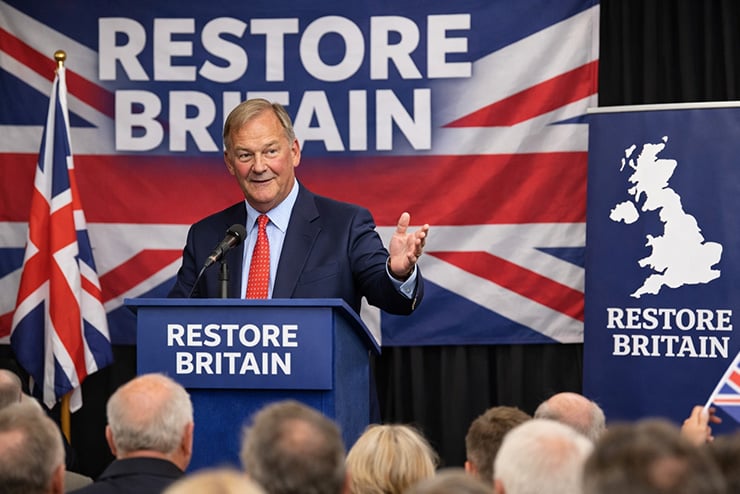
In Mid-March, Restore Britain, led by Rupert Lowe, a party that has existed for four weeks, gained more members than the Conservative Party, which has existed in some shape or other for over 350 years.
How has this extraordinary fact come about? British patriots are tired of treachery. After 14 years of abject failure and record immigration under the Tories, Nigel Farage’s Reform UK party was supposed to represent a break with the past. It promised to be an anti-establishment force that would finally crush the Labour-Tory uniparty in the next general election. But Farage has already betrayed this promise by sidelining patriots, inexplicably tacking to the political center, and recruiting—quite literally—the very Tory MPs who gave us those 14 years of hurt in the first place.
On top of this, Farage personally betrayed Rupert Lowe, throwing him out of Reform, and even tried to get him arrested for allegedly bullying and threatening the Reform party chairman. Lowe’s only real “crime” was daring to overshadow the boss. Enter Lowe’s Restore Britain as an insurgent anti-establishment party rapidly rising to challenge Britain’s establishment Conservatives, who are yet again “Reform-ing” themselves—just as they did in 1832 under Peel, in 1867 under Disraeli, in 1951 under Churchill, Eden, and Macmillan, and in 1979 under Thatcher—shapeshifting to avoid destruction, like the liquid metal T-1000 robot from Terminator 2.
If Americans know Farage, it is as “Mr. Brexit,” a supporting character in a larger MAGA ensemble. This paints him as a “British Trump,” which obscures more than it reveals. Over 30 years in British politics, Farage has consistently served three roles for the establishment: first, he has acted as a safety valve for the Tory Party to vent off right-wingers; second, he has worked tirelessly to co-opt or condemn any political movement to the right; and third, he has not allowed any of his parties—the UK Independence Party (UKIP), the Brexit Party, and now Reform UK—to become more important than himself and his considerable ego. Farage’s parties have been glorified one-man bands, conveniently folded up and put away when their job—containment—is done.
Supposedly a foe of the permanent establishment, Farage’s actions have an uncanny habit of helping it. For example, the rise of UKIP in the 2010s helped to destroy the right-wing British National Party, which had been gaining ground. In July 2016, after finally achieving Brexit, Farage immediately resigned, leading to the collapse of UKIP and the jettisoning of its infrastructure. Farage then came back with the Brexit Party, only to stand down in the 2019 election to give Boris Johnson a clear run. That resulted in the Tory landslide, which led to the great betrayals on immigration of the early 2020s. Again, the Brexit Party was packed up like a folding chair, and allies such as its founder, Catherine Blaiklock, were betrayed.
Reform UK started life as a splinter from the Brexit Party under Richard Tice. As Tice built it up, Farage focused on bolstering his already considerable fame by appearing on the hit reality television show I’m a Celebrity… Get Me Out of Here! in 2023. But then, in early 2024, it was revealed that Tice was only keeping the seat warm. Farage parachuted in as leader with a new set of betrayals, including the sidelining of Ben Habib, to make room for the (still mysterious) Svengali figure, Zia Yusuf.
In the general election of July 2024, Reform won four seats and entered parliament with Farage, Tice, Lee Anderson (a former Tory), and Lowe as members. Over the coming months, Farage held few meetings, was frequently absent from the House of Commons (and his home seat, Clacton), and seemed more concerned with show business than politics. He seemed to lack urgency and focused on trivialities. During this period, he was outshone by Lowe, who amassed a considerable social media following with his bold, no-nonsense, and forthright style. Lowe would say things about controversial topics such as the grooming gangs and immigration, which garnered broad public support and made Farage seem overcautious and timid in comparison. Lowe also proved more energetic and organized as a parliamentarian.
This was intolerable for Farage, who removed Lowe from the party in March 2025 and accused him of bullying and threatening behavior towards Yusuf, even going so far as to call the police! All charges were subsequently dropped. Later, Farage shifted the reason for Lowe’s removal to his “extremist” rhetoric on mass deportations, which Reform subsequently adopted. Since then, we have seen a pattern of Farage “copying Lowe’s homework” and using the same tactic of first calling him racist, and then adopting his policies wholesale.
In addition to all this, unlike Trump, Farage has refused to embrace “the online right,” whom he disparages and gatekeeps out. Thus, unlike MAGA from 2016 to 2024, there is no “online energy” for Reform—this has now all been taken by Lowe’s Restore. Reform dismisses the hundreds of thousands of people who watch political YouTube shows, listen to podcasts, or follow large X.com accounts as “terminally online.” In reality, Reform has become “terminally Westminster” and trapped in a sort of Boomer bubble. Farage has campaigned like a sideshow carnival barker who seems to think it is 1996, not 2026.
Many voters in Britain are sick of charlatans and fakes, which is why Lowe and Restore are now rising, at the moment when Farage and Reform appear to have peaked and entered freefall. ◆
Leave a Reply