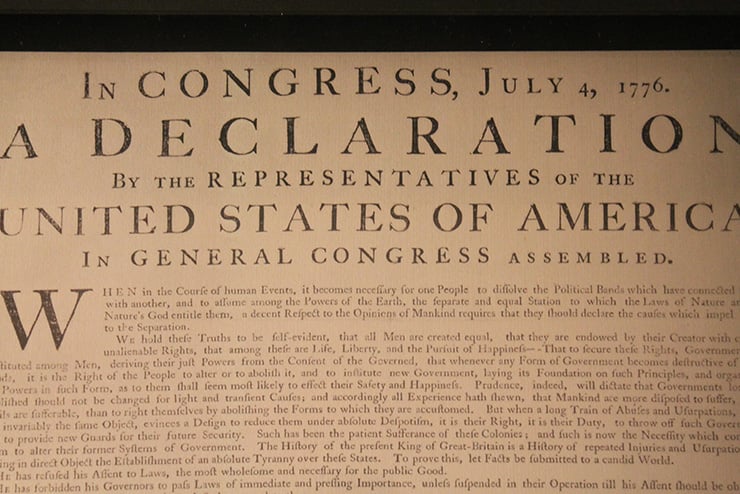
Conservatives don’t need a special occasion to debate what it means to be an American. One line of argument on that topic has remained unbroken since 1959 and ’60, when Harry Jaffa published Crisis of the House Divided and Willmoore Kendall reviewed it critically in National Review. The Jaffa-Kendall controversy evolved into a running battle that, over the decades, has involved such intellectual combatants as M. E. Bradford, George Carey, and, recently, Michael Anton and Chronicles Editor Paul Gottfried.
Jaffa argued that Abraham Lincoln understood the Declaration of Independence as America’s philosophical charter—it established us as what some would call a “proposition nation,” and others have lately described as a “creedal nation.” In Jaffa’s account, Lincoln went beyond the intentions of the Founding Fathers themselves in doing this. Kendall warned that if Lincoln could use the “promise” of the Declaration to redefine America, so could any of today’s enterprising left-wing ideologues.
Today, the left takes the equality enshrined by the Declaration to mean male transvestites are equivalent to women and illegal aliens are equivalent to U.S. citizens. Nor are leftists the only ones who believe that a labor force here is no better than a labor force anywhere else. Equality knows no limits, and universal rights and laws make no distinctions of person or place.
Jaffa did not agree with the left’s interpretation of equality, and in fact, he and his “West Coast Straussian” students are staunch opponents of leftist racial and sexual politics. Jaffa’s own writings about what follows politically from the unnatural character of homosexuality are as right-wing as any traditionalist conservative could ask. For that matter, anyone imagining that America had “liberal” origins consistent with liberalism today should read about Thomas Jefferson’s proposed penalty for homosexual practices.
Even if this July Fourth were not the 250th anniversary of the Declaration, the debate over “creedal nationalism” would have renewed significance in light of President Trump’s America First agenda. The left and some in the center-right believe putting Americans first is wrong, because what is an American anyway? Those who think this way choose to believe the only alternative to abstract, universal Americanism is harsh ethnonationalism that rejects the possibility of anyone who isn’t of WASP descent becoming an American. Only some whites (but not all) are true Americans, according to this caricature.
Writing in The Wall Street Journal late last year, the historian Gordon Wood lent his considerable academic authority to the cause of creedal nationalism, though he did allow that “no nation should allow the percentage of foreign-born residents to exceed about 15% of its population.” Wood’s creedal nationalism may sound moderate, but it was received eagerly by those, like the WSJ editorial board, who are passionately devoted to open borders.
Creedal nationalists have a problem. If the American creed is universal, one must wonder what’s specifically “American” about it—or what’s American about America itself, for that matter. Most creedal nationalists aren’t really “nationalists” at all, and only go so far as to say America was founded upon and best embodies universal rights and laws: our distinctiveness is our universality. If that seems paradoxical, so do the mysteries of many faiths.
Any group of people could, in theory, adopt a belief that all men are created equal and endowed with rights to life, liberty, and the pursuit of happiness. Would that make another America out of whatever place those people happened to live? Obviously not. On the other hand, it’s not race or language that makes a nation: America didn’t separate from Britain over such differences 250 years ago, and while Americans are geographically distinct from the British, we share our continent with white, Anglophone Canadians who are nonetheless not Americans. The divisions between America and England, and America and Canada, are at root political.
But is politics really enough to constitute a nation? For centuries, the nations of Europe were creedal nations in the proper sense of that term—membership in the nation meant belonging to the national church and ascribing to its creed. America in 1776 was exceptional in not having a national church. Americans were mostly Christians, but they were not defined as a polity by a single church or creed.
Even American statesmen with Unitarian leanings—who therefore did not subscribe to the most basic of Christian creeds—questioned whether a nation could persist without a unifying religion. This is one reason John Adams opposed the disestablishment of the Congregational Church in Massachusetts. It’s one reason Jefferson’s “wall of separation” between church and state was a truly radical notion. To the Federalists, it implied anarchy, the imminent dissolution of political society itself.
By the 1830s, leaders from John Quincy Adams to the young Lincoln were trying to outline a “political religion” to fill the void left by a unifying faith. Ironically, Jefferson and his ally James Madison would become the patriarchs of a new American religion. They had fought for freedom from creeds; now their own theologically diffident views were the basis for one. Jefferson, who was an intolerant apostle of tolerance in many respects, would not have been embarrassed. But we have to think seriously about what this creed, in place of the old Christian creeds, can and cannot do—and what it should and should not demand of a citizen’s conscience. ◆
Leave a Reply