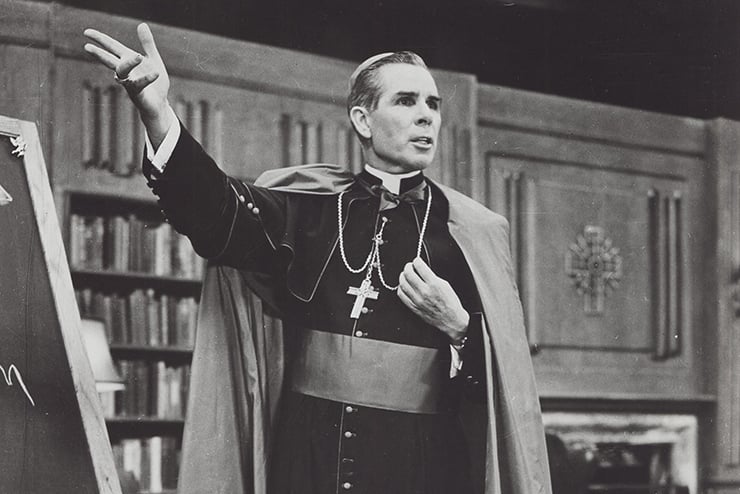
America’s First Televangelist
Born in 1895 in El Paso, Illinois, and baptized Peter John, America’s first televangelist was known by his maternal grandfather’s name, Fulton. The Sheen family owned several farms, and Fulton and his three younger brothers worked them all.
“All the time that we were in school, my mother and father, both of whom believed in hard work, sent us out to one of the two farms they owned by this time, east and west of the city of Peoria,” Sheen recalled. “My brothers rather enjoyed farm work; I suffered it.”
Sheen’s humble origins on the farm were so different from the international fame he would later enjoy as a celebrated public intellectual and the first televangelist. He reflected on this stark change in his circumstances in his 1980 autobiography, Treasure in Clay:
Those who know me now find it hard to realize that there was once a time in my life when I plowed corn, made hay while the sun shone, broke colts to harness, curried horses, cleaned their dirty stalls, milked cows morning and night and in cold, damp weather shucked corn, fed the pigs, dug postholes, applied salve to horses cut by barbed wire, fought potato bugs on the day that a circus came to town, argued with my father every day that farming was not a good life and that you could make a fortune on it only if you struck oil.
Sheen’s childhood was that of a quintessential American statesman, born and raised in middle-class simplicity, compelled to work hard, to do physical labor from a young age, outside among growing things, animals, and the natural order. He wrote:
The determining mold of my early life was the decision of my parents that each of their children should be well educated. This resolve was born not out of their own education, but their lack of it. My father never went beyond the third grade because his father felt he was needed on the farm. My mother had no more than an eighth-grade education at a time when there was one teacher for all the grades.
Sheen’s first work was farming, though he disliked it. He yearned for books and time to study; he excelled in school and knew from the earliest age that he had a vocation to the priesthood. His divine calling led him to pursue a doctorate in philosophy from the Catholic University of Leuven in Belgium in 1923. His rare work ethic honed on the farm propelled him to the completion of an advanced “super doctorate” in 1925, the first American to achieve the university’s prestigious agrégé in philosophy. Sheen’s rigorous education shaped his intellectual foundation and made him the toast of Europe. His tireless devotion to study and his sharp, disciplined mind distinguished him from every other contemporary man of the cloth.
“Without ever expressing it in so many words, I was brought up on the ethic of work,” Sheen wrote. “Not only because it was parental training but perhaps because it was already ingrained in me, the habit of work was one I never got over, and I thank God I never did.”
Sheen was undoubtedly blessed with a unique speaking ability and had a charming way of expressing himself. Above all, he was a profoundly devoted and serious student, and sometimes spent hours preparing his sermons and talks. His autobiography details his method for preparing for public speaking later in his life, which involved no notes and no written transcript. He would study the material and make himself write out his arguments over and over from memory, until the components of what he wanted to say were so ingrained in his mind that his argument would flow naturally. The effect was as if all the ideas he discussed were his own, not products of his study, so he could talk for hours without notes, reasoning through difficult, complex subjects with great clarity. He estimated that one hour of his television show took him 30 hours of careful preparation. On top of this workload, he replied to as many letters and inquiries as he possibly could, which came into his office by the tens of thousands.
The toast of European intellectual circles during his academic career, after completing his education, Sheen was quickly called back to America by his bishop, who sent him into the proverbial wilderness to help run a poor, nowhere parish in Illinois. His bishop secretly intended to place him at the Catholic University of America after he graduated, but wanted to test Sheen’s obedience and humility first by sending him into obscurity for years as a poor parish priest. Sheen taught the uneducated poor of his parish and enjoyed life as a curate, assuming it would be the zenith of his professional calling.
After faithfully serving his time in obscurity, Sheen was finally sent to teach at Catholic University in the late 1920s. When the Catholic candidate Al Smith ran for president in 1928, an explosion of anti-Catholic bigotry erupted, necessitating a response from the Church in America. Sheen was the obvious pick to present it. He was given a weekly radio show called “The Catholic Hour,” which he did for 20 years, until television became the dominant medium and his public evangelization was rerouted to his 1950s TV show Life Is Worth Living, which paid Sheen $26,000 an episode. Over the course of his 16 years as National Director of the Society for the Propagation of the Faith in the United States, Sheen directed over $200 million—including $10 million of his own income from television and radio—to missionary churches in Africa, Russia, China, and South America.
Sheen’s radio hour helped define and publicize a Catholic patriotism in an era when some still questioned whether Catholics could be proper American citizens. Sheen, versed in the philosophy of Thomas Aquinas and Aristotelian virtue ethics, worked tirelessly to reframe patriotism not just as compatible with Catholicism but as the fulfillment of Catholic social teaching. He argued convincingly, week after week, that the loss of God and religion in America was, in fact, the same phenomenon as the loss of patriotism and love of neighbor. Love of God, love of country, and love of neighbor are rooted in the same virtue of piety, and “when one goes out, all go out.”
Sheen saw that the American right and the Catholic Church were engaged in battle with the same enemy: atheistic communism. Unlike some of today’s Catholic integralists, Sheen did not identify the power of the Church with the power of the State but instead insisted that the authority of the State rested in the consent of the governed. “God could save us from our chaos and our slavery by force,” Sheen said, “but that would be the destruction of liberty. God awaits man’s free and unforced response to His call, that is why His last farewell to the world was from the powerlessness of the Cross where His eyes could summon us to the sweet purpose of life.” The Church cannot rob individuals of their freedom by compelling belief, but rather “begs us to seek the things that are above, to rise in our minds with Christ in His Glory.”
Sheen saw all the political problems of his time as fundamentally spiritual. His political philosophy contended that the factions united against Soviet Communism, which would eventually compose Ronald Reagan’s “three-legged stool,” were not three separate coalitions loosely dependent on one another for electoral advantage, but in fact united by a common political philosophy he called Americanism. Robust anti-communist defense, economic freedom, and traditional morality or self-governance—the three legs of the stool—all rested on a proper understanding of human nature and the purpose of government in facilitating what man is and ought to be.
Sheen’s political philosophy of Americanism argued that this proper understanding of human nature and the purpose of government was the essence of Catholic social teaching. Anti-Americanism, communism, envy of the rich, lack of empathy for the poor, and the growing refusal of citizens to be self-governing are rooted in secularism, or the removal of God from public life. “Americanism, as understood by our Founding Fathers, is the political expression of the Catholic doctrine concerning man,” he said.
Sheen was fond of rhetorical paradox and frequently employed it to shock audiences into attention. His political philosophy of Americanism insisted that not only are Catholics capable of being patriotic Americans, but the Catholic is an American par excellence, as only Catholic social teaching places man where he ought to be with respect to both God and the State, such that his political liberty may be in line with both his individual good and the good of the whole.
Thus, the defense hawk, the fiscal conservative, and the cultural conservative are not three isolated factions hastily formed into a political coalition, but rather essential attributes of the same freedom insisted upon by Catholic doctrine. Man must not be subordinated totally to the social or political order, and the social order must not be cast off in search of license or duty-free libertinism.
Fulton Sheen’s enduring contribution to the political philosophy of the American right was to hold in tension all the seemingly contradictory components of the pro-freedom, pro-morality, pro-American coalition he believed necessary to defeat the Communist specter.
“See, our county has theological foundations. In other words, our Declaration of Independence is a declaration of dependence. We are independent because we are dependent on God. If we wish to keep our rights and liberties, we must also keep our God,” he said in a sermon. “Piety and patriotism go together. That’s the first glory of being an American.”
Sheen’s Americanism promoted a strong military and fierce national defense that nevertheless kept itself in bounds and abstained from the fascistic tendency to deny the rights or consent of the governed. Americanism champions a strong economic power that is the sum of discrete individuals freely exerting their right to private property and enjoying the fruits of their own labor, while simultaneously honoring the debt each owes to his nation for securing his God-given freedom, and protecting him against those who would enslave him. And finally, Americanism fosters a moral and religious engine of culture and civil society, true to its beliefs, while also allowing pluralism in the public square, and prioritizing freedom of conscience over forced conversion.
Using his radio and television programs, Sheen presented his Americanism as Catholic social teaching in practice.
The modern error of secularism, Sheen argued, was initially favored as a means of avoiding sectarian violence in a pluralist society, but removing God from public life only served to embolden the state, as the retreat of Jews, Catholics, and Protestants from the public discourse allowed the State to reframe the relationship of man to itself, overstepping its boundaries and claiming ownership of its citizens by setting itself up as the bestower of liberty.
Quoting the opening of America’s founding document in one of his radio programs, Sheen said, “Notice these words: The Creator has endowed men with rights and liberties; men got them from God! In other words, we are dependent on God, and that initial dependence is the foundation of our independence.” He continued: “Each person has a value because God made him, not because the State recognizes him. The day we adopt in our democracy the already widespread ideas of some American jurists that right and justice depend on convention and the spirit of the times, we shall write the death warrant of our independence.”
Secularism removes God from the discourse concerning what we owe the state and what the state owes to us. Sheen’s political philosophy was intended to put man back where he belongs: dictating to the state what it ought to be, on the basis of what man was created to be by God. “Firstly, his rights come from God, and therefore cannot be taken away; secondly, the State exists to preserve them.… The recognition of the inalienable rights of the human person is Americanism, or to put it another way, an affirmation of the inherent dignity and worth of man.”
The brilliance of Sheen’s mind is evident in his writing, where he frequently studies and delights in paradox. He had a habit of taking components of political philosophy, psychology, or theology and spinning them around in his mind to reveal all of the facets, dependencies, and correlations at once. Sheen’s methods borrow from G. K. Chesterton, whom he states is his chief influence and favorite author. Sheen’s discourse is sometimes complex, venturing one way only to double back and give exceptions, stating a firm attribute of a given subject only to claim the exact opposite attribute also takes residence in the very next sentence.
The paradox shocks the mind and bids the viewer to pay attention, fascinated by the contradiction. At first, it seems childlike and whimsical, until one recalls that the Bible is also rife with paradox: God frequently gives second-born sons the inheritance of the first-born, rewards the weak and brings the strong to heel, and claims that the poor are rich in spirit while the wealthy are impoverished. The happy fault; the crucified savior.
The truth of the matter is that only a highly disciplined mind, as Sheen possessed, can perceive, isolate, rotate, understand, and finally deploy the full paradox of reality. This ability is essential in political philosophy, which considers the multifaceted dependence of man upon the state, the state’s duty to man, and the ordering of the political in alignment with the divine law and natural justice.
In a similar way, the comedian first understands his audience’s anticipated outcome, and thus can deliver the hilarious punchline, forcing one’s mind to consider conflicting elements, holding that chaos in tension while examining the nature of the relationship between the opposing ideas. This takes diligence and focus.
Because Sheen was able to do this, he was well-suited to describe the folly and half-baked nature of all the political and theological heresies of his time to his audience: the libertarian abstraction of man as an economic actor devoid of duty to neighbor and country: an individual but not a social economic actor. The chaotic soup of failed Western ideas in philosophy, sociology, and economics espoused by Karl Marx, which lacked “a single Russian idea in the whole philosophy… It is bourgeois, Western, materialistic, and capitalistic in its origin.” Sheen was able to see Communism as “a groan of despair, not the revolution that starts a new age. It is the logical development of civilization which for the last 400 years has been forgetting God.”
Libertarianism, communism, reactionary politics or traditionalism, and secularism all isolate and overemphasize one aspect of human nature, or one duty or power of the state, or one negative outcome of modernity, and run with it, failing to keep all other facets of reality in tension. Fulton Sheen’s great contribution to American political philosophy was his ability to describe all the babies these modern political heresies proposed to throw out with the bathwater, and make a compelling case to millions over the course of his life that Americanism was the better path.
One of Sheen’s most compelling paradoxes was his prescient prediction that the apologetics of the 21st century would reacquaint man with God once again, but not through the goodness of creation, the majesty of nature, or the magnificence of beauty. Sheen understood that once God was banished from public life and popular imagination, modern man would become blind to the positive proof of His existence, and would instead reach him the other way around: via the broken, shattered state of the human mind bereft of its Creator.
Sheen saw even our lost sense of right and wrong, our modern disconnection with God, as a sign of great hope, telling his audience:
The more divine the talk and the more the talk is related to the Crucifixion of Our Lord, the more it involves the unknown element of self-sacrifice to our modern pagans, the more responsive they are. The Lord is never wanting potential converts in any age. It is rather the actualization of that potency that is the problem, and that depends principally on us.
Sheen said that “there are two ways of knowing how true and good God is. One is by never leaving Him; the other is by abandoning our hearts as we de-divinize our lives.” His book Peace of Soul, published in 1949, explores the psychological prison of the modern mind and proposes spiritual solutions, not therapeutic philosophy, for the unhappy mind. In his autobiography, he anticipated people like Jordan Peterson and the bevy of podcasts focusing on the fractured, painful existence of life in the digital era way back in 1979:
There is a third approach to an electronic audience which will be in the future. It will not always be the direct, nor even the indirect which I used. It is what might be called the anthropological. I do not use this word in the sense of the science of man’s beginning. I merely mean it as the roots of the word imply—a study of man. The presentation of religion had been principally from God to man, but now it will be from man to God. It will not start with the order in the universe alluding to the existence of a Creator of the cosmos, it will start with the disorder inside of man himself. It will take all the findings of our psychological age and use them as a springboard for the presentation of the Divine Truths . . . I often wish that I were younger so that I might use this third approach which I have mentioned, namely, starting with the unhappiness inside of the human heart. The audience is always there, the opportunities are ever present.
Fulton Sheen’s path to sainthood proceeds, with beatification (the last step before canonization) scheduled for Sept. 24, 2026, at the Dome at America’s Center in St. Louis, Missouri.
Sheen will soon be known as America’s saint—a quintessential modern man formed of strong stock in the American heartland, sent to defend the faith in the arena of ideas, first mastering radio and then television media to reach millions of people, and mold America from an anti-Catholic political tradition to a political and intellectual powerhouse teeming with faithful Catholics at all levers of power. The first televangelist, a prominent and respected scholar, and an elegant and polished communicator, he raised more money for the world’s poor than any religious figure of his time, and worked tirelessly throughout his life to defeat communism, which he saw as a precursor to the Antichrist.
How fitting that he will be beatified, and perhaps canonized, by the first American pope. Fulton Sheen died in 1979 in his private chapel while at prayer, at age 84, after a long struggle with heart failure. He wrote in his autobiography that same year:
I beg Him every day to keep me strong physically and alert mentally in order to preach His Gospel and proclaim His Cross and Resurrection. I am so happy doing this that I sometimes feel that when I come to the Good Lord in Heaven, I will take a few days’ rest and then ask Him to allow me to come back again to this earth to do some more work.
Fulton Sheen, dutiful worker, obedient patriot, radiant intellect, American saint. God love you!
Leave a Reply