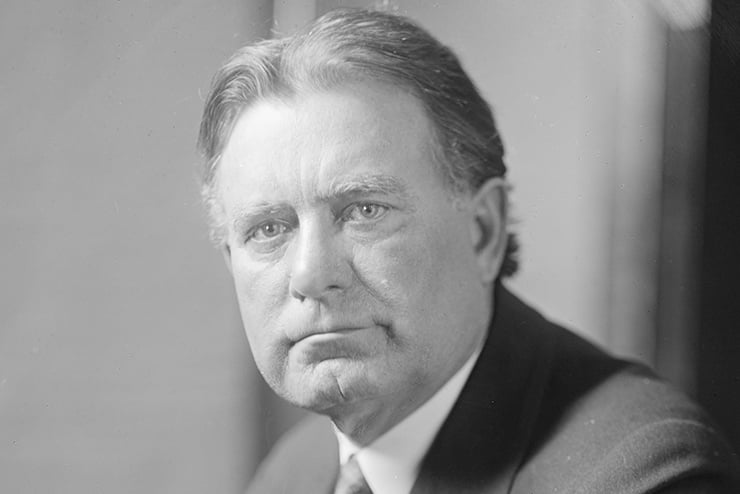
Early American Populist (1865-1940)
Long before Donald Trump and the Make America Great Again movement, before Pat Buchanan and his Buchanan Brigades, at a time when the terms “populism” and “nationalism” were seen as incompatible with the Republican Party, there was William Borah.
Eighty-six years after his death, still revered in his home state of Idaho (where he holds the record as its longest-serving U.S. senator and is honored with a statue in the National Statuary Hall), William Edgar Borah is inarguably a figure of historical consequence. He is also a precursor and midwife—if not a founding father—of the increasingly dominant populist faction within the Republican Party.
Borah began his political career as a Republican who broke ranks with his party during the 1896 election to support the presidential campaign of populist Democrat William Jennings Bryan. Borah was inevitably a figure who upset so-called regular Republicans with his often contrarian stands. When he was elected to the Senate in March 1907, he was a self-styled “Bryan Republican” who reached across the aisle to support measures such as popular election of senators (before the 17th Amendment of 1913, U.S. senators were appointed by state legislatures).
When Democrat Woodrow Wilson was elected president in 1912, Bryan backed much of Wilson’s New Freedom agenda—but not all of it. He was one of 25 senators who opposed the 1913 Federal Reserve Act, which created the central bank system that oversees interest rates.
Borah felt there was too much power in the hands of too few. Like Pat Buchanan generations later, the Idahoan completely distrusted Wall Street. Just as Borah railed against the Fed and the big banks for the crash that brought about the Great Depression, Buchanan would denounce the “idiot bankers,” and “the Big Kahuna … the Federal Reserve” for the financial panic of 2008.
Borah reluctantly supported Wilson’s declaration of war during World War I. But he later became an “irreconcilable,” those whom Wilson bitterly decried as “that little band of willful men” who stopped U.S. entry into the League of Nations. Borah also used his influence as chairman and ranking member of the Senate Foreign Relations Committee to keep the U.S. out of the World Court.
The Gem State lawmaker’s commitment to noninterventionism and avoiding war at all costs was lifelong and unyielding. Were he in the Senate today, Borah would surely question the wisdom of U.S. military actions in Venezuela, Cuba, and Iran, having opposed during the 1930s “gunboat diplomacy” and America’s heavy hand in Latin America.
He also fiercely opposed U.S. involvement in the war in Europe during the late 1930s and, in what was called the Great Debate of 1939, Borah led a bipartisan coalition of senators who stopped Roosevelt’s repeal of the Neutrality Act, which the president tried to do in order to give aid to nations at war with Germany.
“I am proudest of doing what little I have been able to do to keep us out of Europe,” he told reporters. “I mean in terms of abiding by George Washington’s advice to avoid entangling commitments. I do not mean isolation in terms of trade and economic matters and so forth.”
Borah rose to prominence at a time when technologies like the internet, social media, and television were beyond the imagination of even the Buck Rogers comics that ran in the daily newspapers. When newspapers and radio were the only mass media, Borah dominated those formats through his masterful oratorical prowess. With his booming basso profundo voice, big gesturing hands, and shock of black hair, the gentleman from Idaho cut a compelling figure on the Senate floor, and he could pack the press and visitors’ galleries on any day he chose to speak.
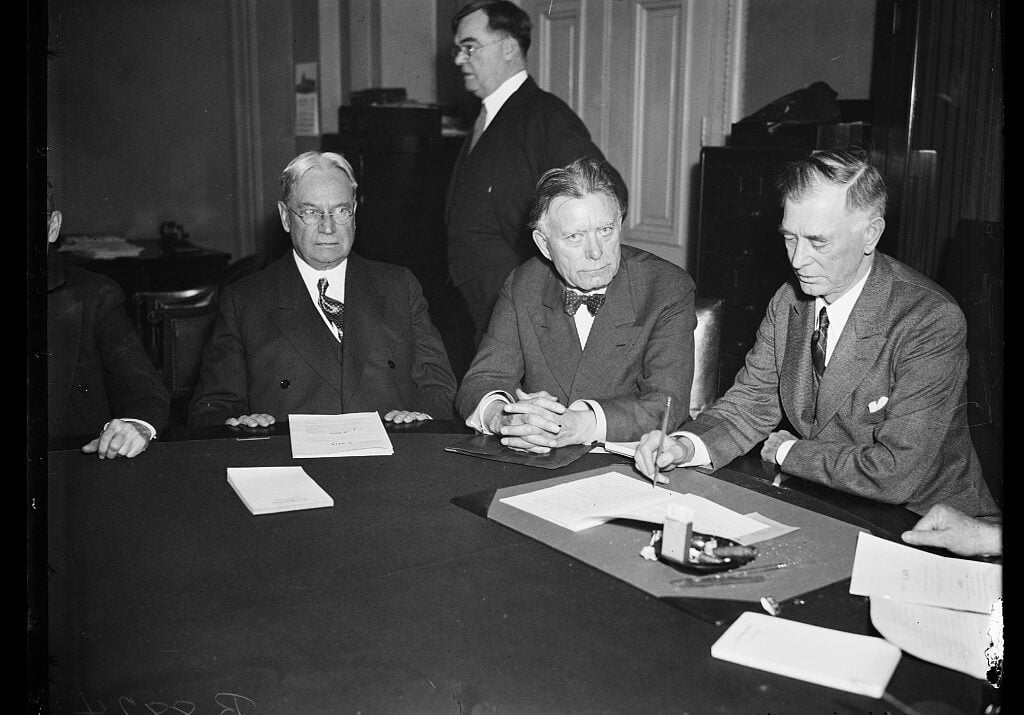
(Library of Congress / public domain)
Borah had honed his natural oratorical skill through his experience as a trial lawyer and during his brief stint as a Shakespearean actor. He rose to international fame with his crowning achievement, his Nov. 19, 1919, speech against the League of Nations, which is considered one of the greatest speeches ever delivered in the Senate, and which dealt a deathblow to President Wilson’s idealistic plan. His remarks were so eloquent and persuasive that senators openly wept at his conclusion. Afterward, the Senate’s presiding officer and Wilson’s own vice president, Thomas Marshall, sent Borah a note that read, “Even a mummy on a pedestal could not remain silent after such a speech.” The British ambassador, Viscount Grey, remarked, “I have watched this debate most carefully and in all my experience, I have never heard a debate on a higher plane than that was conducted by Senator Borah.”
Borah had been considered a potential Republican presidential candidate since his freshman term in the Senate, and speculation about his ambitions grew along with his fame. Yet Borah was also independently minded and irritated Republican leaders by breaking with the party line. He was also not likely to accept playing second fiddle as a vice presidential candidate. An apocryphal story holds that in 1924 President Calvin Coolidge asked the rising political star if he was interested in a place on the national ticket. Borah is said to have replied without hesitation, “Which place, Mr. President?”
He was most interested in the job in 1936, when a poll of party chieftains showed him to be the favorite. Nevertheless, the GOP leaders who then controlled the nomination process opted for the more moderate and more malleable candidate, Kansas Governor Alf Landon—probably because they realized that Borah was uncontrollable.
In a eulogy following Borah’s death in 1940, Sen. Arthur Vandenberg, of Michigan, hailed his colleague from Idaho as one of those senators “in the company of [Henry] Clay, [Daniel] Webster, and [James G.] Blaine as a statesman who failed the presidency but outshone successful rivals.”
Borah once expressed this idea more simply in 1928, telling his supporters, “I would rather be Borah than be president.”

The son of a prosperous farmer and devout Presbyterian, William Borah was born in Fairfield, Illinois, in 1865. The future senator’s “first love was not statesmanship or politics or even the law, but the theatre,” C. O. Johnson wrote in his biography, Borah of Idaho. “His first ambition was to be an actor.” While working on his father’s farm, he practiced his oratory before the mules. The call of the stage was so strong that young Borah ran away from home to join an itinerant Shakespearean theater troupe. He secured the role of Mark Antony in Julius Caesar, but after three weeks without wages and a dwindling food supply, he returned home for his parents’ love and a guarantee of three meals a day.
Borah decided to become a lawyer rather than an actor and, while living with his sister Sue and her husband in Lyons, Kansas, began studies at the University of Kansas. A bout with tuberculosis, however, stopped Borah from securing a degree. Under his sister’s care, he conquered tuberculosis and, under the aegis of her lawyer-husband, began “reading for the law”—a practice widely accepted in the U.S. at the time, through which one could become an attorney with neither a college nor law school degree.
Borah served a stint as Lyons’ city attorney before deciding, like so many of his generation, to “go West” to make his fortune. He went as far as his meager savings would take him, stopping at Boise, Idaho, which was then the “wild West”—a town full of cattle rustlers, horse thieves, and gamblers. It was in that frontier town where Borah’s legal career flourished, and he became a renowned lawyer.
In celebrated trials, Borah successfully prosecuted one Jack Davis for the murder of two sheepherders (though Davis was later pardoned), and in 1907 tried William “Big Bill” Haywood, along with two other members of the Western Federation of Miners, for the murder of Governor Frank Steunenberg during a miner’s strike. Haywood was acquitted in large part because his attorney was the most celebrated American lawyer of all time: Clarence Darrow. Though Borah lost the trial, Darrow praised the young prosecutor as “the ablest man” with whom he had ever dueled in court.
After those high-profile trials, Borah’s prominence in the legal profession soared, and he landed big retainers, including from Idaho’s largest lumber and mining companies. Borah “had amassed $100,000 before he went to Washington,” Current Biography wrote in a 1940 profile of Borah just after his death. In 1907, $100,000 was worth the equivalent of $3.5 million today—a tidy sum for a man of humble origin to have amassed by his early 40s.
With his financial situation well secured, Borah plunged into politics. He became the Republican state chairman and in 1895 married Mary McConnell, daughter of Idaho’s Republican governor, William J. McConnell. Borah had met “the boss’s daughter” while campaigning for her father.
Like many Republicans who considered themselves “progressive,” Borah was attracted to the 36-year-old Democratic nominee for president, William Jennings Bryan. Borah, in fact, tried to run for Congress in 1896 as a “Bryanite Republican” and stumped on a platform of reigning in banks and other big businesses, instituting the popular election of senators, and a graduated income tax.
It goes without saying that such a platform did not endear the young Republican hopeful to the more conservative elements in his party. Borah lost his first bid for office that year, as he did in a subsequent bid for the U.S. Senate. That was in 1904, when senators were still elected not by popular vote but by state legislatures.
“Send me absolutely free or not at all,” Candidate Borah told the legislators. They opted for the latter because he would not go along with a deal forged by the ruling caucus in the legislature. After years of speaking out against what he called “King Caucus,” Borah was finally picked for Idaho’s other Senate seat in 1908.
Much as contemporary republicans such as Rand Paul, Thomas Massie, Josh Hawley, and JD Vance have at times broken with the party over matters of principle, freshman Senator William Borah of Idaho was widely noticed by the press for often going against the grain of the Republican establishment. Borah frequently sided with Democrats against his party’s leadership in order to enact populist reforms.
When Democrat Woodrow Wilson came to the presidency in 1912, Borah eagerly pledged to help the new president pass legislation that he believed would improve the lives of common Americans. “If you ask me if I am a Republican, I answer ‘yes,’” Borah said, “As I understand Republican doctrines. I am a Progressive, but I want to fight inside the old party.”
How could someone, a modern reader may wonder, agree with the reform agenda of Democrats and, at the same time, insist they “understand Republican principles?” That Borah could proudly claim both sums up the philosophy of populism, both in his time and ours. Populism follows no set party line but borrows from disparate ideological dishes.
“It depends on what populists you’re talking about,” Georgetown University Prof. Michael Kazin, author of The Populist Persuasion and the much-praised biography of Bryan A Godly Hero, said in an interview for this article. “As I’ve argued for decades, it’s an essentially contested concept.”
Using Kazin’s definition of populism as an adaptable ideology, one can easily identify an undercurrent of populist thought that has existed in both parties from Borah, to George Wallace, to Ronald Reagan in his early presidential campaigns, to Pat Buchanan and Donald Trump. All would, on occasion, veer outside of the traditional boundaries of left and right in order to speak directly to the concerns of working Americans who felt abused by both parties.
David Pietrusza, author of six much-praised books on presidential election years, put it another way. “If populists favored either a conservative or a liberal ideology, well, they would just be conservatives or liberals,” he said in an interview for this article. “But they are not. They march to the beat of their own drum—and often that drum is designed to launch a parade of disaffected, angry voters.”
Borah’s cooperation with the Democrats suddenly ended after the Great War, when he perceived that Wilson’s agenda was no longer helping the common man against wealthy business interests, but empowering a new foe: big government. Wilson’s post-World War I plan for a League of Nations, in which nations of the world would debate and vote on international issues rather than go to war, set off alarm bells for Borah. This would be an offense against the sovereignty of nations, he felt, and a violation of George Washington’s admonition to avoid “entangling alliances.”
In 1919, Wilson took the unprecedented step of going on a nationwide whistle-stop campaign not for an election, but to promote the League of Nations treaty. Borah became the face of the opposition to Wilson’s plans and shadowed the president’s travels with his own cross-country tour. In the Senate, Borah led the opposition to the treaty, which the pro-Wilson press attacked as “The Battalion of Death” (the League of Nations was supposed to end all war, after all). Borah’s spell-binding Nov. 19 address on the Senate floor killed the League of Nations once and for all.
President Wilson was known to hold grudges, but surprisingly, he held no quarrel with the Idaho senator. One day the retired president was being driven through Washington and spotted Borah crossing the street. He remarked to his companions in the automobile, “There is one irreconcilable whom I can respect.”
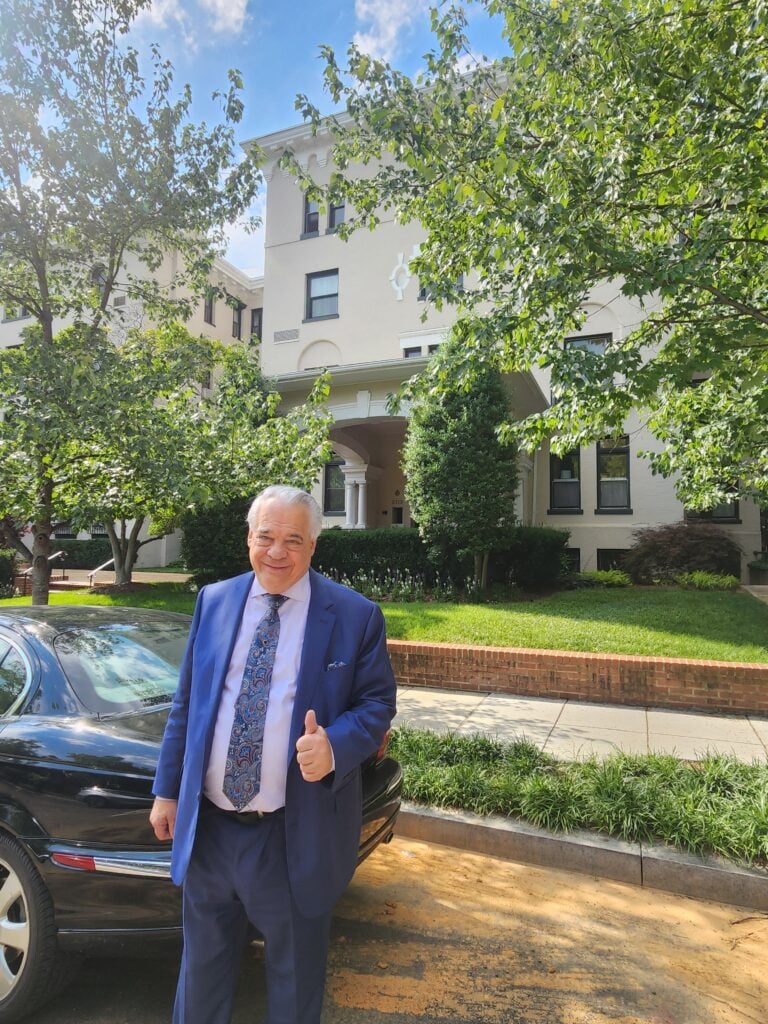
Borah’s home at 2139 Wyoming
Ave. NW, Washington, DC.
Borah’s home is still a national
landmark.
Borah earned a new nickname after his victory against the League of Nations, “The Great Opposer,” which was still in currency in 1926, when he broke with Republican President Calvin Coolidge by opposing the bipartisan move to join the World Court. Coolidge, upon hearing that Borah had a morning regimen of horseback riding for exercise at Washington’s Rock Creek Park, quipped, “I’m amazed he can ride at all. I was under the impression that a rider had to go in the same direction as his horse!”
Of his own independence and propensity to sometimes work with the opposition party, Borah said, “I will travel with the devil if he’s going in my direction.”
The election of Franklin D. Roosevelt in 1932 provided Republican Borah with the opportunity to cross party lines again and support some of the New Deal agenda. He played a key role in the enactment of the Glass-Steagall Act, which separated risky trading and investment from traditional community banking activities. President Clinton’s repeal of that act in 1999 was a key cause of the 2008 financial crisis.
Again, Borah broke with the Democrats when their agenda switched from reform to government control. Roosevelt’s plan to enlarge the Supreme Court and thus make it more judicially sympathetic to the New Deal estranged Borah from his administration. As a member of the Senate Judiciary Committee, he cast one of the deciding votes to kill Roosevelt’s court-packing plan.
As the former chairman and ranking member of the Foreign Relations Committee, Borah remained consistent in his view that all alternatives to war must be pursued to avoid the risk of Americans losing their lives unnecessarily. He sought to enact legislation outlawing war as a means of resolving conflicts.
In the late 1930s, as war in Europe loomed large and talk of U.S. involvement was increasingly audible, Borah sought to visit Germany and to convince Hitler to abandon his claims over Poland. The German government, aware of Borah’s reputation as one of the best-known American politicians, not only approved the trip but offered to pay for it. Borah changed his mind, deciding that such a trip would be politically harmful, but regretted that decision after the German invasion of Poland in September 1939. “Lord, if I could only have talked to Hitler, all this might have been averted,” Borah told William Kinsey Hutchinson, Washington bureau chief of the International News Service.
On Jan. 19, 1940, William Borah awakened with an illness beginning with a cerebral hemorrhage and died soon after. He was 74. As has been said of other politicians who took their curtain call in life before potentially damaging events could occur, it might also be said that William Borah knew when to die. Mourned by political friends and opponents alike, he went out as a respected titan of the Senate in Washington and an unbeatable politician at home—“the Big Potato,” as Idahoans called him.
Had he lived, it is possible he would have faced the same retribution inflicted upon other politicians who opposed aiding the Allies prior to Japan’s declaration of war on the U.S. Republican Sens. Gerald Nye of North Dakota and Burton K. Wheeler of Montana, and New York Rep. Hamilton Fish all lost re-election in wartime or in immediate postwar elections because they were seen as too committed to noninterventionism and waited a little too long to call out Hitler as a menace.
Borah had been virtually unchallenged in all his re-elections. Whether or not he might have avoided any postwar retribution for his noninterventionism, he might have been done in by charges of anti-Semitism. Though Borah did denounce Hitler after the reports of Jewish persecution following Kristallnacht in 1937, he also opposed expanding the immigration of Jewish refugees to the U.S., on the grounds that too many Americans were suffering from the Great Depression, and an influx of immigrants would create even more competition for scarce jobs.
Borah also may have dodged a few bullets simply by living at a time when the personal lives of politicians were off-limits to the press and public. Although his marriage to his wife Mary—whom he called Little Borah—seemed solid and the couple inseparable, Borah did have his dalliances. He had an affair with Teddy Roosevelt’s eldest daughter, Alice Roosevelt Longworth, and fathered her daughter. The mischievous Alice wanted to subtly acknowledge the parentage by naming the child Deborah (“De Borah”), but her husband—and House Speaker Nick Longworth—wanted to avoid scandal, and shot that plan down. Nevertheless, Washington wags liked to call baby Paulina “Aurora Borah Alice.”
Borah in the U.S. Capitol
Visitor Center’s
Emancipation Hall.
Today, William Borah’s bronze statue is in the U.S. Capitol, and no one talks of putting it in mothballs. The Borah Foundation, under the auspices of the University of Idaho, holds regular forums on world peace. At worst, his unforgettable regret, “If only I could have talked to Hitler” is still cited as an example of gross naivety about dealing with tyrants. The late pundit Charles Krauthammer mentioned it in three columns urging a stronger hand in dealing with China, Russia, and Iran; some bring it up today to characterize President Trump’s efforts to negotiate with Iran.
But for the most part, those who care to remember William Borah recall him in much the way as occasional friend and foe Franklin Roosevelt did upon his death in 1940:
We shall miss him, and shall mourn him, and long remember the superb courage that was his,” the president said. “He dared often to stand alone and even at times to subordinate party interest when he presumably saw a divergence of party interest with the national interest.
Leave a Reply