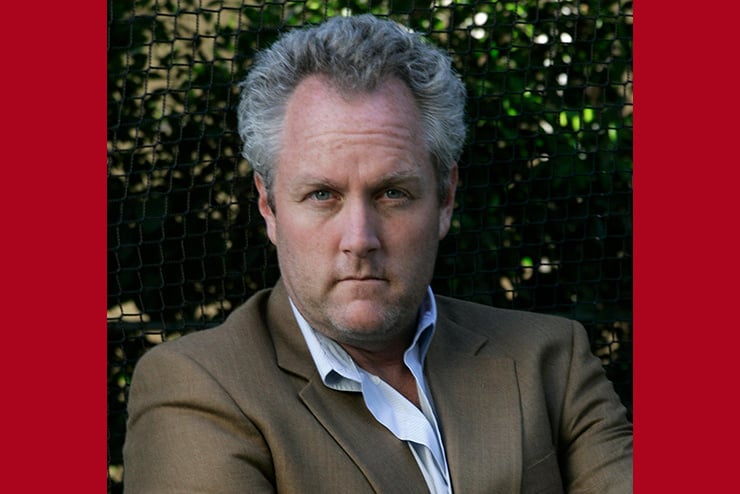
Andrew Breitbart was an angry man. He was angry because he found himself in a world where the mainstream media lied to the American people with impunity, wielding its immense power to tear down a country he loved. A pioneer in new media, Breitbart helped found the Huffington Post, launched Breitbart.com, and broke stories large and small in pursuit of a single great aim: exposing and destroying what he called the Democrat Media Complex.
In March 2012, Breitbart died suddenly at the age of 43 from heart failure. He left behind his devoted wife, Susannah Bean Breitbart, and four young children. We now live in a media world largely shaped by his no-holds-barred style of journalism, and by his insistence that the truth, however inconvenient, must be told.
Adopted as an infant, Breitbart was raised in Brentwood, California, in a mostly secular Jewish household. Breitbart’s formative years in the 1980s coincided with an America governed by Ronald Reagan and a California governed by Republican George Deukmejian. If Aristotle was right that the regime shapes the character of its people, then it is certainly true that Reagan’s America shaped Andrew Breitbart. Hollywood still made movies that, mostly, extolled the virtues of the United States. Those virtues were in abundance in the California of his youth, where hard work was rewarded aplenty.
He saw this in his adoptive father, Gerald Breitbart, who owned a steakhouse in Santa Monica. Seven days a week, his father served customers at what would become a landmark restaurant. Going to school with many children whose parents worked in the entertainment industry, Andrew once asked his father whether any celebrities had dined there. Gerald replied sternly that he didn’t notice celebrities and treated every customer the same. This left a strong impression on the young Andrew: that a man should be judged on his own terms, celebrity being irrelevant. He would write in his 2011 book, Righteous Indignation: Excuse Me While I Save the World, that his parents, both Republicans, never discussed politics, let alone conservative politics. They simply lived it.
Summers were spent in the family motor home, touring the United States. Andrew and his sister watched their parents, especially their father, engage with strangers across the country who had one essential thing in common: they were Americans. This was not a trivial observation for a young man who would later build his life around the proposition that the American people, left to their own judgment, were decent and discerning.
By his own admission, Andrew was not a serious student. He attended the prestigious Brentwood School before enrolling at Tulane University, from which he later said he left with fewer skills than when he entered. He had chosen Tulane partly, he confessed, because New Orleans was a party town and he was told that he could go out drinking every night and not go to the same bar twice.
Although conventionally liberal as a young man, Breitbart would soon find that his classes as an American Studies major were almost entirely anti-American in nature. Rather than Mark Twain and the great American writers he had anticipated, he was fed a steady diet of critical theorists whose purpose was to deconstruct everything he had known to be good about the country and Western literature. Despite this, he remained a liberal with liberal views and a predictable distaste for Republicans, his own parents notwithstanding.
After college, Breitbart returned to Southern California, waiting tables at a local restaurant and taking low-level jobs in and around the film industry, including dropping off scripts at actors’ homes. His ambition was not yet focused. It is worth noting, however, that all the while he was driving between studios, he listened to talk radio. It was there that he encountered Rush Limbaugh—not by his own choosing, but at the gentle suggestion of his future father-in-law, the actor Orson Bean.
Bean was a genuine American original: a wit, a storyteller, and a conservative who had appeared on The Tonight Show Starring Johnny Carson more often than almost any other guest. He was married to the actress Alley Mills, and his daughter Susannah would become Andrew’s wife. When Andrew noticed Limbaugh’s book, The Way Things Ought to Be, on Orson’s shelf and demanded to know why it was there, Orson simply suggested he listen to the man before judging him. Andrew tuned in to KFI AM 640, expecting to confirm his worst suspicions. What he found instead was a happy warrior—a man of uncommon humor, courage, and clarity who took on the American left three hours a day, 52 weeks a year, without breaking a sweat. Andrew was transfixed. He had gone looking for evil personified and instead found a great teacher. He later called him “Professor Limbaugh,” so powerful was the encounter. He swallowed hard and told Orson Bean that he was right.
But it was an earlier moment that had truly cracked Breitbart’s liberal worldview. Watching the United States Senate’s treatment of Clarence Thomas during his 1991 confirmation hearings, led by Senators Ted Kennedy and Joe Biden, Breitbart understood that he was not witnessing principled liberal truth-telling. It was a coordinated smear. The charges against Thomas were false, and the men leveling them knew it. The liberal framework he had inherited collapsed. In its place arose something more honest and more durable: a determination to call things by their right names. Breitbart also saw that the American media was complicit in the attempted takedown of Thomas. Not only were lies being told, but they were amplified by supposedly objective journalists.
Throughout most of American history, there was no question that newspapers were partisan. There was no illusion that they were objective observers. This changed in the early 20th century with the founding of the first journalism schools, most notably the University of Missouri-Columbia School of Journalism and later the Columbia University Graduate School of Journalism. As more Americans attended university, the impression arose that, because journalists were attending journalism schools, they would emerge as objective arbiters of the truth. A new standard of professionalism had been created, and questioning a journalist’s objectivity was simply unnecessary. Whether that was ever true or not, by the time he graduated from Tulane in 1991, Breitbart knew from his college experience that journalism courses, like those in the American Studies department and other social sciences, were rotten to the core.
Around this time, Breitbart met Matt Drudge, whose Drudge Report had already demonstrated that a single person with an internet connection and a willingness to publish what the mainstream press refused to touch could change the entire media landscape. Drudge’s revelations on President Clinton and the Monica Lewinsky scandal demonstrated the power of the new media in spades. Breitbart worked closely with Drudge for years and absorbed everything he could from the experience. Drudge was the proof of concept that one did not have to be part of the mainstream media to have an impact.
It was in this spirit that Breitbart went to work for Arianna Huffington in 2005, helping her conceive and build what would become the Huffington Post. At the time, Arianna was something of a conservative, at least nominally. Her husband, Michael Huffington, had run for the United States Senate in California as a Republican in 1994.
Andrew’s aim at the Huffington Post was characteristically subversive: to draw out from behind the anonymous pages of left-wing websites the real members of the liberal intelligentsia, to put their names on articles and essays, to make them stand up publicly for the beliefs he considered both wrong and destructive. He was not yet a conservative in the traditional sense. He thought of himself as more of a libertarian and retained much of that sensibility throughout his life, including on questions like drug legalization and same-sex marriage. But in the broadest sense, he was conservative. He believed in America. And he believed that the Democrat Media Complex was engaged in a systematic effort to lie to the American people and tear the country down.
Breitbart would go on to found Breitbart.com and a series of companion sites he called the “Bigs”: Big Government, Big Hollywood, Big Journalism, Big Education. They were conceived as different channels within a single network, places where Americans could not only learn what was happening in their country but also become part of the story. Citizen journalism was not a marketing slogan for Breitbart. It was a strategy. He believed that if ordinary Americans were given the tools and the platform, they would do what the mainstream press would not: tell the truth.
Breitbart was an early and enthusiastic supporter of the Tea Party movement, speaking at rallies across the country. He saw in those crowds something the media refused to acknowledge: that the movement was not driven by racism or ignorance, but by a genuine, well-founded love of country.
At Tea Party events, Breitbart would later write, he encountered working-class whites, Hispanics, and blacks who shared a common love of the United States and a common anger at being told by the Democrat Media Complex that their patriotism was merely a mask for bigotry. The charge of racism, he argued, was not an argument. It was a weapon—the left’s preferred method of shutting down debate. He would come to identify with the Tea Party far more than with the Republican Party establishment, which he viewed as too cowardly to fight back.
Breitbart’s big break in journalism, at least on an operational level, came through his support and promotion of the young investigative journalist James O’Keefe. In 2009, O’Keefe and his colleague Hannah Giles posed as a pimp and a prostitute and visited multiple offices of ACORN (the Association of Community Organizations for Reform Now), a federally funded community organizing group with deep ties to the Democratic Party. They captured on video ACORN staff offering advice on how to set up a brothel, evade taxes, and traffic underage girls. Breitbart understood immediately that the story had to be rolled out methodically as a series to maximize its impact. He released one tape, waited for ACORN to deny and dismiss, then released another. Then another. ACORN’s credibility collapsed in real time, and Congress ultimately defunded the organization. O’Keefe and Giles’ reporting, which was funded through a $25,000 loan from Breitbart’s father, changed the national conversation.
Breitbart also made hay out of one the more farcical Democratic political scandals in 2011, when Congressman Anthony Weiner was caught having sent sexually explicit photographs of himself to a young woman via Twitter. Weiner initially tried to blame Breitbart and conservative journalists for making up the story. Breitbart, characteristically, did not wait for Weiner’s carefully managed press conference to run its course. He walked to the podium himself and addressed the assembled press corps before Weiner could reach it, turning the occasion into exactly the circus that Weiner had earned. He had a gift not only for breaking stories but for making them.
Breitbart wrote two books, the first, Hollywood, Interrupted: Insanity Chic in Babylon—The Case Against Celebrity, co-authored with Mark Ebner in 2004, was an early and bracingly unsentimental look at the culture of celebrity and its consequences for American political and moral life. It reached the New York Times bestseller list. The second and more important work, Righteous Indignation, published in 2011, was part memoir, part manifesto, and part cultural diagnosis. It remains essential reading for anyone who wants to understand how the media complex Breitbart identified actually works.
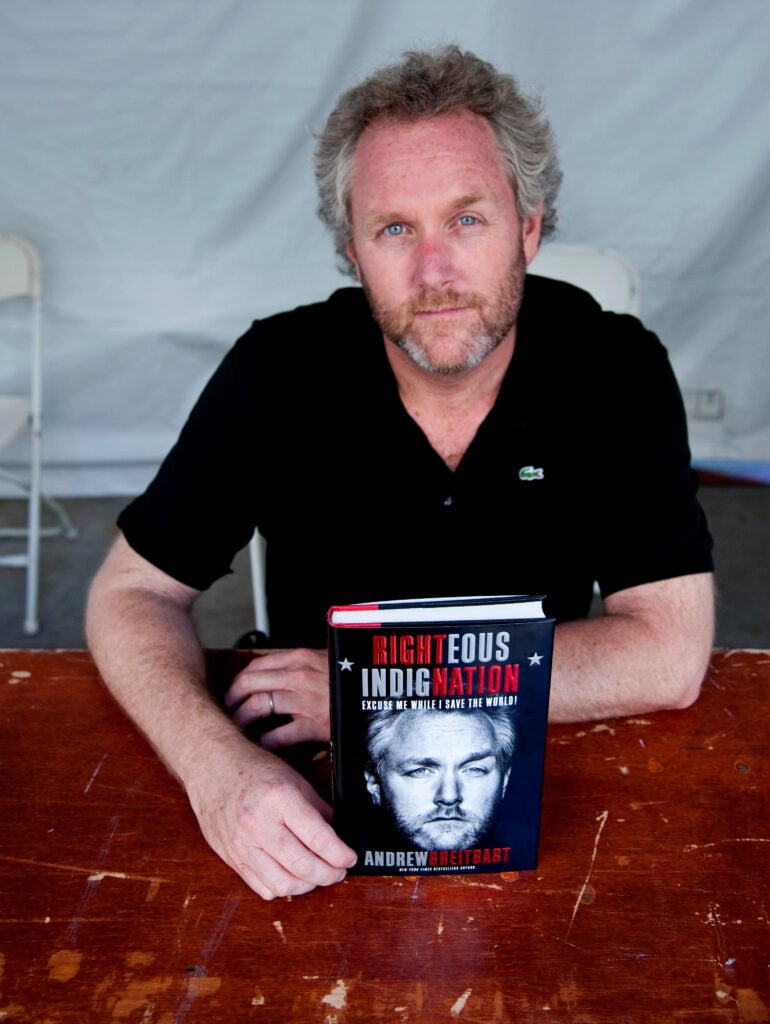
Breitbart’s intellectual understanding of the enemy was more sophisticated than his combative public appearances suggested. In Righteous Indignation, he offered a lucid account of the Frankfurt School and its migration from Weimar Germany to the United States, with many of its ilk eventually settling—with some irony not lost on Breitbart—in the sunny California of his own childhood. The critical theorists of the Frankfurt School, including Herbert Marcuse, Theodor Adorno, and Max Horkheimer, sought to destroy the cultural foundations of Western civilization from within.
Where classical Marxism had failed to ignite revolution through economics, the Frankfurt School’s “cultural Marxism” would spread left-wing cultural ideas about the evils and inequalities of Western society by gaining power over America’s cultural institutions: its universities, media, entertainment industry, and schools. In this way, the Frankfurt School abandoned ideas of direct revolution and implemented what Italian Marxist Antonio Gramsci called the “war of position,” in which Marxist intellectuals would seek to develop an alternative hegemony within American society, and eventually challenge the dominant culture. This concept came to be known as the “long march through the institutions.”
Breitbart found it darkly comic that these architects of civilizational despair had spent their American exile in beautiful, sun-drenched Santa Monica—indoors, in suits and ties, writing about the inevitable decline of the very country that had given them refuge. He articulated well the shallow nature of their arguments, the word games and rhetorical sleights of hand that had been used to twist young minds in American universities for decades. The left, he observed, had discovered that it could shut down virtually any discussion by labeling its opponents as racists. It was a tactic, not an argument. And for too long, Republicans had been too cowardly to call it what it was.
Breitbart was a recipient of the Claremont Institute’s Lincoln Fellowship, which he described as a boot camp in the Constitution. The experience energized him. He spoke of the American Founders with a special passion, and he saw his own work—taking down a corrupt and dishonest media—as squarely in the tradition of those men. The Founders understood that a free press was essential to republican government, and that a morally dishonest press could destroy it. Breitbart believed that his attempt to challenge and expose the corrupt establishment press was not radical. It was patriotic.
Breitbart was also guided by something simpler and more powerful than any theoretical framework: a sense of decency. He was not primarily an ideologue. He was a man who had looked at what the left was doing to his country and found it morally wrong. He did not care greatly about the philosophical questions that might divide conservatives. If you loved America, he was for you. If you were in the business of tearing it down, he was coming for you. It was a simple framework, and it worked.
Breitbart famously argued that politics is downstream from culture, meaning that before conservatives could win elections, they would have to win the culture war—the universities, the entertainment industry, and the newsrooms. But the left never made any distinction between culture and politics. Every film, every television program, and every university curriculum was a political instrument. Here, Breitbart’s formulation does not hold up; indeed, he has it backward. Politics, properly understood, is the shaper of society as a whole, and the culture is a mere reflection of it. This is especially evident with the American left. For them, everything is politics. There is no downstream. Those leftist professors are political, not cultural, actors. So, too, are the directors and producers making leftist movies. And those media organizations that pretend to present the news are in fact little more than political operatives. Such is the primacy of politics.
Breitbart often pointed to George Stephanopoulos, a political hack for President Bill Clinton who, after cleaning up the Clinton White House’s scandals, was rewarded by ABC News with an analyst role and later as host of This Week. It was to signal to the political world that the Democrat Media Complex protected its own. Indeed, Breitbart would argue, they were one and the same.
The power that Breitbart wielded, between his platform on Breitbart.com and his Tea Party following, became apparent when, in the 2010 midterm elections, ABC News invited him to participate in its election-night coverage. Media Matters for America and allied organizations launched a petition campaign against the network, collecting more than 125,000 signatures from people who opposed Breitbart’s appearance on a panel discussing the election. Such was the measure of the threat he posed. Those who hold a monopoly on the narrative do not like competition.
Andrew Breitbart died of heart failure on March 1, 2012. His intellectual and political project, if it can be reduced to a single sentence, was to take down the Democrat Media Complex before it took down America. He saw in the new media—in blogs, in citizen journalism, in video captured on cell phones—the tools by which ordinary Americans could expose what the press was hiding and defend what the press was attacking. He believed that there was something inherently good in the American people and, if given the facts, they would act on them. He was not wrong.
He fought with energy, humor, and what can only be called joy. That quality is sorely lacking on the American right today. His legacy lives in the hearts and minds of his countrymen who fought alongside him, who watched him wade into hostile territory with a grin on his face and the truth as his weapon. We would do well to emulate him.
Leave a Reply