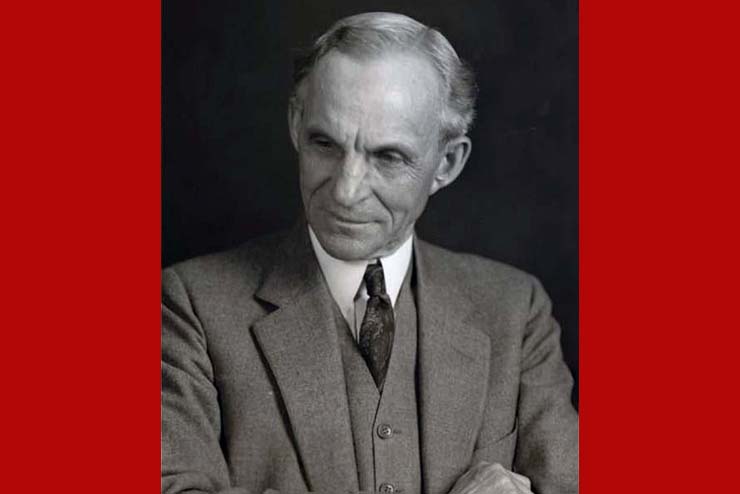
Maker of the Middle Class
Henry Ford, founder of Ford Motor Company and inventor of the iconic Model T, was a towering figure in 20th-century America. A pacifist, popular reformer, and industrialist, Ford can be best understood as the creator of the modern American middle class.
The idea that a middle class provides social stability goes back to antiquity. Aristotle, in his Politics, spoke of a “middling sort” of citizen who acted as a remedy against class warfare between the rich and the poor. “Combine the poor and the rich in one body, or … increase the middle class,” he wrote. “Thus an end will be put to the revolutions, which arise from inequality.” In America’s Founding era, Jefferson and Hamilton sparred over whether yeoman agriculture or an urban commercial class would best support an American middle class. In the 19th century, the expansion of the western frontier provided a means for struggling Americans to acquire property and independence.
In the 20th century, the middle class turned to Ford’s assembly line and the economic miracle of American manufacturing. Before the phrase “American Dream” was ever coined, Ford understood that striving for economic prosperity was fundamental to the American spirit.
Mary Ford, an orphan of Belgian immigrants, brought forth her first-born son, Henry, in Springwells Township, Michigan, now known as Dearborn. Henry Ford finished eighth grade in a one-room schoolhouse; he did not attend high school. His only other formal education was a bookkeeping course. The balance of Ford’s education came from practical undertakings.
It is sometimes falsely said that Ford invented the automobile. Ford invented something different. Before Ford, luxury vehicles dominated the automobile market. They were expensive to acquire and required tremendous work to maintain, mechanically and aesthetically. Where the pharaohs of Ancient Egypt had ornate carriages with a team of horses and stablemen, the wealthy at the turn of the 20th century had ornate gasoline–powered carriages with a mechanic and a driver. The social impact of the luxury automobile was negligible. Ford designed a technology—an automobile suitable for the masses, the Model T—and the means to produce it well and cheaply, for the benefit of the people—ultimately, to set them free.
Ford at once cherished work and sought to reduce it. He thought the essence of human experience resided in the work a person did—“through work and work alone may health, wealth, and happiness inevitably be secured”—and that work should provide them freedom. “Power and machinery, money and goods, are useful only as they set us free to live,” he said. In this respect, he recalls Aristotle’s description of virtue in the Nicomachean Ethics. “Wealth is evidently not the good we are seeking; for it is merely useful and for the sake of something else.”
Before the Model T, the distance an ordinary person could walk in two hours limited his access to the most valuable use of his labor. A man could congregate in the squalor of urbanity, where he might work for wages in various manufacturing or service jobs, or he could locate himself in a rural location and work his land. In both cases, it was rare for the ordinary man in a household with children, through industry or frugality, to scratch out more
than subsistence.
Ford invented the Model T to change that. When the ordinary person owned an automobile, the radius in which he could work grew exponentially. Where an hour of travel once took him at most four miles, it could now take him almost 40. As his opportunity for work grew, so did the value of his labor. And when he was not working, his opportunities for leisure grew too.
Ford was sued in 1919 by a litigant arguing that he should run his company for the benefit of shareholders rather than for its employees and customers. The Michigan Supreme Court argued against Ford in Dodge vs. Ford Motor Co., and Ford was forced to pay shareholders a dividend. During the suit, Ford remarked, “My ambition is to employ more men; to spread the benefits of this industrial system to the greatest possible number, to help them build up their lives and their homes.”
After he lost the case, Ford took a financial risk by hoarding cash to repay his financiers and get them out of his business. “The worst time to borrow money is when banking people think you need money,” Ford would write in his autobiography.
With the financiers expelled, Ford Motor adopted an accounting system based on the time required to complete productive tasks—also known as work—rather than dollars. Ford Motor would not switch to a standard two-column financial accounting methodology again until it went public in 1956.

Ford designed every aspect of the Model T for mass production and mass consumption. He reduced its manufacture to a minimum number of high-quality, durable parts, and made them of vanadium steel, a high-strength, corrosion-resistant alloy. He told the public the Model T came in any color a customer wanted “so long as it is black.” The four-cylinder gasoline engine used a magneto and a crank, discarding a battery. A simple three-speed transmission anchored the drivetrain. Two leaf spring suspensions, front and rear, absorbed the shock of primitive roads. The “Tin Lizzie,” as it was known, came as a coup, a sedan, or a truck. Aftermarket modifications proliferated.
An automobile designed for mass consumption must be massively affordable. Ford used his time accounting method to improve his manufacturing technique. By reducing the number of parts and simplifying the motions required to assemble a Model T, Ford reduced production time. Through practical experimentation, Ford reduced the number of manufacturing steps and the time from start to finish to 90 minutes from 12 hours. Ford’s managerial genius shrunk his one truly variable cost, labor—the materials cost what they cost—to the least possible. His corresponding pricing created a new market.
The success spurred demand for more labor. Ford’s answer was to bid up wages, promising in 1914 $5 a day for 40 hours a week. As Ford noted in his autobiography, he thought of this in terms of, “Otherwise we cannot abolish poverty” and “A low wage business is always insecure.” His generosity distressed his business partners, who would remain with him until 1919.
Ford’s labor force thus became the highest-paid and most leisured proletariat anywhere on the globe, and, as such, transcended its status. Ford’s unskilled labor graduated to the middle class and became consumers of Ford cars and accumulators of capital.
To ensure the highest productivity of his well-paid labor, Ford created the company’s Sociological Department and the Service Department. The Sociological Department, established by John Lee, surveilled Ford’s labor for social failings, such as alcohol abuse, gambling, profligacy, household strife, and other pathologies. Ford also supported his labor through internal social programs, including an English-language school. The “service department,” Ford Motor’s 3,000-man private security branch run by the feared Harry Bennett, used force to fix other problems. It was not beneath Bennett to use threats, intimidation, and fists to achieve Ford’s aims. The infamous Hunger March and Battle of the Overpass left people injured, and in the case of the Hunger March, dead.
One of Ford’s most memorable quotations is “History is bunk.” He believed history trapped people in the mistakes of the past. He even forbade managers from recording the results of experiments. “I am not particularly anxious for the men to remember what someone else has tried to do in the past, for then we might quickly accumulate too many things that could not be done,” Ford wrote.
Yet, outside the factory, Ford repeatedly sought to recreate the past as he imagined it, most notably in Greenfield Village, an open-air museum he developed that brought to life, in painstaking detail, iconic aspects of his childhood.
Ford’s rebellion against history as a restraining force against industry and innovation came with contempt for tradition, bureaucracy, and the opinions of experts. “We fortunately did not inherit any traditions and are not founding any,” he wrote. “If we have a tradition it is this: Everything can always be done better than it is being done.”
An amateur Socrates, Ford enjoyed testing the opinions of experts, whom he saw as both arrogant and ignorant. “We have most unfortunately found it necessary to get rid of a man as soon as he thinks of himself as an expert,” he wrote, “because no man ever considers himself expert if he really knows his job.” In that spirit, Ford frowned upon titles, suggesting title-seekers should wear a badge to the effect of: “This man has nothing to do but regard himself as important and all others as inferior.”
Ford saw administration, finance, and unions as tools for people who were not working to take advantage of those who were. “A business …is a collection of people who are brought together to do work and not to write letters to one another,” he quipped in his autobiography. And, “That which one has to fight hardest against in bringing together a large number of people to do work is excess organization and consequent red tape.”
Of union leaders, particularly radicalized Bolshevists, he said, “Their union salaries liberated them from the necessity of work so that they can devote their energies to subversive propaganda.” Anti-union Ford regarded himself as the perfect labor leader. “The only true labour leader is the one who leads labour to work and to wages,” he wrote.
Ford selected his labor for loyalty and work ethic. His wage scale was flat and he did not racially discriminate. William Perry became Ford Motor’s first salaried black employee—and probably the first in any major American manufacturer—in 1914. His black employees repaid Ford with loyalty. Even after the company was unionized, which Ford had fiercely resisted, black employees would cross a picket line for “Uncle Henry.”
Ford’s egalitarian predilections partly define Fordism. He believed in the equal worth of every man’s labor, provided he desired to work and could be assigned the right specialized task. He ordered his managers to find manufacturing tasks that handicapped veterans could perform, and he hired the disabled to fill those roles. Soon the blind were outperforming the sighted in tasks such as the tactile business of counting screws. “We do not prefer cripples,” Ford said, with his hallmark directness, “but we have demonstrated that they can earn full wages.”
When Ford finally ceased production of the Model T in 1927, 15 million had been delivered, a number that suggests the cars were owned by a vast majority of working-class families. Ford’s industrial system and labor practices vastly expanded the ranks of an American laboring population that could afford bourgeois comforts: a middle class.
By 1927, the automobile market had matured. A new labor and consumer model had grown up, based on things Ford thought odious: management-labor conflict (unions relieved management of responsibility for labor), consumer finance, market segregation (tiered branding to keep consumers spending as high as possible), mechanical obsolescence, and psychological obsolescence (frequent new models with superficial improvement). Ford Motor would have to play along to thrive, and Ford was not one to play games he did not like.
While he never formally ran for president, “Ford for President” clubs sprang up across the country in 1916 and 1924. In 1916, Ford received 5,000 write-in votes in the Ohio primary. Viewed as a populist and friend of labor, Ford disliked partisan politics and traditional politicians. Both the American Party and the Prohibition Party sought to run Ford as their candidate in 1916. Ford would ultimately throw in with Woodrow Wilson and the Democrats and fund Wilson’s bid for the tight race in California.
Ford ran for the Senate in 1918, at Wilson’s urging. But, according to Ford biographer Steven Watts (author of The People’s Tycoon), Ford “refused to campaign” and felt “clear analysis and goodwill could solve problems.” While his unusual style endeared him to the regular man, Eastern elites found him fatuously unschooled. Rumors—likely spread by his Republican opponent, Truman Newberry—that he had a German agent working for him at Ford Motor wrecked his campaign. Nonetheless, his involvement in the political scene led to another presidential attempt in 1924.
Ford regarded the Republican candidate, Calvin Coolidge, as a friend, and ultimately endorsed him for president in 1924. Ford, Thomas Edison, Harvey Firestone, and Thomas Burroughs had a social association they called The Vagabonds, who would tour upstate Michigan in a Model T. On one occasion, the Vagabonds visited Coolidge at his home in Vermont. According to one apocryphal story, their T broke down and Ford crawled beneath the undercarriage to make repairs. When Ford emerged, a passerby stopped to ask what the trouble was and who they were. Ford, covered in grease, introduced himself and Thomas Edison. In disbelief, the man pointed to Calvin Coolidge and said, “I suppose now you are to tell me this pip-squeak is the President of the United States.”
Coolidge shared Ford’s egalitarian streak, although in a different way. The president would say in his July 5, 1926, address celebrating the 150th Anniversary of the Declaration of Independence, “If all men are created equal, that is final.” Coolidge’s elaborate explication of the Declaration’s meaning and historical origin—he attributed its antecedents to Puritan ministers such as Thomas Hooker and John Wise—gave it theoretical effect. But Ford’s specialization of labor, belief in labor’s equal worth, and the higher pay gave, acta non verba, the Declaration a practical significance. As he wrote in his autobiography:
It is entirely feasible to abolish both poverty and special privilege—and there can be no question that their abolition is desirable. Both are unnatural, but it is work, not law, to which we must look for results.
Ford was on to something. It is easy to speak of republican government. It is exceedingly difficult to put it into effect without a large middle class capable of accumulating capital.
Ford was a pacifist. He opposed involvement in World War I and sponsored the “Peace Ship,” a failed private effort at negotiating an end to the Great War. While Theodore Roosevelt counseled preparedness, Ford argued that preparation for war would lead to it. “I will do everything in my power to prevent murderous, wasteful war in America and the whole world,” he wrote.
He took a beating from the media for his noninterventionist stance. “It is worse than ineffable folly for pestiferous busybodies in this country like Henry Ford to nag the President to make an ass of himself,” an editorialist at the Louisville Courier wrote. In time, Ford would become part of the industrial war effort to break Imperial Germany.
Peaceable Ford again opposed intervention in Europe as the storm gathered in the 1930s. Charles Lindbergh, another famous Detroiter and a friend, solicited Ford to join the America First Committee and oppose American involvement in World War II. It is worth noting that many other notable political figures also joined, including Gerald Ford, Potter Stuart, Sargent Shriver, Kingman Brewster, and Henry Regnery. Regardless, President Franklin Roosevelt was not amused. While the rallying cry “America First” hailed back to the 19th-century America Party and was even used by Wilson in his 1916 campaign, in the 1930s, Roosevelt and his allies denigrated the phrase as “isolationist.”
Ford would not last long on the America First Committee, however, due to his ownership of The Dearborn Independent. The extent to which he actually wrote any content for The Dearborn Independent is unclear. Its prominent editorial theme on the dangers of the “international Jew” brought him discredit. In 1927, aggrieved plaintiffs sued the paper for libel. Ford quickly apologized, settled, and closed The Dearborn Independent. In the litigation, he claimed to be unaware of editorials under his byline, the nature of the remarks, and to be “shocked” by the content. To his Jewish friend Rabbi Leo Franklin, he sought to explain himself with words to the effect of, “The Independent wasn’t referring you.” Franklin, in turn, came to Ford’s defense and said Jews should accept Ford’s “word that he has been misled,” though afterward Franklin’s relationship with Ford went cold.
The Dearborn Independent got attention in continental Europe. The text was translated into German; the Nazis greatly appreciated the content, and Adolf Hitler began keeping a picture of Ford in his Munich Office. In 1937, Ford would receive the Grand Cross of the German Eagle from the National Socialist regime. He naively accepted the award, writing:
My acceptance of a medal from the German people does not, as some people seem to think, involve any sympathy on my part with Nazism. Those who have known me for many years realize that anything that breeds hate is repulsive to me.
Fordism was not as good for Nazi Germany as Hitler had hoped, however. At the outbreak of the war, the War Department pressed an aging Ford—in need of anti-Hitler bona fides—into America’s service to oversee, conspicuously, the development of a mass production effort to produce B-24s on a moving assembly line. When Ford finally got the Willow Run assembly plant humming, a production juggernaut was born. In April of 1944, on the eve of D-Day, Willow Run produced 428 B-24s, or one bomber every 90 minutes. In three days of 1944, from April 24 to April 26, Willow Run produced one bomber every 45 minutes.
During the “Big Week,” the U.S. military’s name for a February 1944 bombing extravaganza, 4,000 heavy bomber sorties dropped 20 million pounds of bombs on Germany to devastating effect, and also cost the U.S. Army Air Force 200 downed heavy bombers. If there was ever a sign that the war was lost for Germany, it was the potential of Willow Run to replace those losses within two weeks.
Strategic bombing killed as many as 600,000 Germans in World War II. Ford’s efforts at Willow Run demonstrated the almost unlimited military power of the U.S. manufacturing industry. There is doubtless a lesson there for today, as the policies of the last decades have hollowed out and outsourced that power abroad, often to America’s strategic rivals.
In 1945, Ford, hobbled by a stroke, ceded control to his grandson, Henry Ford II. Ford Motor Company, flirting with bankruptcy, had failed to profit from the war effort—one of the few industrial enterprises to do so. Ford died in 1947 at the age of 84.
Leave a Reply