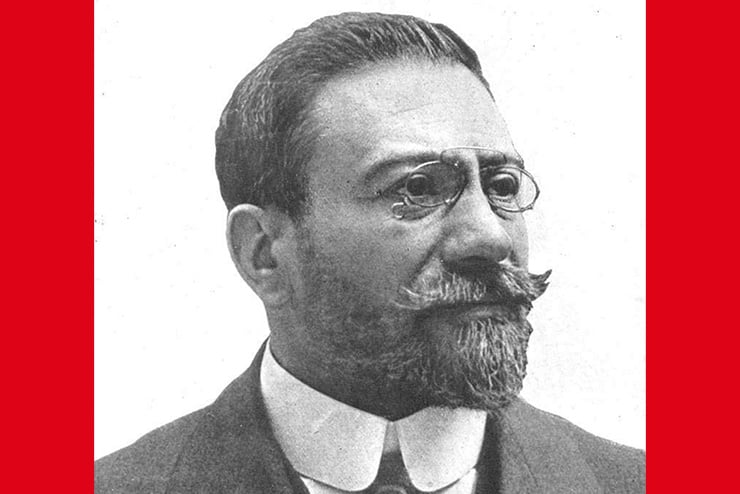
The Spanish Traditionalist
Juan Vázquez de Mella (1861-1928) was one of the stellar figures in Spanish traditionalism and a formative influence on the Spanish right. A man of principle, he served as a deputy in the Spanish legislature, the Cortes Generales, for 16 years and is regarded as one of Spain’s greatest orators. He twice refused offers to serve as a minister, once from the architect of the Spanish liberal state, Prime Minister Antonio Cánovas del Castillo, and once from Prime Minister Antonio Maura, a conservative.
Vázquez de Mella supported Carlist traditionalism during the Carlist Wars, which were fought between Spain’s liberals, who sought to consolidate the modern State, and the traditionalists, who aimed to preserve the country’s traditional Catholic social and political order. Though Vázquez de Mella was a defender of the Carlist pretenders to the throne, he broke with the Carlist candidate for the throne, Don Jaime III, since Jaime had supported neutrality in World War I. Vázquez de Mella and the traditionalists had always been pro-German and, above all, advocates of the Austro-Hungarian Empire, which they saw as the ideal political model.
Vázquez de Mella’s doctrine centered on the defense of traditional order and rested on several key concepts: the distinction between political and social sovereignty, a federative monarchy, and organic representation.
Vázquez de Mella also challenged many traditionalists on the notion of political realism, even going so far as to call for “a union of the far-right, and the further, the better.” His close companion was the pragmatic traditionalist politician Víctor Pradera, who, upon Vázquez de Mella’s death, best articulated his ideas in his absence. Pradera became one of the leading authors of the anti-liberal and anti-parliamentary magazine Acción Española, which brought together traditionalists, monarchist conservatives, and the fascist Falangists. All these rightist groups were united in their opposition to the communist-supported Spanish Republic, and their ideas would inform the nationalist side in the Spanish Civil War and the subsequent regime of Francisco Franco.
To understand Vázquez de Mella, it is necessary to grasp the nature of 19th-century Spain and the contributions of its main traditionalists. These included the philosopher Juan Donoso Cortés, who was not strictly a traditionalist but laid the foundations of Catholic political theology (which influenced the German political theorist Carl Schmitt); Jaime Balmes, a traditionalist priest who sought to reconcile the moderate liberals with the Carlists by proposing the marriage of Isabella II to the son of Carlos María Isidro; and Antonio Aparisi y Guijarro, one of Carlism’s greatest political theorists.
These traditionalists opposed the idea of equality and defended aristocracy, which they regarded as a natural elite distinguished by high moral standards and cultural refinement. They argued that it was better to have one king than hundreds of rulers in a democracy. They also maintained that democracy was contrary to human nature and that universal suffrage as a source of law was a falsehood.
Moreover, they viewed socialism as a denial of human freedom, which inevitably leads to the destruction of social responsibility and, consequently, of solidarity within the individual, the family, and the community. Without solidarity, only nihilism remains. Thus, the socialist system ultimately ends in the confiscation of private property and its conversion into public wealth controlled by the State.
Spain political environment was complex during the 19th century. Many liberals were revolutionaries and afrancesados(meaning they were aligned with France and the principles of the French Revolution), although there were other liberals, like Gaspar Melchor de Jovellanos, influenced primarily by political theorists of the English Enlightenment, such as John Locke. They were profoundly anti-Catholic; when in power, they used their offices to confiscate much of the Church’s property. Others, like Prime Minister Ramón María Narváez and Antonio Cánovas del Castillo, adopted a more moderate stance; although Catholic and conservative, they made the serious mistake of defending institutional neutrality over cultural hegemony, and administrative centralization over the preservation of Spain’s traditional common law and codes of regional independence, known as the fueros.
The true synthesis of liberty and order, thought to be rooted in the Catholic principle of subsidiarity, was not found among all so-called traditionalists. But many of them held to these principles and fought alongside the Carlists under the motto “Dios, Patria, Rey, y Fueros” (“God, Fatherland, King, and Traditional Liberty”). Others were simply former liberals disillusioned with liberalism.
Most genuine traditionalists defended the administrative decentralization characteristic of the older Spanish Habsburg rule and opposed the centralization introduced by the later Bourbons. They viewed this position as one based on the Catholic principle of subsidiarity, which holds that each region knows its problems best and has the greatest interest in solving them. Traditionalists believed that laws should adapt to the character of the people and would oppose, for example, a Basque imposing his customs on a Valencian or vice versa, or any kind of general imposition by a centralized administrative state. This was what they meant by defending the fueros.
The fueros were legal norms, including customs and other privileges granted by the king or the feudal lord to a specific territory or place. The fueros provided a standard for regional legislative autonomy and governance and recognized the historical cultural institutions of Spain’s various regions and peoples. The great American libertarian thinker Murray Rothbard was thoroughly familiar with the concept of the fueros and its role in Spanish history, and he used it to develop his own libertarian political theories. The fueros were fiercely opposed by Spanish liberals, who in 1812 abolished them in the Constitution of Cádiz, arguing that the fueros were an obstacle to achieving the liberal goal of equality.
Vázquez de Mella understood the social sphere as a collective whole, since the individual cannot disregard his past or the tradition in which he is embedded. Societies can be distinguished not only by their customs or forms of government, in accordance with their traditions, but also by their positive legislation, which may take a thousand different concrete forms. Every local or historical community has the right, even while belonging to a broader state entity, to maintain and cultivate its own political and social structure.
This concept of social organization based on local traditions was what Vázquez de Mella called “social sovereignty,” and the primary goal of his political theory was to defend this sovereignty against the encroachments of the centralized State. In Vázquez de Mella’s view, when everything depends on the State, the individual rights of man, such as the right of association, are undermined. Yet this does not mean that the State is inherently opposed to them; rather, in an orderly society, each must complement the other.
The work of the revolutionaries is precisely the opposite; they seek a totalitarian State that will impose left-wing ideology from the top down. Vázquez de Mella, therefore, regarded the optimism of political liberalism as naïve and made a devastating critique that remains valid today. He showed that the French Revolution began by abolishing mediating institutions between the individual and the State, proclaiming the social and religious emancipation of the individual, and ended in the emancipation of the State from natural law. The absolute State had gained control in various parts of Europe, emancipating itself from a higher order and becoming the supreme definer of rights, the sole regulator of society, and the absolute moderating power over all forces. In a speech before the Cortes in February 1908, he said:
The political work of the French Revolution consisted primarily in destroying all those intermediate bodies—family estates, guilds, autonomous universities, municipalities with their own assets, regional administrations, and even the Church’s patrimony—that, as protective corporations, stood between the individual and the state.
Vázquez de Mella opposed the confiscation of Church property and argued that religious institutions must have economic independence. That does not mean he believed that Church and State should be separated, but rather that the State should be morally subordinated to the dictates of the Church. On a practical level, he regarded state education as an illegitimate intervention into the domain of the family and the Church.
Vázquez de Mella argued that the “internal constitution” of Spain was founded upon its ancient Cortes parliamentary system and the fueros, the Spanish nation having arisen from a federation of numerous kingdoms united under a monarchy. The Spanish coat of arms, he noted, is not a single symbol, but the composition of four emblems gathered beneath the crown. National and political unity in Spain did not arise from the imposition of some dominating power, but rather from centuries of coexistence and common struggle. The distinction between the Spanish State (the monarchy) and the Spanish nation allowed for political federations without anyone demanding the merger of the regional sub-nationalities. Thus, even when sovereigns declared war, normal relations and trade among their peoples could continue unhindered.
Therefore, Spain was in essence a collection of nations that had merged into a higher unity, bound by a spiritual cause that united men through reason and will. That spiritual cause was the Catholic faith, and its proper form of government was the federative monarchy. Spain was a collection of autonomous kingdoms bound by the same faith under one king, and by a shared evangelizing mission. For this reason, he firmly rejected any Jacobin attempt at centralization and homogenization. In a 1903 speech,
he said:
The national spirit is not opposed to the regional, because it is nothing more than the synthesis of the regional spirits… We have a peculiar, unique life that each region preserves to a greater or lesser extent; and each region shares traits with all the others. There is a common collective history and a particular, distinct one. Both must be fully affirmed. I affirm the regional spirit in all its purity; but I also say that if even a single regional history were removed, Spain’s common history would be mutilated and rendered incomprehensible.
Even so, Vázquez de Mella always opposed secession in principle, because he believed it would allow foreign elites to divide Spain, prey upon its weakest regions, and defeat the whole. The solution to internal disputes between regions was not separation but the restoration of the stable, intermediating institutions that resolved conflicts between individuals, regions, and the State. These would serve to both support the State and to limit and counterbalance its power.
Countering the communist theory of class struggle, Vázquez de Mella formulated his theory of “sociedalism” or “corporatism.” This idea began from the premise that social classes exist, each with distinct interests and within a natural hierarchy. Therefore, organic representation within a parliamentary system had to embody all the interests present within the political community: intellectual interests through the universities, religious ones through the clergy, and material ones through the aristocracy, as well as those of the army and the various guilds. Perhaps the most important idea within his concept of sociedalism was the “imperative mandate,” under which the people’s democratically elected representatives would be legally obliged to fulfill the campaign promises under which they had been elected.
This organic political representation was fundamentally different from that of the political party systems of Western democracies, which he described with irony: if political parties were abolished, society would not mourn their loss; but if social groups or classes were eliminated, society itself would disappear.
One way to understand Vázquez de Mella is to compare his political theories to the Southern states’ rights arguments made before and during the American Civil War. The Spanish traditionalists were fighting for the same principles: the rights of the states (in their case, the fueros and regional autonomy within a federated monarchy) and the defense of the traditional order against the subjugation of the individual by the centralized State. This was the traditional order that the political theorist Dalmacio Negro would call Spain’s “pre-liberal liberal tradition.”
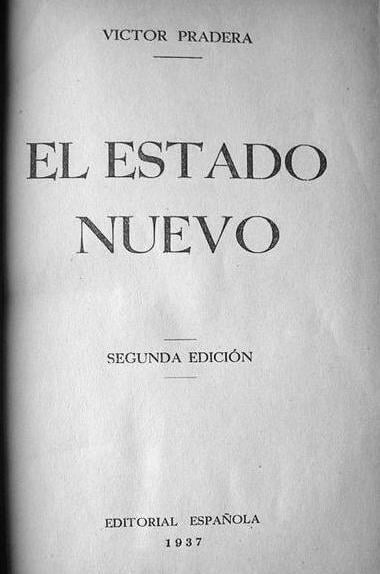
The traditionalist ideas of Vázquez de Mella’s were synthesized by Víctor Pradera in his 1935 book El Estado Nuevo (“The New State”), which later served as the foundational political theory of the Francoist State. As a legislator, Vázquez de Mella was a man of principle who wasn’t able to achieve much on a practical level, on as he and like-minded traditionalists were vastly outnumbered in the Cortes. He often found himself preaching to deaf ears while in office, yet he exerted enormous influence afterward. In this way, he was very much like Spain’s version of American politicians Pat Buchanan and Ron Paul.
Leave a Reply