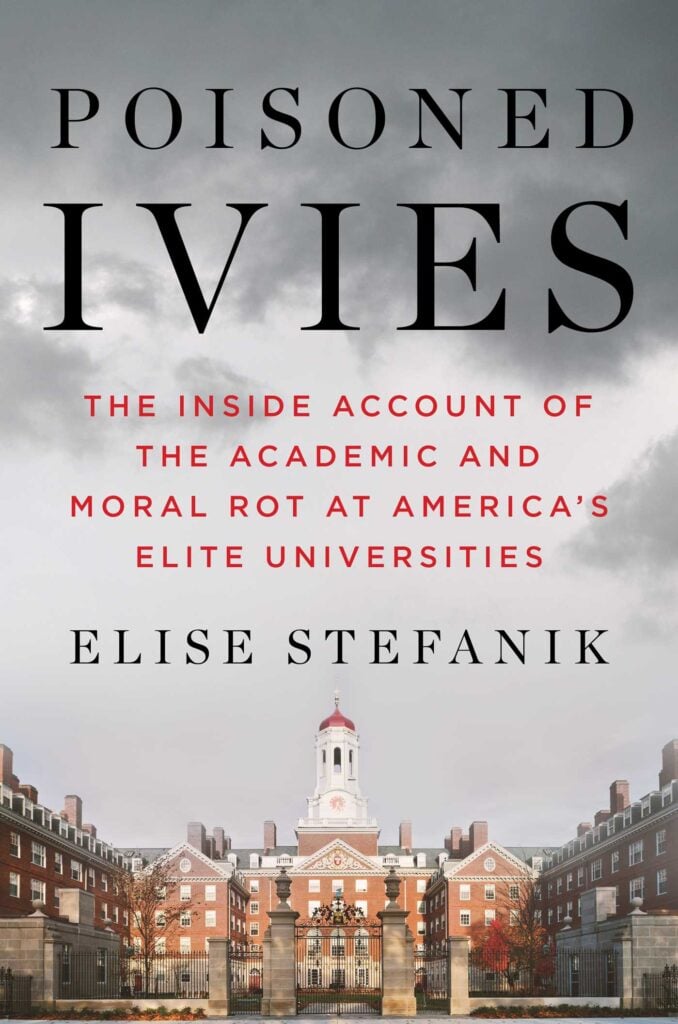
by Elise Stefanik
Threshold Editions
256 pp., $29.00
The most-watched testimony in the history of Congress, we learn early in Poisoned Ivies, was not from the Watergate hearings, the 9/11 Commission, or even the impeachment of President Bill Clinton. It was when the presidents of Harvard, MIT, and the University of Pennsylvania appeared before the House Committee on Education and the Workforce on Dec. 5, 2023. While the number of views, which has totaled over a billion, has been aided greatly by the modern ubiquity of social media, it is just as true that countless Americans were stunned by then-Harvard President Claudine Gay’s inability to answer definitively if calling for the genocide of Jews violates Harvard’s code of conduct.
Gay’s response to this question, pointedly asked by New York Congresswoman Elise Stefanik, was, “It depends on the context.” Penn’s then-president, Liz Magill, gave similarly noncommittal answers, dripping with legalese. Within a month, both Gay and Magill would be forced to resign from their posts. MIT’s president, Sally Kornbluth, was the sole survivor of the hearings, though Stefanik insists it should have been a clean sweep.
As Stefanik recounts in the polemical but highly readable Poisoned Ivies, this exchange nearly did not happen. On the day of the hearing, she woke up with a particularly virulent case of the flu, but instead of rolling over and remaining in bed, she soldiered through a session of Congress so busy it almost makes the reader tired in sympathy. By 6:30 a.m., she was on the set of Fox & Friends, followed by a morning of meetings, chairing the House Republican Conference, and then taking her seat at that fateful education committee.
Late in the day, still feeling ill and with the university presidents having largely succeeded in ducking and dodging questions, Stefanik decided to try one more round. She initially planned to ask whether “calling for the genocide of Jews violated your university’s code of conduct?” Expecting an affirmative response, she planned to ask what disciplinary action had been taken against those who made such calls. But that easy “yes” never came, and, as Stefanik notes in the epilogue, this hearing, the “hearing heard around the world,” became the proudest accomplishment of her six terms in Congress.
Stefanik was first elected to the House of Representatives in 2014, when she was just 30—the youngest woman ever elected to Congress at that point (Alexandra Ocasio-Cortez now holds that title). Some of the most enjoyable parts of Poisoned Ivies are Stefanik’s description of her life before becoming a congresswoman. She describes working at her parents’ plywood and veneer panel business, helping her mother “file invoices, send faxes, and design and send sale coupons to customers.” Thanks to an excellent high school education, she was admitted to Harvard University, where her time overlapped with that of Mark Zuckerberg, Pete Buttigieg, and Vivek Ramaswamy. Unlike many other members of Congress, she did not hail from a privileged background; she was the first person in her family to attend college.
Stefanik naturally comes across as aggrieved when Harvard, her alma mater, pursues left-wing priorities, even at the expense of educational excellence. However, based on her experiences as an undergraduate, she cannot be terribly surprised. She was there in 2006 when Larry Summers was forced to resign over his comments regarding the number of women in STEM fields—an early instance of cancel culture. She also memorably describes an undergraduate protestor intentionally vomiting to disrupt a student career event sponsored by the Department of Homeland Security, the Central Intelligence Agency, and other government agencies.
Academia has only further devolved since Stefanik’s graduation in 2006. As she reports early in the book, barely one-third of Americans now believe a college education to be “very important,” down from 75 percent in 2010. While ballooning costs and the widely reported decline in the quality of education are surely part of it, the unending politicization of campus life is likely the primary cause. Having been on Yale’s campus in 2015, during a controversy over whether students’ Halloween costumes were racially insensitive or cultural appropriation, I share Stefanik’s view that university life is being controlled by the loudest and most fervent agitators.
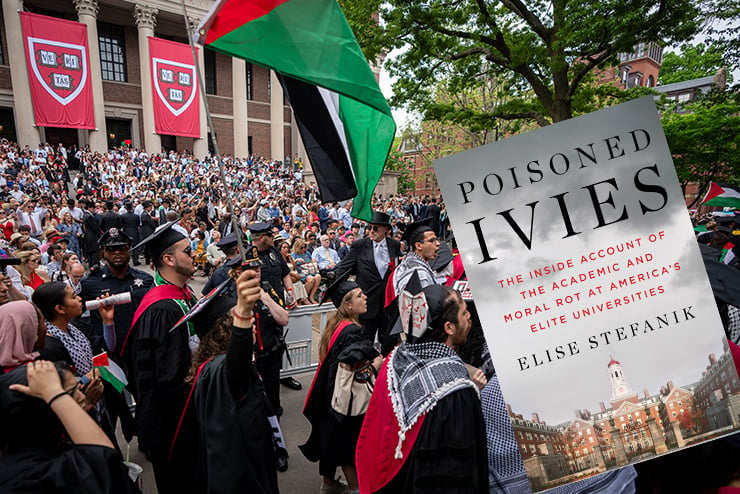
In the days and weeks immediately following the Oct. 7, 2023, attacks on Israel, one would expect students to rally to the aid of their Jewish classmates, or at least maintain a respectful silence. Instead, encampments sprang up at Ivy League universities, some professors ecstatically praised Hamas, and agitators pressured students and faculty to proclaim allegiance to the Palestinian cause in order to access areas of campus.
While the expressions of support for the Palestinians were examples of First Amendment-protected speech, it did not stop there. In addition to protesters barricading Jewish students from crossing places like Beinecke Plaza at Yale, there were a few cases of outright acts of violence committed against Jewish students. In one instance, a 24-year-old Columbia University student was assaulted while hanging fliers about Israelis abducted by Hamas, leaving him with an injured hand. At Yale, I interviewed Sahar Tartak, who was rushed to the hospital after a protester poked her in the eye with a Palestinian flag (she has a scar, but thankfully no permanent injury).
Throughout the congressional hearings, Ivy League presidents were quick to invoke free speech as a defense for the campus demonstrations. While this might normally be a reasonable defense, Stefanik observes that the Foundation for Individual Rights and Expression ranked Harvard dead last for free speech in its 2023 and 2024 reports, calling its climate “abysmal” due to the prevailing opinion of students that politically incorrect speakers should be shouted down and that violence could be used to block a speech.
Stefanik approvingly quotes Marc Rowan, then a member of the Wharton School advisory board, who noted that while “microaggressions are condemned with extreme moral outrage” (i.e., misgendering someone or using the wrong pronouns), somehow, “violence, particularly violence against Jews,” is clearly tolerated on most Ivy League campuses. As Stefanik correctly notes, none of these universities would tolerate Ku Klux Klan demonstrations. Unrestricted free speech only seems to apply when it comes to denouncing Jews, white Americans, or anyone not considered a privileged class in the view of the Diversity, Equity, and Inclusion (DEI) schema.
Stefanik proposes solutions that include everything from tenure review to withholding funding from schools to taxing endowments—the last proposal was incorporated into President Trump’s 2025 Big Beautiful Bill federal budget reconciliation act. While many conservatives appreciate Trump’s greater willingness in his second term to wield federal power, they should be on guard against possible overextension. Even vocal critics of Harvard have suggested the Trump administration went too far in withholding funding from arguably essential research priorities until deals with the federal government were struck. Certain Republican legislators have also feared that legislation passed by the House in response to these demonstrations may come at the cost of First Amendment rights.
While Stefanik’s base and those who already agree with her will surely appreciate her book, it might not be particularly effective at persuading those not already on board. A friend recently remarked to me that his mother, who is a center-left Jewish Ivy League graduate, was incredulous when she learned about the extent of these anti-Semitic campus incidents. I would hesitate to recommend this book to her, anticipating that she would be turned off by Stefanik’s strident tone, as well as her use of visceral adjectives to convey her contempt for the universities’ left-wing agitators and complacent administrators, whom she calls “sickening,” “repulsive,” “vile,” and “heinous.” This red meat will appeal more to Republican primary voters and her loyal constituents in Upstate New York rather than those still trying to make up their minds about the best way to handle out-of-control campus activists. While the majority of Americans are now questioning their long-standing assumptions about free speech on American colleges, some may be critical of the Trump administration’s targeting of university endowments and Congress’s resolutions on anti-Semitic speech.
On the other hand, the raw, emotive story Stefanik tells is part of what makes it compelling and relatively rare among books authored by sitting members of Congress. It is also grounded in the specifics of concrete events and actual policy proposals. Readers cannot help but pity parents spending $85,000 a year for their child to be subjected to, at the very least, profound distractions from their studies or, at worst, outright acts of ethnic bullying.
Although this is Stefanik’s first book, she hints in the acknowledgments that there will be more to follow. Readers would likely welcome a second book, though one that is more persuasive than polemical and more attuned to counterarguments of critics. That said, Poisoned Ivies succeeds in providing a record of precisely how elite universities lost the confidence of so many Americans.
Leave a Reply