
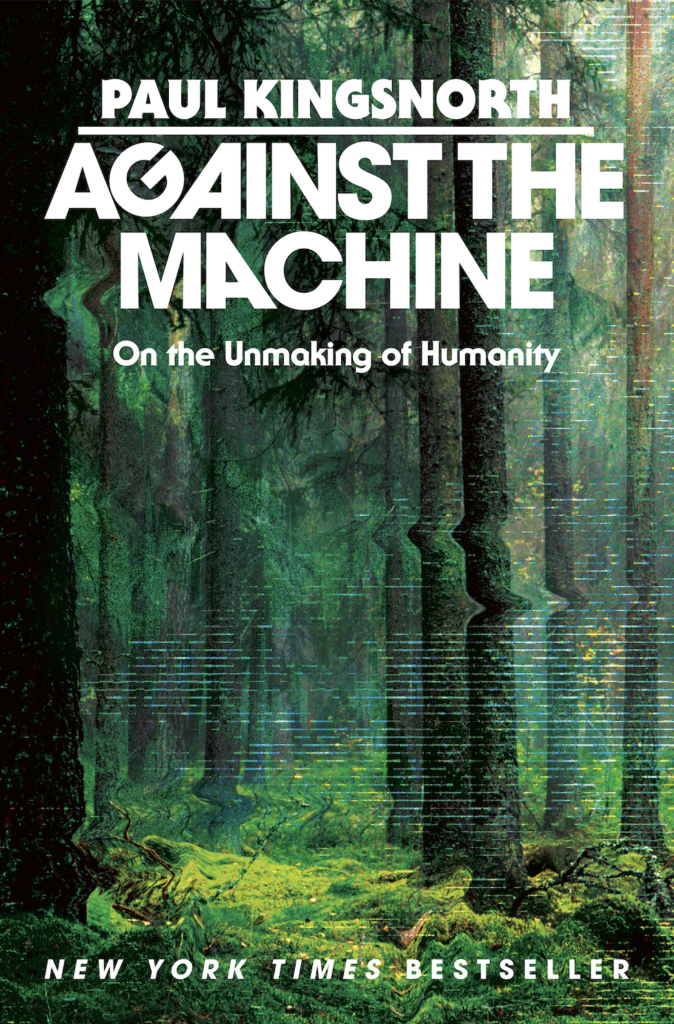
Against the Machine: On the Unmaking of Humanity
by Paul Kingsnorth
Penguin Random House
368 pp., $32.00
“Technology,” we are often told, “is neither good nor bad, but merely what we make of it.” But what if technology is taking advantage of our complacency to make something of us?
What if, in fact, there really is a “ghost in the machine”? The phrase was coined by British philosopher Gilbert Ryle in 1949 as part of a critique of Cartesian dualism. While Ryle would no doubt have scoffed at the notion that our increasingly complex machines might come to embody autonomous minds, the idea has begun to proliferate in the age of AI and is frequently embraced by our Silicon Valley savants.
Already in the 1960s, media guru Marshall McLuhan popularized the idea that electronic technology was quickly becoming an extension of human consciousness, radically realigning our self-awareness and reshaping the social order. If McLuhan sometimes expressed mild reservations about the long-term implications of electronic media, the French thinker Jacques Ellul, a contemporary of McLuhan, was a trenchant critic of what he called “the technological illusion.” As Ellul wrote in The Technological Society (1954), “Technique has become autonomous, it has its own laws, its own evolution, and its own demands.”
Paul Kingsnorth’s latest book explores the implications of Ellul’s assertion, especially in light of the emergence of a world in which the internet has become the dominant political and social reality. In Kingsnorth’s analysis, the “Machine” (always capitalized) becomes an all-encompassing term describing the malign evolution of modernity under the influence of technological change. Artificial Intelligence, in his view, is simply the endgame in a development that began with the Industrial Revolution, though its roots in Western thought date back to Duns Scotus and the late Middle Ages. The era of the great revolutions, the rise of Progressivism, the emergence of the nation-state, capitalism, Marxism, feminism, the sexual revolution—Kingsnorth believes all of these and more are profoundly implicated as carriers of, or as products of, the tyranny of the Machine. In short, technology, which has been with us since the invention of the wheel, has in the modern era become what philosopher Eric Voegelin might have termed a “second reality” that threatens to devour our very humanity.
Conservative cheerleaders for capitalism and endless economic progress will find much of Kingsnorth’s dissection of the technological imperative off-putting, especially since his perspective is shaped not by leftist egalitarian fantasies but by the Orthodox Christian tradition, rooted as it is in ideas of a sacred order that encompasses both man and nature in a mutual dependency. The eclipse of this sacred order had a number of causes, but chief among them was the rise of capitalism, which by the 18th century had fueled the growth of the great cities, drawing millions off the land and stripping them of their settled roles and identities—merging them, in the end, into that great mass of rootless individuals we sometimes call the proletariat. Referencing Lewis Mumford’s The City in History (1961), Kingsnorth argues that the great migrations out of the rural villages effected an unprecedented transformation. According to Mumford, “In the transfer of authority to the city, the villager doubtless lost in no little degree his powers of self-government, and his feeling of being entirely at home in an environment in which every human being, almost every animal, every patch of land or flow of water, was thoroughly known to him.”
Moreover, it was this massive shift toward urbanization, first in the West and then elsewhere, that eventually resulted in what Kingsnorth calls “Machine globalization,” or the dream of “Cosmopolis.” Globalization has been fed by an underlying current of utopian hope for the cessation of the centuries of war-making between hostile nations and religious factions that dominated most of history since the late Middle Ages. Hence, the emergence of the UN and the EU alongside the corporatization of the Western world. But the promises of the “End of History” (i.e., of national conflict) haven’t quite panned out as planned. “Any talk of the End of History these days,” Kingsnorth writes, “is less likely to refer to a final berthing in the port of liberal democracy than to an ecological or cultural meltdown.”
But even if the dream of Cosmopolis has begun to dissolve, and even as a variety of populist upheavals have filled the vacuum, we are still left with the totalitarian power of the Machine, which is “still humming in [its] fibre optic cables and looking down on us from satellites.” The Machine is the “true inheritor of the cosmopolitan dream, made manifest in every flowing screen, and it is remaking us all in its own image,” Kingsnorth writes.
In short, it is not capitalism per se that feeds the Moloch-like appetite of the Machine; it is technocracy, which, in turn, is the bastard offspring of the scientific enterprise. Modern science, in this view, is chiefly responsible for ushering in what French thinker René Guénon called the “reign of quantity,” the “decisive turn away from the spiritual life toward the purely material realm.” It is science and its utilitarian rationalism that have smashed all the old idols and undermined our capacity for belief in a transcendent dimension.
It is this etiolated rationalism that has inspired modern man’s attempt to build his own “closed system”—that is, an artificial world which has ushered in an age of “hyperreality.” Echoing British writer Philip Sherrard, Kingsnorth asserts boldly that “far from being an advance, the whole modern scientific project may be a ghastly failure.” Why so? Because modern science has produced, in addition to all the wonders, “the dehumanization of both man and of the society that he has built in its name.” Of course, most contemporary men and women would not admit to their dehumanization. Yet to the extent that they live as deracinated aliens, not only in their own bodies but in their indifference to the divine, they are bereft of full humanity.
Man in the era of the Machine is quintessentially not homo religiosus, but Psychological Man, as the late Philip Rieff so strenuously argued. No longer does he find purpose by identifying and serving something outside himself. Instead, his commitment is inward, directed by the imperatives of the sovereign self. Yet in its quest for fulfillment, this seemingly autonomous self unknowingly and ironically serves the ends of the Machine, and those ends demand a complete overthrow of the cultural restraints that previous societies placed upon the ego.
Our contemporary anticulture thus thrives upon a radical overthrow of human nature. Men and women become interchangeable, and gender “fluidity” becomes the model for human sexuality, transcending the old sexual “binary” and thus the chief biological obstacle to self-definition. Such an ideology, at its most extreme, involves the complete abandonment of the very idea of family, as we see in Sophie Lewis’s manifesto Full Surrogacy Now: Feminism Against the Family (2019), which calls for the abolition of the “stratified, commodified, cis-normative, neo-colonial apparatus of bourgeois reproduction in favor of gestational communism” (her word for the industrial production of children in artificial wombs).
Readers may ask whether Kingsnorth relies too heavily on such seemingly outlandish examples to make his case, but we would do well to recall how rapidly post-1960s Western women abandoned the traditional ideals of motherhood, embraced artificial birth control, and swarmed into corporate hives to become the avant-garde of postmodern consumerism.
At times, Kingsnorth’s analysis comes off as little more than intelligent commentary on the more original contributions of his precursors. However, in the final chapters of his book, he asks, “What is the drive behind all of this?” If, in fact, the Machine is a force with an agenda of its own, then what is the real nature of the Machine? He is quite aware that technology is a product of human ingenuity, but forcefully suggests that there may be purposeful, non-human intelligence inhabiting the Machine that eludes purely rational understanding. This “supersensible” entity now gestating in the networks of the Machine is not the superintelligence celebrated by the likes of Ray Kurzweil, but something far more disturbing, something imagined by Rudolf Steiner in a 1919 lecture called “The Ahrimanic Deception.”
Ahriman was a primordial Zoroastrian demon of “pure matter,” who, according to Kingsnorth, “manifested in all things physical—especially human technologies—and his worldview was calculative, ‘ice-cold’ and rational.” While Kingsnorth does not accept Steiner’s occult demonology, he nevertheless cautiously postulates that a ghostly, preternatural presence guides the development of internet technologies. Drawing upon the work of 19th-century Russian mystic Ignatius Brianchaninov, Kingsnorth classifies the Ahrimanic spirit as, in fact, the Antichrist, who, in the words of the Orthodox saint, “will reveal before mankind by means of cunning artifice, as in a theater, a show of astonishing miracles… All men, led by the light of fallen nature, alienated from the guidance of God’s Light, will be enticed into submission by the seducer.”
In the same year of Steiner’s lecture, Irish poet W. B. Yeats published his oft-quoted poem “The Second Coming,” in which he asked: “And what rough beast, its hour come round at last, / slouches toward Bethlehem to be born?” Perhaps Kingsnorth is channeling Yeats when he writes, “Whatever is happening, it feels to me as if something is indeed being ‘ushered in.’ Through our efforts and our absent-minded passions, something is crawling towards the throne… The great mind is being built. The world is being prepared.” Many of his readers will no doubt find all this an intuitive leap too far, yet it does seem we are now enmeshed in a vast technological web, rather than the ancient sacred canopy that once enveloped humankind during the Age of Faith. The result of this change will surely be sinister.
Leave a Reply