

Butler: The Untold Story of the Near Assassination of Donald Trump and the Fight for America’s Heartland, by Salena Zito (Center Street; 256 pp., $29.00). Salena Zito is one of the few genuine political journalists remaining in this country. Traditionally, that job entailed an almost religious devotion to getting the true story and not being a partisan hack; a life history rooted in a real American community, enabling sympathy with the typical American; and a prodigious talent as a writer. Zito exhibits all three traits in abundance.
Butler is, as the title indicates, a look at the near assassination of Donald Trump in 2024 in the Pennsylvania town of that name. It is also one of the most insightful accounts I have encountered of why Trump won the election that followed. Zito was at the fateful event and spoke at length with Trump the day after the attack. Her account of his clear conviction that he had been spared by “the hand of God,” and of the spiritual sentiments that filled Trump’s supporters in the aftermath, makes for riveting reading, as does her description of his triumphant return to Butler in October (his opening line of “As I was saying…” is one for the ages).
The core of Zito’s analysis of Trump’s appeal relies on a variation of David Goodhart’s distinction between Somewhere and Anywhere people. She refers to “the placed” and “the placeless.” The first are those who, like Zito herself, live in vibrant communities of working people and who maintain ties to that place and its people. The second are the coastal elites whose second home is the airport and who do not know or care much about the kind of people who make up the bulk of the country.
Everyone knows the jet-setting billionaire businessman from Queens who is our president is not a descendant of the placed. Yet Trump’s rapport with them was vastly more substantial than that of his thoroughly unlikable opponent in the 2024 election. Zito tellingly compares a Harris/Walz Pennsylvania bus tour—which involved meeting almost no working-class Pennsylvanians and confined itself to establishments out of touch with local populations and their populist politics—to Trump’s intensive travel throughout the small-town communities of Pennsylvania’s working and lower-middle classes.
She also gives us a chapter that astutely points out why JD Vance was such a brilliant VP pick. That Zito’s reliable radar picks up the same genuineness in the man that I detected after reading his Hillbilly Elegy confirms my sense of who should be at the top of the Republican ticket in 2028.
(Alexander Riley)
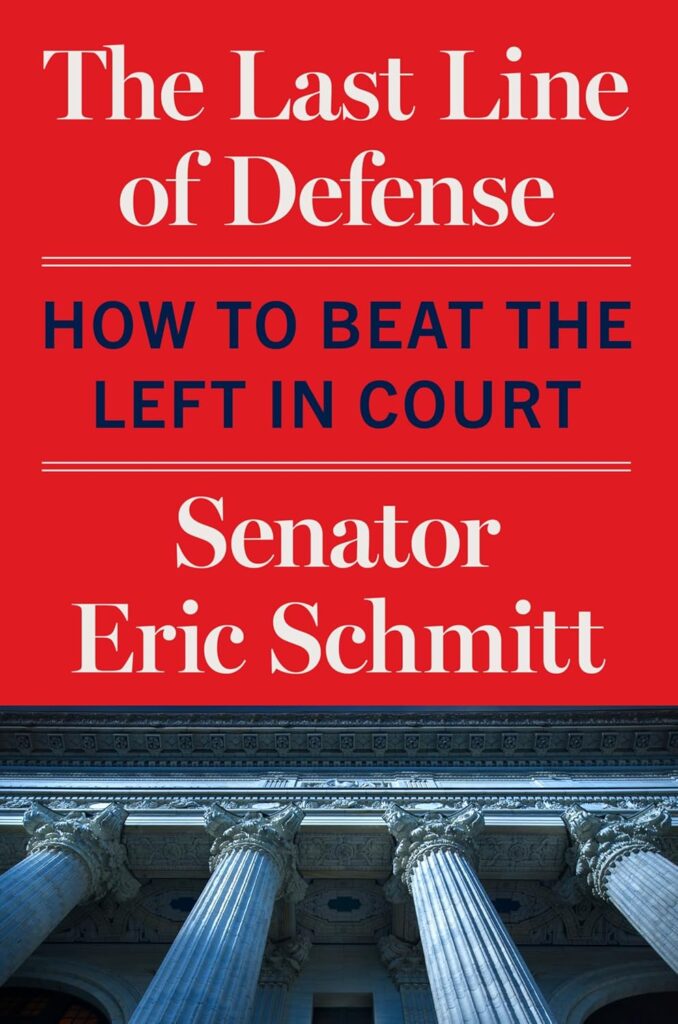
The Last Line of Defense: How to Beat the Left in Court, by Eric Schmitt (Broadside; 272 pages; $32.99). For a long time, the left had a near-monopoly on the use of the law as a weapon. That has changed in the past decade, and pols like Schmitt have been on the front line. He took his seat in the Senate in 2023, representing Missouri, but most of this book deals with his time as attorney general for the “Show Me” state. There, he developed strategies to oppose Washington’s overreach, the manipulations of the administrative state, and woke ideology.
It was the COVID era that set him on his course. He saw the mandates on vaccines, masks, and social distancing as inherently anti-democratic, pushed along by officials whose main expertise was in self-promotion. He aims some of his sharpest barbs at Anthony Fauci, highlighting his contradictions and arrogance, shown when he refused to answer questions under oath, repeating “I don’t recall” 174 times.
One of the main weapons of the left’s “experts” during the COVID era was their selection of evidence, ignoring or sneering at anything that did not fit their paradigm. Conservative lawyers, therefore, had a chance to amass persuasive research material from primary sources that had been ignored or suppressed. To effectively communicate this evidence, Schmitt looks to the example of Antonin Scalia, a jurist he sees as having combined plain speaking with elegant thinking.
Tactically, discovery is “one of the most powerful tools for uncovering what institutions would rather keep hidden,” Schmitt writes. “In the face of public statements, spin, and carefully managed narratives, discovery forces the truth into the light.” One of the greatest tools of discovery is the Freedom of Information Act, which often provides a trove of material hidden under Democratic administrations.
He also reiterates how progressives will simply dismiss judicial decisions they do not like. The classic example was Joe Biden’s refusal to comply with the Supreme Court’s judgment invalidating his waiving of student loan debt, but there are many other instances of obfuscation and delay. Law for your side, but not mine, apparently.
Schmitt does an effective job of stitching all this together, though he could have spent more time discussing how the legacy media supports progressive talking points. Despite the left’s control of the media, Schmitt believes that the tide of public opinion has turned. The challenge now is for the right to consolidate its wins and expand the battlefield.
(Derek Parker)
Leave a Reply