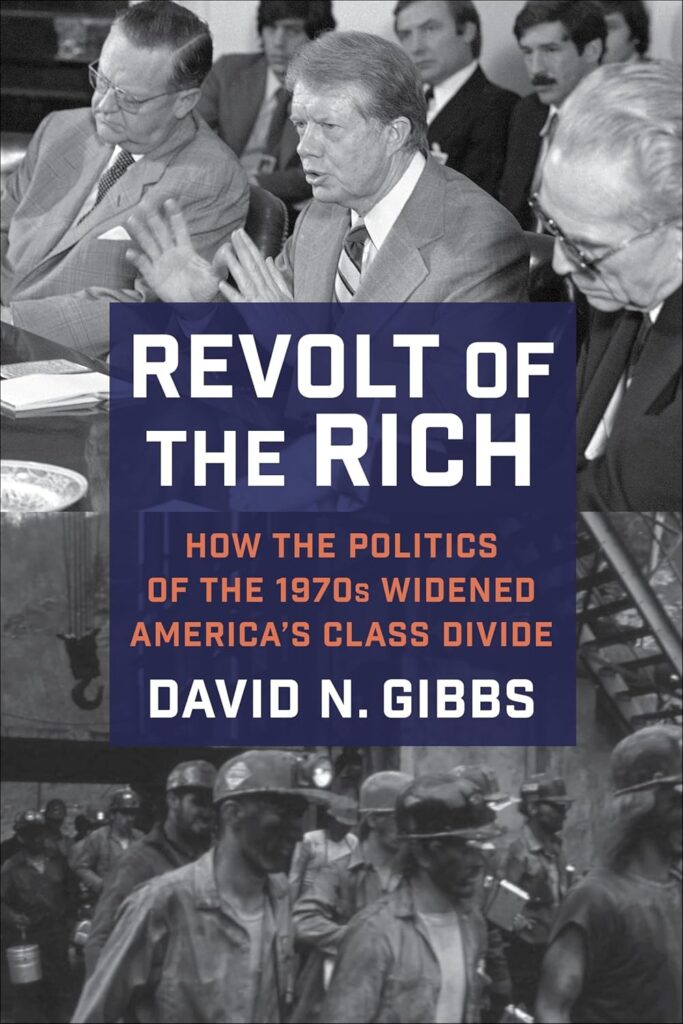
Revolt of the Rich: How the Politics of the 1970s Widened America’s Class Divide
by David N. Gibbs
Columbia University Press
392 pp., $30.00
In the 1970s, neither my friends nor I would have flinched if any of the fathers in our upper-middle-class social circle had gone out for a beer with the gas station attendant who changed their oil. Our mothers shared a cup of coffee with the cleaning lady before going grocery shopping. Such interclass encounters didn’t register with us kids. We were too busy mowing lawns, parking cars, and stocking shelves to pay for Led Zeppelin albums and subscriptions to National Lampoon. Besides, the gas station guy’s son played shortstop on our high school baseball team. And the cleaning lady’s daughter shared makeup tips with our sisters.
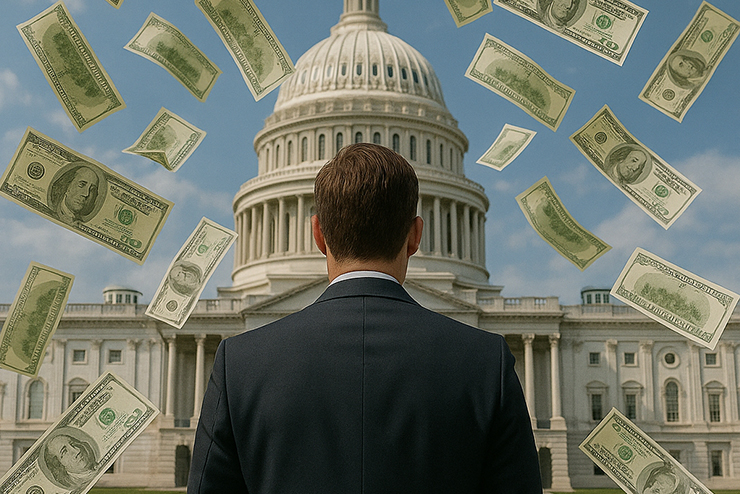
Skip ahead to yesterday. How many nights would you guess that Netflix founder Reed Hastings has spent in a dive bar with his plumber, explaining his multimillion-dollar donations to Kamala Harris? How many stress-free unpaid internships have the coddled progeny of Harris supporters, like Blackrock CEO Larry Fink or Apple widow Laurene Powell Jobs, toiled at to impress Ivy League admissions staff? Everyone knows the ultrawealthy have destroyed the American Dream. If you’re wondering how they pulled it off, David Gibbs’ Revolt of the Rich provides a good answer. “America’s shift toward wealth concentration was the product of pressures from economic elites,” Gibbs writes. That much is intuitively obvious; however, Gibbs’ historical sleuthing provides the illuminating backstory to that pithy summation.
It’s hard to imagine the United States economy having anything but smashing success after the Great Depression and World War II. America’s prewar manufacturing base, later expanded to accommodate wartime production, hummed while Europe’s lay in ruins. Thanks to their roaring success as the Allies’ arsenal of democracy, Americans in 1945 opened themselves to the idea of a more planned economy and the potential for full employment. As the global postwar reconstruction continued, American labor and capital both benefited from high profit rates and stable growth. Wealthy individuals and business elites stifled their initial protests against labor’s earliest expansions of power and government efforts to control inflation. Gibbs aptly labels this peaceful coexistence the “class compromise.”
However, business interests eventually protested once they concluded their share of the postwar economic pie might shrink. The economic elite’s self-preservation campaign kicked off with its mockery of 1946’s Full Employment Act as “akin to slavery,” forcing the bill’s rewrite as the Employment Act of 1946, with its mandate for full employment excised. Meanwhile, organized labor reeled after price controls disappeared and inflation surged. Labor’s misguided response in initiating widespread strikes, along with Truman’s disempowering “lack of charisma,” handed Republicans control of both houses of Congress in 1946, for the first time since 1930.
Labor then lost even more leverage when right-to-work laws took effect after the new Republican majority rubber-stamped the Taft-Hartley Act, twice—the second time after Truman’s symbolic veto. Gibbs cites Taft-Hartley as one of the “principal constraints on the class compromise” for its limiting of unionized labor’s ability to organize nationwide.
As the fabric of the class compromise started to fray, any electoral discussion of class conflict became taboo. American voters would not hear about this “forbidden issue in American elections” again until the hapless Bernie Sanders championed it to a tone-deaf electorate in 2016. Hillary’s preordained 2016 ascension to the throne had taken precedence over reviving America’s moribund manufacturing base, in the estimation of George Soros and The Atlantic.
The postwar growth in think tanks further bolstered the pro-business cause. The Mont Pelerin Society, dedicated to the “propagation of free market ideas,” marched arm in arm with the nascent Chicago School and its “preexisting bias against labor unions.” The Volker Fund, Foundation for Economic Education, and the International Chamber of Commerce all provided ideological support. Religious leaders, happy to jettison biblical truths for rhetorical advantage, joined the crusade. Billy Graham employed anachronism to teach his flock that, along with its freedom from snakes and disease, the Garden of Eden had “no union dues, no labor leaders” either. Business leaders could not have enlisted more convincing advocates to change the public’s perception of business’s “spiritual dimension” and thereby sway the country’s largely Christian voting base to accept their rapacious agenda.
These PR stunts, though effective, were largely superfluous in light of the “undemocratic features” that loomed over the class compromise’s feeble long-term survival prospects. America’s great fortunes remained in the avaricious hands of business interests and wealthy individuals. Elected government officials subserviently bowed to private investors as the “main source of economic dynamism.” Later, as inflation rose and profits sank, elites refashioned their peaceful class compromise into a more bellicose class confrontation. The compromise had run smoothly all the way through the late 1960s. But as the financial elites eventually confronted the “unacceptable burdens” of “unionized labor, the welfare state, progressive taxation, and economic regulation,” the “revolt” of the book’s title kicked off.
Gibbs’ identification of the 1970s “striking decline in the rate of profit” as the “central factor in America’s right turn” reads like he cut it out of Das Kapital and pasted it right into his insightful work. Cheap insults aside, he’s right. Those who ignore his argument will fail to understand why Sam’s Club members now outnumber country club members among the Republican Party faithful. Gibbs echoes Marx again when he writes that American business eventually coalesced as “a reasonably unified social class.” Business exercised its class interests through the National Association of Manufacturers and the U.S. Chamber of Commerce, both friends of the Nixon administration. Those of us allergic to Marxist jargon refer to these groups as rent-seeking parasites. But that’s a linguistic distinction without an economic difference.
Once think tanks, academics, and business lobbies had secured the mobilization on solid ground, business interests expanded their remit into creating “an overarching conservative movement.” They found natural allies in socially conservative evangelical Christians who, by then, had probably given up looking for biblical passages about union dues, and in libertarians, who never met a free-market idea they didn’t launch a magazine in support of. The resultant “fusionism” united business interests with cultural conservatives who rode shotgun as their impotent junior partners. According to Gibbs, “This strategy … engineer[ed] a historic break with the New Deal class compromise.” Meanwhile, Democrats abandoned the working class, since they were “already committed to an identitarian agenda based on an affluent and well-educated constituency.”
The Vietnam Syndrome paralyzed America’s global agenda after 1975. But not even 58,220 dead American soldiers could inhibit the movement from identifying foreign policy, military spending, and the Cold War as new hunting grounds. In what might be the strongest part of his book, Gibbs details neoconservatives’ chicanery and self-interested double-dealing under the guise of supporting the mobilization.
Richard Perle parlayed his experience consulting to military contractors into “lucrative ventures in the security and antiterrorism business.” Paul Wolfowitz and Albert Wohlstetter landed remunerative sinecures on corporate boards, as did the “godfather of neoconservatism” himself, Irving Kristol. The opportunistic neocons co-opted “human rights discourse as a new and powerful justification for militarism” while, as Gibbs painfully reminds us, forgetting to mention that “military interventions and wars—even those undertaken with the best of intentions—typically worsen human rights abuses.” Social and religious conservatives unwittingly welcomed the militarist neoconservatives into the coalition even though the two camps had nothing in common.
Not even a simple Georgia peanut farmer, Jimmy Carter, could elude the influence of the pro-business think tanks and lobbying groups. Before you knew it, Carter had implemented “conservative antilabor policies … regressive changes to taxation and an austerity program aimed at controlling inflation” that did little more than increase unemployment, though not for any neocons. To Gibbs’ credit, he refuses to blame today’s harmful economic divide on the left’s go-to scapegoat, Ronald Reagan. As his abundant evidence shows, Gibbs writes, the Gipper “merely expanded on a right-wing policy agenda that commenced earlier—during the presidency of Jimmy Carter.”
But under what political taxonomy can anyone consider Jimmy Carter right-wing? Despite his early declaration of impartiality, Gibbs’ distorted perspective of political categories may force conservative readers to hold their noses as they plow through Revolt. Gibbs does not actually seem to understand what he calls “the well-understood phrases ‘conservative’ and ‘right wing.’” He defines these as “policies that advance economic deregulation and wealth concentration at the domestic level,” a definition that ignores the ideological chasm between traditional conservatives and economic libertarians.
Gibbs also includes “militarism and military interventions overseas” in his definition of right-wing, an absurdity to anyone who’s read Pat Buchanan or Chronicles, or even seen a recent poll. Such simplifications lead one to label Jimmy “Let’s Give Away the Panama Canal” Carter as right-wing. Lastly, his abundant counterfactual analyses cheapen his first-rate scholarship; let us hope future editions lose them.
Leave a Reply