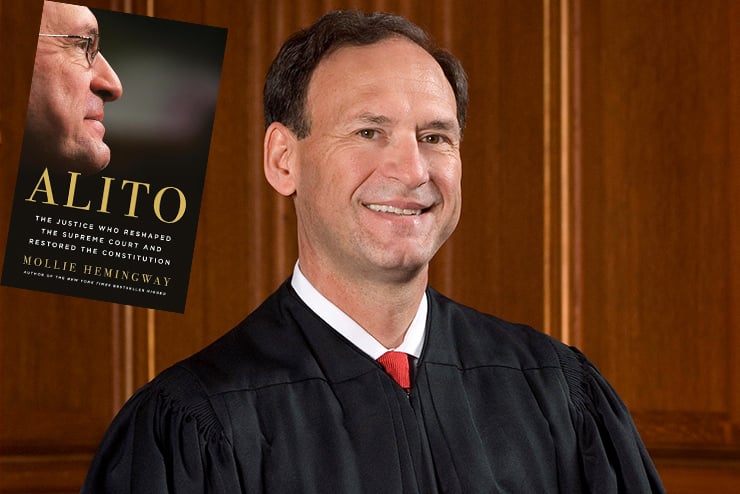
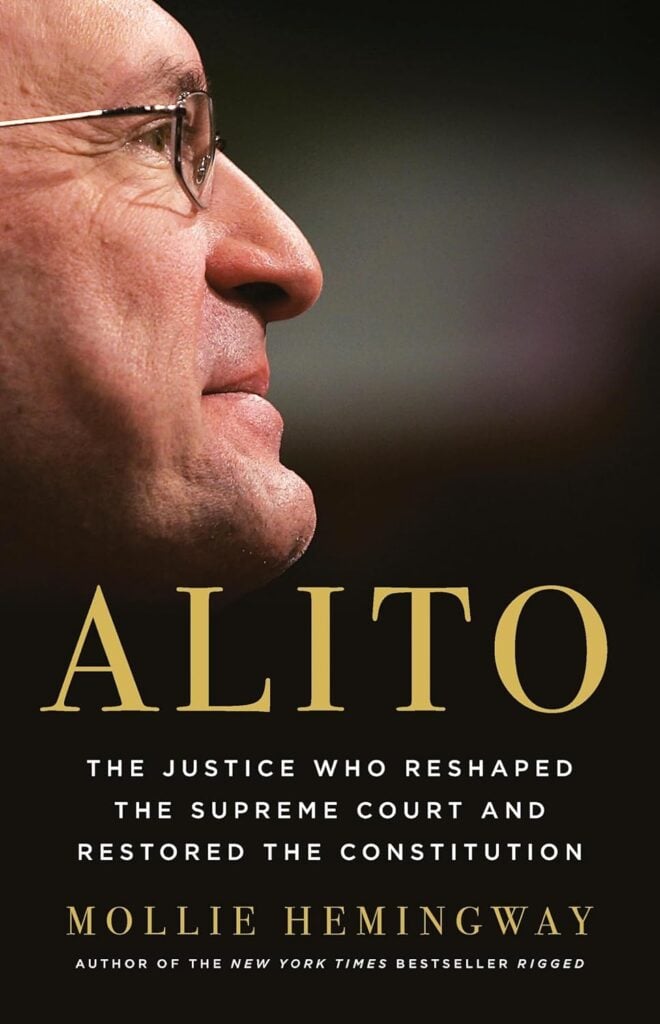
Alito: The Justice Who Reshaped the Supreme Court and Restored the Constitution
by Mollie Hemingway
Basic Liberty
352 pp., $32.00
Samuel Alito was no 1960s campus radical. His fealty has always been to the ordinary folk back home.
“I saw some very smart people and very privileged people behaving irresponsibly,” he said during his Senate confirmation hearing in 2006. “And I couldn’t help making a contrast between some of the worst of what I saw on the campus and the good sense and the decency of the people back in my own community.”
Recovering from the insanity of the 1960s is a major theme of Alito: The Justice Who Reshaped the Supreme Court and Restored the Constitution by Mollie Hemingway.
Hemingway’s book has already made news by revealing that liberal justices threw tantrums and tried to “slow-walk” the final release of Dobbs v Jackson, the 2022 decision that overturned Roe v Wade. Justice Sotomayor claimed the Court’s legitimacy was at stake and, according to Hemingway, Justice Kagan yelled loudly enough to rattle the walls on First Street.
Alito is beautifully written and cogently explains legal terms and Justice Alito’s personality. Hemingway describes Alito’s jurisprudence as part originalism: in short, sticking to the plain meaning of what the Founding Fathers and Congress wrote into law, but also something more. Alito rejects a “hyper-literalist” approach to originalism while preferring a method that more closely comports with outcomes ordinary citizens might want.
“While efforts to understand the philosophy behind Alito’s jurisprudence can be revealing, in some respects his skills are unique to him,” Hemingway writes. Alito resists “comfortable theories of textual interpretation,” opting for tradition and natural law “when a question is legally indeterminate.” A decision “must be both a convincing legal argument and agreeable to the American public who must live with it.”
Otherwise, he risks becoming another celebrity justice, a peacock on the bench preening for an audience that already agrees with him. In other words, practical originalism requires a wise and even-tempered judge. While there is much to be learned from Alito’s carefully argued opinions, it is his character that makes him an exceptional jurist.
Alito is also good at quietly marshaling the other justices to his arguments and has been instrumental in an impressive string of conservative victories. In 2023, the Court ruled against institutionalized racism at colleges and universities. In 2024, it ended “Chevron deference,” the doctrine that had given federal bureaucrats the authority to impose rules and regulations without clear congressional authorization. In 2025, the Court ruled that public schools violated the religious rights of parents by inflicting gender ideology on their children.
Is this “originalism”? According to Adrian Vermeule of Harvard Law School:
Originalism has now outlived its utility, and has become an obstacle to the development of a robust, substantively conservative approach to constitutional law and interpretation.
Alito should still be regarded as an originalist, but he might agree with Vermuele that something more than mere textual exegesis is required. After all, when the justice was grilling a lawyer for the ACLU in 2026 about the definition of man and woman, he wasn’t examining the text of the Constitution. He was using natural law, tradition, and common sense.
Alito, it should be noted, has an extremely dry sense of humor. His Princeton roommate said that although “characterized as shy by people who didn’t know him,” Alito is “very funny.” When the oval table in his chambers was replaced by a square one, he solemnly announced to the clerks that, by the order of the chief justice and since the time of the American Revolution, it costs more to make an oval table, and thus the change. After a slight pause, he let on that he was joking. When presented with a picture of Jay-Z, Alito asked his clerks, “What is a rapper?” They didn’t know until hours later that he was again kidding. Alito’s clerks hold him in awe, often feeling outmatched and superfluous in the aura of such a brilliant mind.
Alito describes the powerful influence that his Italian neighborhood of Mercerville, New Jersey, had on him growing up. He was born and raised in an Italian community and family of strong Catholic faith. “I am who I am,” he said at his confirmation hearing, “because of my parents and because of the things that they taught me.” His grandparents were all Italian immigrants. His father, Samuel Alito, Sr., was a teacher who became the director of New Jersey’s nonpartisan Office of Legislative Services, providing “exhaustive, unbiased research to legislators of both parties.” Rose Alito, Samuel Sr.’s wife, was a teacher. The Alitos fit in well in what Justice Alito would describe as “a warm, but definitely unpretentious, down-to-earth community.” Most of the adults, he noted, were not college graduates.
A pivotal moment occurred during Alito’s sophomore year at Steinert High School. He turned in a book report to his English teacher, Elaine Scorsolini. She noticed the quality of his work and told him he was ready for something more challenging. She gave Alito his first list of classics. Soon after, he obtained a reading list from The Lawrenceville School, an elite preparatory academy nearby. Then he purchased Modern Library books at the Korvette department store. He read Joseph Conrad’s Victory and Lord Jim, Tolstoy’s The Brothers Karamazov, and the works of James Joyce.
Alito graduated in 1968—a “tumultuous time” in American history, as Hemingway notes. He then went on to Princeton. In 1970, the faculty called for a campus-wide strike to protest the Vietnam War. Eighty percent of the students skipped class and were offered a pass/fail option for the semester. Alito was “beyond annoyed,” Hemingway notes. His focus was academic, not political.
Yet politics couldn’t be averted: Alito had a low draft number. Thinking that being an officer was his best option, he joined the Reserve Officers’ Training Corps (ROTC). Protesters brutally harassed ROTC students until Princeton banned the program during Alito’s senior year. Things weren’t much better at Yale Law School in the 1970s, where Alito was an editor of the Yale Law Journal. He admired one professor in particular, Alexander Bickel, the author of the book The Supreme Court and the Idea of Progress. The book espoused what was then an unpopular idea: judicial restraint.
After law school, Alito clerked for the U.S. Court of Appeals for the Third Circuit in New Jersey. He then got a job in the U.S. Attorney’s Office in New Jersey, where he argued cases as an appellate attorney. In 1981, he got a job in the Office of the Solicitor General in Washington, D.C. His first argument before the Supreme Court was in 1982.
It was in Ronald Reagan’s Washington of the 1980s that Alito found an ideological home both in the government and at the new Federalist Society. A colleague, also a lawyer, joked after spotting Alito at a Federalist Society meeting that it was like “bumping into a friend at a bordello.” (The Federalist Society has come a long way since then.)
In 2022’s Dobbs v. Jackson Women’s Health Organization, the Court, in an opinion written by Justice Alito, overturned Roe. Hemingway argues that Dobbs was a corrective to an unconstitutional decision.
Hemingway’s book was published just before Louisiana v. Callais, the Court’s April decision against racial gerrymandering. Justice Alito cast it as an “update” to the framework that has governed Voting Rights Act cases for years, while the liberal justices, in dissent, called it a “demolition” of the law. “That map is an unconstitutional gerrymander, and its use would violate the plaintiffs’ constitutional rights,” Alito wrote of Louisiana’s heavily gerrymandered voting district map.
Hemingway never mentions the one book that provides the necessary context to this controversy and to the life and thinking of Justice Alito: The Age of Entitlement: America Since the Sixties by Christopher Caldwell. As Caldwell explained,
The changes [in federal law] from the 1960s, with civil rights at their core, were not just a major new element in the Constitution. They were a rival Constitution, with which the original one was frequently incompatible—and the incompatibility would worsen as the civil rights regime was built out.
Americans have lived under two rival constitutions for 70 years. Brown v. Board of Education stated that segregated schools were inherently unequal, but also went further, striking down freedom of association. Caldwell argues that if Americans were left to freely associate, the culture would have worn away racism. It was already happening in popular culture; rates of intermarriage were rising. Forcing citizens to live under two separate constitutions, however, caused resentment. The DEI and wokeness that proceeded caused more bitterness from Americans who were called racists and lost jobs merely for being white.
It was this iniquitous, un-American system that Alito began to dismantle in Louisianna v. Callais. For that alone, he belongs on Mount Rushmore.
Leave a Reply