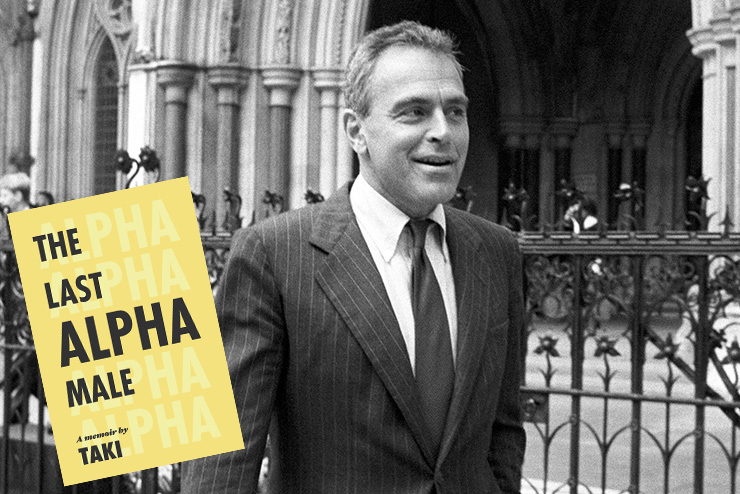
by Taki Theodoracopulos
Passage Publishing
203 pp., $39.95
I’ve known Taki for more than two decades through my writing for Chronicles and The American Conservative, and from spending time with him at conservative gatherings. Above all else, Taki is the original bon vivant, enjoying fine food and libations, good company, and beautiful women. He is the best of company—interesting, witty, knowledgeable, high-spirited, and just plain fun. My wife would add “charming.”
My older sister and her husband stayed in Monte Carlo for a time in 1960. When she returned home, she regaled the rest of us in the family with tales of the millionaire European playboys and the parties they threw on their yachts anchored offshore, the sports cars they drove through the streets of Monaco, and the beautiful women surrounding them. I didn’t know it then, but my sister was describing Taki Theodoracopulos.
“Let me tell you about the very rich,” said F. Scott Fitzgerald in his 1926 short story “The Rich Boy.” “They are different from you and me.” Taki certainly is, but Fitzgerald also says that because of being born into great wealth and luxury, the rich are soft. Taki certainly is not. He was a top athlete, excelling at polo, tennis, and judo, even serving as captain of the Greek national judo team.
Taki’s new memoir The Last Alpha Male is shockingly honest, hiding nothing except, chivalrously, the names of some of his female co-conspirators. His life has been mostly a fun romp, and for the reader of his book, all a fun romp. It had me cracking up at times, appreciating Taki’s wisdom in his more sober moments, stunned at how he could manage multiple relationships simultaneously, surprised by his athletic prowess despite his regimen of drinking, late-night parties, and visits to brothels, his socializing with the glitterati of the international set, and all the time writing about it in The Spectator.
Taki didn’t come from generational wealth but from a father who created it from scratch. Honor and courage were everything to the father, who was twice decorated by the Greek government and rebounded after losing nearly everything during World War II and then in the battle with the Communists at the end of the war. After the war, he convinced the U.S. government to sell him surplus American Liberty and Victory ships on the cheap, as compensation for the American bombing of his factories, and he launched a new career as a Greek shipping magnate. His business ventures later included a textile plant in the Sudan and a string of hotels. Taki greatly respected and admired his father for his resilience, courage, and bold decisions—but also for his womanizing.
“He believed,” says Taki, “as do I, that the truly great sin is to abstain from things that give us pleasure: eating red meat and drinking red wine, smoking, and chasing women. What else is one supposed to do, live like a monk, eating greens all day and never going on one’s yacht?” However, all that indulgence is to be done with discretion and style. One is duty-bound not to leave one’s wife, “even as a proper sense of entitlement means you never unwillingly give up a mistress.”
Instead of apologizing for any of this, Taki makes a case for it, forgetting that such a way of life requires having millions of dollars to sustain it. In Taki’s view, “There is no more innocent way of passing an evening, than overeating, drinking to excess, filling up your lungs with smoke, betting more than you can afford on the queen of diamonds, and, of course, fornicating to excess.” Those who engage in such pleasures should not be condemned but cherished, says Taki, because they are not trying to control or oppress others, but “are peacefully engaged in ruining their own lives.”
Tennis was an early pathway for Taki, who calls himself the “poor little Greek boy,” into the world of European celebrities, royalty, and, of course, beautiful women. He joined the circuit at the tender age of 19, playing by day and partying by night. He had an advantage over the top players: He was among the unseeded, which meant he didn’t usually last past the second round, giving him plenty of time to pursue the young pretty things who followed the circuit.
Taki tells stories not only about himself on the circuit but also about other players. Perhaps the best is about Frank Shields, the grandfather of Brooke, who had retired from the game by the time Taki joined the circuit. The tall, handsome Shields ranked #1 in America in 1933 and remained one of the top-ranked Americans into the 1940s, not retiring until the 1950s. He had a reputation for drinking and chasing women. During Davis Cup play in Paris, he chased a woman to Le Havre and right onto the ship she was taking. He spent the night with her and awoke the next morning to find the ship 200 miles out to sea. When he didn’t show up for his doubles match against the French, the American team had to forfeit.
Wherever Taki lived or visited, he managed to meet the local stars. In 1956, he was at New York’s Little Club with Linda Christian, the recently divorced wife of Tyrone Power. Spying the beautiful Christian, Mickey Mantle asked the club’s owner if he would invite Christian and her date to join him and Billy Martin at their table. A baseball fan, Taki immediately accepted the request, knowing full well that the Mick was only interested in Christian.
Surprisingly, Taki had been a fan of the New York Yankees and Mantle for years by then. On a visit to New York in 1948, an executive working for Taki’s father took the poor little Greek boy to a Yankee game, and he was hooked. In 1951, Mantle, only 19, became a starter in the outfield for the Yankees. Taki would follow his extraordinary career from beginning to end. “Mickey was an extremely good-looking All-American crew cut type,” Taki writes, “and I admired how he played hurt throughout his career, never once using an excuse of taking himself out of a game. He played drunk and sober, with or without sleep, and he was, above all, a gent, a farmer’s boy from Oklahoma with inherent good manners and respect for those less talented than himself.”
Although Mickey Mantle and Billy Martin focused most of their energy on Linda Christian, Mantle did invite Taki to visit him and his teammates in the dugout the next day. Taki didn’t mind Mantle and Martin’s moves on Christian, saying, “They were men, each with a pulse, and I might have been mildly offended had it been otherwise.”
Mantle was married to his high school sweetheart at the time and would remain married to her until he died. This didn’t stop him from bedding other women, nor did it hurt his popularity as a baseball player. If he had been a politician, extramarital affairs would have destroyed him.
Like many, if not most, in continental Europe, Taki considers requiring strict monogamy for politicians unrealistic and harmful. When Taki was young, his father derided a Greek prime minister for being uxorious and predicted he would soon fall from power. The prediction came true. “I remembered this many years afterward when I met the worst ever example of uxoriousness among occupants of the White House, Jimmy Carter. The peanut farmer was the nicest of men. Not only did he cheat on his wife only in his mind, he permitted Rosalynn to attend and speak at his cabinet meetings. Needless to say, he was a disastrous president.”
Not surprisingly, Taki finds feminism “the bane of all humankind.” From the early days of the feminist movement, Taki called it out for what it was—a war against biology. He watched it grow from embarrassing assertions to now-putative sacrosanct principles that we are required to embrace. He’s found it easy to debate the topic, which he has done on several occasions, including on The Phil Donahue Show, because all he has to do is tell the truth, while his opponents get themselves tied in knots promoting outrageous fictions.
Taki says American women would find greater happiness and satisfaction, and exercise more power and influence, if they would stop trying to outcompete men at being men and instead learn from their ancient Greek sisters that female power lies in femininity, beauty, and emotional and sexual allure.
It might surprise some, but not those who know Taki, that for him the most important attributes of a man are not his ability to charm and seduce women but his honor and courage. Here, he again goes back to ancient Greece for examples—Leonidas and his 300 Spartans, Pericles, Miltiades, Themistocles, Pheidias, Socrates, Plato, Aristides… Men who had the courage of their convictions and lived by their ideals.
Theodore Roosevelt was an American who, in Taki’s estimation, did just that, and so, too, did his four sons. Roosevelt was awarded the Medal of Honor for leading the charge up San Juan Hill in the Spanish-American War, and Theodore Roosevelt Jr. was wounded in World War I and then awarded the Medal of Honor for his heroics on Utah Beach at Normandy in World War II. Quinton, a fighter pilot, died in World War I. Archie and Kermit fought in both World Wars, and Archie was wounded in both. They all could have avoided serving in combat roles.
Now in his late 80s, Taki looks back on his youth—his vitality, exuberance, excesses, conquests, failures, mistakes—with few regrets. What he misses most, though, is not the young Taki (though he was very fond of that guy), but the world the young Taki lived in. Europe and America have changed dramatically since then—and not for the better.
Leave a Reply