The writing of history is shaped by the writer’s time and intended audience. Modern attempts to retell history are lessons in themselves, prima facie evidence that someone has seen the utility of a reexamination. Newly available facts may be pertinent; fresh concepts and alternate terminology may have value. Any new slant may lead to what we now call revisionist history—whether readers of such revisionist tracts are made more intelligent, as many self-designated educators assert, is uncertain.
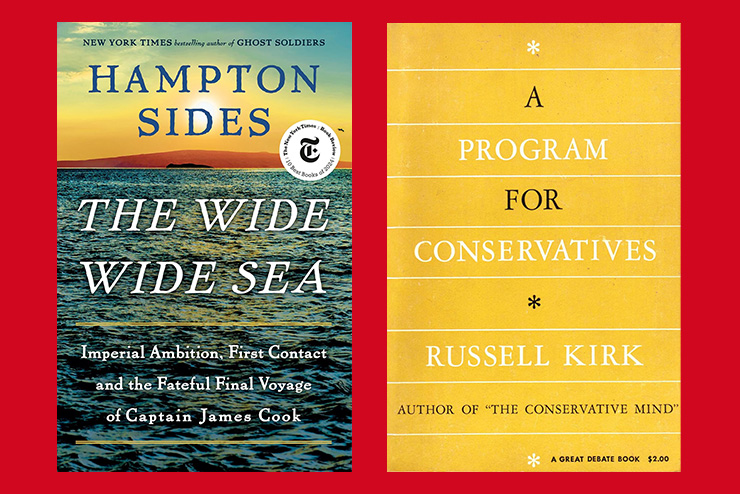
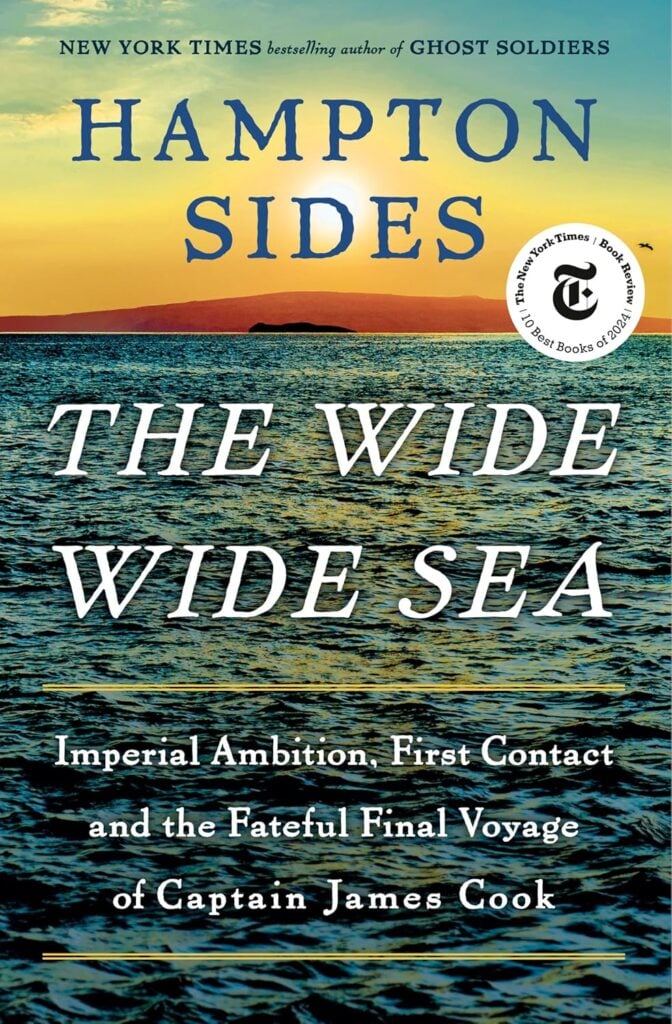
In The Wide, Wide Sea: Imperial Ambition, First Contact and the Fateful Final Voyage of Captain James Cook(2024), Hampton Sides provides a sort of revisionist history of the British explorer of Australia, New Zealand, and Hawaii. He builds on earlier records, starting with Cook’s own accounts, for the purpose of reconciling the captain with a critical modern world. Sides is aware of hostility toward canonic treatments of European exploration by radical anthropologists, feminists, anti-colonialists, and anti-whites, so he treads carefully between their positions and the historian’s proper ideal of objectivity.
Cook himself set an example of cultural neutrality when he approached what were viewed as primitive cultures. While his relativism had limits—he condemned cannibalism and human sacrifice—he tried to avoid an attitude of superiority. He tried to curb the worst of Western influences and to reduce thoughtless abuse of the natives by his men. He quarantined any of his sailors who carried disease. He ate local foodstuffs and observed local courtesies. He even privately questioned the propriety of introducing Occidental knowledge and goods to primitive peoples, thereby agreeing with his subsequent detractors. Although it was beneficial to share some technologies, such as iron tools, he was convinced that contact with European explorers had already done much damage to the natives and would do much more.
These positions do not suffice to exonerate Cook in the eyes of his critics, who would like him to have adopted today’s attitudes, behavior, and nomenclature—better yet if he and all his ilk, whether English, Spanish, French, or Dutch, had gone to the bottom of the sea. The best Sides can do with this contemporary audience is to highlight Cook’s scruples while acknowledging modern criticism. He sounds a few notes of mea culpa, provides native geographical names, and capitalizes the terms “natives” and “indigenous,” making them, by a majuscule, races. For feminists and the nonbinary, the term “people” is occasionally employed where I would write “women.”
Sides’s position is tricky; his book is the result of trying to satisfy both the goat and the cabbage, as the French say.
—Catharine Savage Brosman
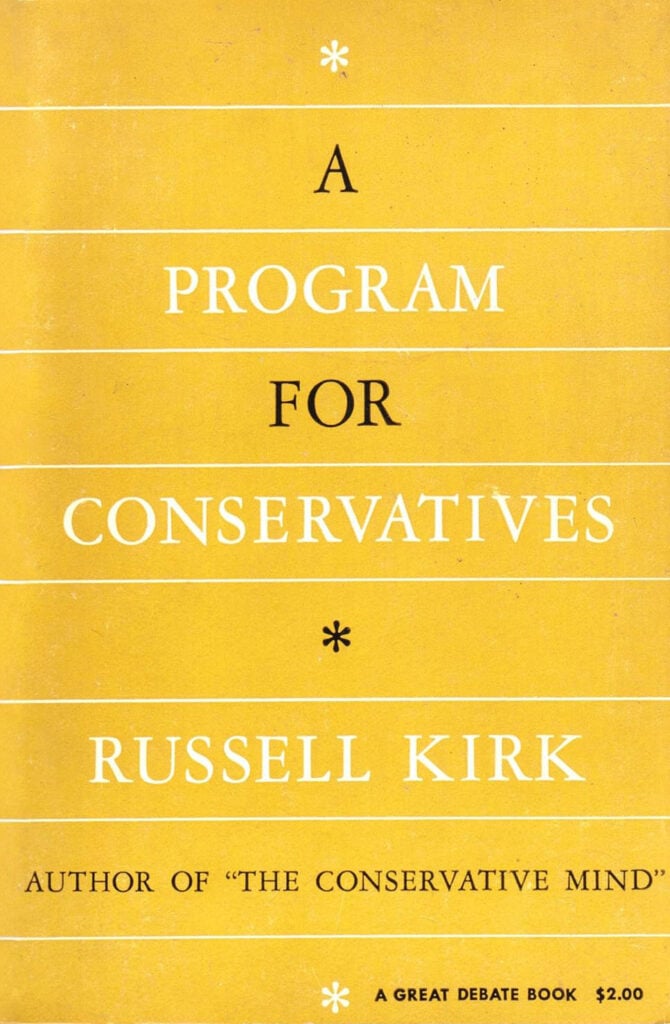
Just a year after writing The Conservative Mind, the indefatigable Russell Kirk published A Program for Conservatives. Here, Kirk was not so concerned with broad intellectual history and focused instead on a series of themes or problems in human social life on which conservatism gives us indispensable food for thought.
The list of themes treated, each of which gets its own chapter, is instructive: The mind, the heart, social boredom, community, social justice, wants, order, power, loyalty, and tradition. The reader will find himself in every chapter wanting to copy down large chunks of Kirk’s luscious prose to ensure that they remain forever in memory.
What to say in a brief comment on a book overstuffed with brilliant insight? There is, for example, Kirk’s extended polemic against the “degradation of the democratic dogma.” This is the kind of relativist leveling we see all around us in American culture today. I think of Kirk’s rhetoric every time I hear someone who claims to be on the right lauding “democracy” to the skies, without any qualification. The distorted ideology of “One man is as good as another, or maybe a little better” has done immeasurable harm. The truth is that inequality is unavoidable. Indeed, it is a good thing.
Every reader who is concerned about the decline of our educational institutions will be especially drawn to Kirk’s chapter on the problem of the mind. What he wrote about the decay of the colleges and universities three quarters of a century ago remains true.
Kirk wrote that the scholar requires two other figures for his full splendor: the priest and the gentleman. As we have nearly exterminated both, the scholar, too, is nearing extinction. While the university Kirk adored charged itself with familiarizing young people with great literature and a view of “elevated human character,” its mutated present form preaches hatred for greatness and elevation as mechanisms of oppression. The real human person has become an object of derision for today’s professors. Kirk told a sad tale, not to make us cry over what we’ve lost, but to arm us for the struggle to come.
Chronicles readers know Kirk is an American intellectual treasure. This invaluable book is long out of print, but used and digital copies can still be found online.
—Alexander Riley
Leave a Reply