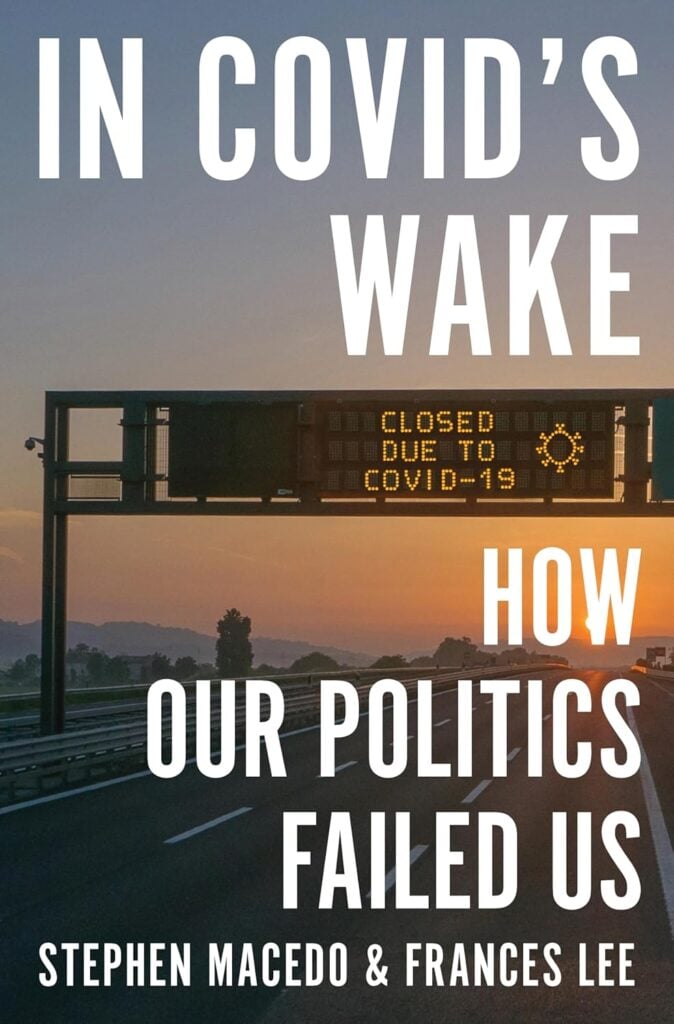
In Covid’s Wake: How Our Politics Failed Us
by Stephen Macedo and Frances Lee
Princeton University Press
392 pp., $29.95
Talleyrand’s barb, “They have learned nothing, and they have forgotten nothing,” was aimed at France’s Bourbon dynasty, but it could just as easily be a motif for our time. It certainly applies to our government health officials who mismanaged the COVID pandemic, as outlined in this dense, authoritative book by Princeton University professors Stephen Macedo and Frances Lee.
The appearance of COVID seemed to come as a complete surprise to governments around the world—but it should not have. In fact, a slew of plans had been drawn up to deal with various pandemics. Significantly, the plans took a broad view, balancing the costs of policies dealing directly with the disease with the wider impact of those policies on social cohesion and public spending. But those well-thought-out plans were quickly pushed aside in favor of draconian restrictions.
Macedo and Lee trace the start of this official overreaction to the fulsome endorsement by the World Health Organization (WHO) of China’s harsh initial reaction, which included lockdowns, shuttering of businesses, and suppression of dissent. The WHO team that backed China’s response had only been in China for a week and had seen only what the Chinese government was willing to show it. Nevertheless, China thus became the model for official responses across the globe.
In the United States, this blunt-force approach was supported by statistical models painting pictures of worst-case outcomes, and by the views of specialists in epidemiology and biostatistics. The problem, according to Macedo and Lee, was that the models they used had previously been shown to be very poor indicators of the spread of disease, veering wildly towards apocalyptic scenarios. However, they gave a scientific veneer to the opinions of the scientists generating them, and the numbers they churned out made for easy headlines. Unsurprisingly, the policy advice of the epidemiologists and biostatisticians focused narrowly on their area of expertise. There was little regard for the social costs of lockdowns and six-foot distancing. The only metrics that mattered to them related to infection rates and mortality counts.
The authors treat the suppressed discourse about the origin of COVID as a case study of the attitudes of the time. There was evidence that the virus was the result of gain-of-function research at the Wuhan Institute of Virology. But reasonable claims about this, including by President Trump, were dismissed as tinfoil-hat conspiracy theories or outright racism, to be labeled as misinformation and censored.
The authors spend a good deal of time examining the role of the media. Most journalists had little interest in nuance or balance. They wanted sensationalism from the data and no trace of ambiguity from their interviewees. They usually accepted what they were told by an “expert” without question. “Slogans like ‘follow the science’ covered over contestable value judgements, large uncertainties, and the need for tough choices balancing costs and benefits and distributing them fairly,” Macedo and Lee write.
Even from the early days of the pandemic, it was clear that those most at risk were the elderly and those with preexisting illnesses. The young and healthy may get infected, but most of them could ride it out. The media, however, would often focus on cases of the young dying without mentioning that they were atypical. The tone became one of looming, all-embracing catastrophe, and to avoid it even the most stringent and divisive policies were justified.
As it turned out, most of the pre-vaccine remedies officials imposed on society were not particularly useful. Even at the time, there was little evidence showing that mask mandates, social distancing, stay-at-home orders, and school closures would affect the spread of the virus. But those in the scientific and medical community who dared to question the emerging orthodoxy were subject to ridicule, attacks on their backgrounds and qualifications, and, in some cases, the loss of their livelihoods. Most researchers chose to keep quiet. Groupthink did not just prevail; it was enforced with an iron fist.
It is this point that brings Macedo and Lee, who usually write with cool detachment, close to anger. Even in a time of social stress, they argue, science advances by informed criticism and diversity of thought. What happened instead was the censorship of opposing views—even of research that provided results at odds with the official line. When Joe Biden was elected president in 2020, the CEOs of the social media platforms allied themselves with the government’s censorship machinery. It did not take much persuasion for them to embrace a powerful role in controlling the flow of information offered to them by the White House.
The pandemic experts and the tech giants were not the only ones who benefited from the era of COVID. The elite “laptop class,” as Macedo and Lee call them, found the restrictions easy to comply with: they simply moved their workplaces to their homes. They wore masks everywhere and loudly admonished anyone who did not. They enjoyed telling each other how much they were suffering, even though there were few signs of them suffering at all. COVID provided them a golden opportunity for virtue signaling. “In many ways,” Macedo and Lee note dryly, “cultural and political elites in the U.S. had a ‘good’ pandemic.”
Those who actually bore the brunt of the lockdowns and business closures were the very workers that the progressive, credentialed class insisted the restrictions were meant to protect. Macedo and Lee write that the harshest impact was on the group classed as “essential workers”—those who kept the day-to-day economy running, which they did without college degrees or hefty paychecks.
One shortcoming of the book is that Macedo and Lee do not delve into the reasons why the Brahmin caste of knowledge specialists readily accepted the authoritarianism that accompanied the Biden-era COVID policies. They point to the near-universal correlation between advanced degrees and support for the Democratic Party. Maybe it was tied to another affliction—Trump Derangement Syndrome—the readiness to put aside principles, rationality, and everything else in the campaign to defeat the Bad Orange Man.
Or maybe the “laptop class” simply likes to believe that the end of the world is nigh, and only those with strings of letters after their names have the intelligence, the expertise, and the vision to prevent it. Whether pandemic, climate change, or nuclear war—there is always a momentous disaster approaching that needs these experts, who often come to feel that only they and their kind truly appreciate the danger and possess the solution.
“Higher levels of education may enable people to better understand complex policy options,” Macedo and Lee write. “But it has also come to be associated with the sort of moralistic disdain for partisans of the other side that is so rampant in America’s political culture.”
From the distance of five years, how can we evaluate the COVID era and the responses to the pandemic? Certainly, there was the tragedy of over a million deaths in the U.S. But as Macedo and Lee point out, there were other costs, such as a loss of economic productivity, a massive increase in public debt, and a setback in education due to school closures. These issues should not be airbrushed out of the historical record.
Crucially, COVID also turned the political and class fissures that existed in American society into chasms. The “experts” who were constantly featured as talking heads on the nightly news programs took a huge hit to their credibility, as did the legacy news networks themselves. There has been a lasting collapse of trust between the “laptop class” and the less-privileged parts of society. This sense of increased polarization might be the most damaging outcome of the pandemic, and recovery will take a long time—if recovery is even possible.
“In the book we emphasized the shortcomings of members of the knowledge class because we are part of that tribe,” Macedo and Lee write. “Those of us on the progressive side need to have a sober look in the mirror.”
What, then, is to be done? The authors look at a few possibilities to ensure that future governments, when facing a crisis, would have a wider range of advice sources. One proposal they suggest is the creation of a “Team B” of senior experts who are given the role of asking tough questions of every policy recommendation. It is not a bad idea, but the authors do not sound optimistic that it will happen.
Most probably, since there has been no national conversation about the disastrous government response to COVID, officials will make the same mistakes during the next crisis. There will be an absence of critical thinking, a lack of clear policy goals, and an intolerance of contrary views. We’ll see the same performative gestures and authoritarian certainties from experts, and eye-catching headlines and sensationalism from journalists. In short, nothing will be forgotten, and nothing will have been learned.
Leave a Reply